
Universo da obra
Universo da obra
“I cannot forgive--I love.”
There are four bare walls; there is a Christ upon the walls, in red,
carrying his cross; there is a Blessed Bambino with the face rubbed out;
there is Madonna in blue and red; there are Roman soldiers and a Christ
with tied hands. All the roof is gone; overhead is the blue, blue
Italian sky; the rain has beaten holes in the walls, and the plaster is
peeling from it. The chapel stands here alone upon the promontory, and
by day and by night the sea breaks at its feet. Some say that it was
set here by the monks from the island down below, that they might bring
their sick here in times of deadly plague. Some say that it was set here
that the passing monks and friars, as they hurried by upon the roadway,
might stop and say their prayers here. Now no one stops to pray here,
and the sick come no more to be healed.
Behind it runs the old Roman road. If you climb it and come and sit
there alone on a hot sunny day you may almost hear at last the clink of
the Roman soldiers upon the pavement, and the sound of that older time,
as you sit there in the sun, when Hannibal and his men broke through the
brushwood, and no road was.
Now it is very quiet. Sometimes a peasant girl comes riding by between
her panniers, and you hear the mule’s feet beat upon the bricks of the
pavement; sometimes an old woman goes past with a bundle of weeds upon
her head, or a brigand-looking man hurries by with a bundle of sticks
in his hand; but for the rest the Chapel lies here alone upon the
promontory, between the two bays and hears the sea break at its feet.
I came here one winter’s day when the midday sun shone hot on the bricks
of the Roman road. I was weary, and the way seemed steep. I walked into
the chapel to the broken window, and looked out across the bay. Far off,
across the blue, blue water, were towns and villages, hanging white and
red dots, upon the mountain-sides, and the blue mountains rose up into
the sky, and now stood out from it and now melted back again.
The mountains seemed calling to me, but I knew there would never be a
bridge built from them to me; never, never, never! I shaded my eyes with
my hand and turned away. I could not bear to look at them.
I walked through the ruined Chapel, and looked at the Christ in red
carrying his cross, and the Blessed rubbed-out Bambino, and the Roman
soldiers, and the folded hands, and the reed; and I went and sat down
in the open porch upon a stone. At my feet was the small bay, with its
white row of houses buried among the olive trees; the water broke in a
long, thin, white line of foam along the shore; and I leaned my elbows
on my knees. I was tired, very tired; tired with a tiredness that seemed
older than the heat of the day and the shining of the sun on the bricks
of the Roman road; and I lay my head upon my knees; I heard the breaking
of the water on the rocks three hundred feet below, and the rustling of
the wind among the olive trees and the ruined arches, and then I fell
asleep there. I had a dream.
A man cried up to God, and God sent down an angel to help him; and the
angel came back and said, “I cannot help that man.”
God said, “How is it with him?”
And the angel said, “He cries out continually that one has injured him;
and he would forgive him and he cannot.”
God said, “What have you done for him?”
The angel said, “All--. I took him by the hand, and I said, ‘See, when
other men speak ill of that man do you speak well of him; secretly, in
ways he shall not know, serve him; if you have anything you value share
it with him, so, serving him, you will at last come to feel possession
in him, and you will forgive.’ And he said, ‘I will do it.’ Afterwards,
as I passed by in the dark of night, I heard one crying out, ‘I have
done all. It helps nothing! My speaking well of him helps me nothing!
If I share my heart’s blood with him, is the burning within me less? I
cannot forgive; I cannot forgive! Oh, God, I cannot forgive!’
“I said to him, ‘See here, look back on all your past. See from your
childhood all smallness, all indirectness that has been yours; look well
at it, and in its light do you not see every man your brother? Are you
so sinless you have right to hate?’
“He looked, and said, ‘Yes, you are right; I too have failed, and I
forgive my fellow. Go, I am satisfied; I have forgiven;’ and he laid him
down peacefully and folded his hands on his breast, and I thought it was
well with him. But scarcely had my wings rustled and I turned to come up
here, when I heard one crying out on earth again, ‘I cannot forgive! I
cannot forgive! Oh, God, God, I cannot forgive! It is better to die
than to hate! I cannot forgive! I cannot forgive!’ And I went and stood
outside his door in the dark, and I heard him cry, ‘I have not sinned
so, not so! If I have torn my fellows’ flesh ever so little, I have
kneeled down and kissed the wound with my mouth till it was healed. I
have not willed that any soul shall be lost through hate of me. If they
have but fancied that I wronged them I have lain down on the ground
before them that they might tread on me, and so, seeing my humiliation,
forgive and not be lost through hating me; they have not cared that
my soul should be lost; they have not willed to save me; they have not
tried that I should forgive them!’
“I said to him, ‘See here, be thou content; do not forgive: forget this
soul and its injury; go on your way. In the next world perhaps--’
“He cried, ‘Go from me, you understand nothing! What is the next world
to me! I am lost now, today. I cannot see the sunlight shine, the dust
is in my throat, the sand is in my eyes! Go from me, you know nothing!
Oh, once again before I die to see that the world is beautiful! Oh, God,
God, I cannot live and not love. I cannot live and hate. Oh, God, God,
God!’ So I left him crying out and came back here.”
God said, “This man’s soul must be saved.”
And the angel said “How?”
God said, “Go down you, and save it.”
The angel said, “What more shall I do?”
Then God bent down and whispered in the angel’s ear, and the angel
spread out its wings and went down to earth.
And partly I woke, sitting there upon the broken stone with my head on
my knee; but I was too weary to rise. I heard the wind roam through the
olive trees and among the ruined arches, and then I slept again.
The angel went down and found the man with the bitter heart and took him
by the hand, and led him to a certain spot.
Now the man wist not where it was the angel would take him nor what he
would show him there. And when they came the angel shaded the man’s eyes
with his wing, and when he moved it the man saw somewhat on the earth
before them. For God had given it to that angel to unclothe a human
soul; to take from it all those outward attributes of form, and colour,
and age, and sex, whereby one man is known from among his fellows and is
marked off from the rest, and the soul lay before them, bare, as a man
turning his eye inwards beholds himself.
They saw its past, its childhood, the tiny life with the dew upon it;
they saw its youth when the dew was melting, and the creature raised its
Lilliputian mouth to drink from a cup too large for it, and they saw how
the water spilt; they saw its hopes that were never realized; they saw
its hours of intellectual blindness, men call sin; they saw its hours of
all-radiating insight, which men call righteousness; they saw its hour
of strength, when it leaped to its feet crying, “I am omnipotent;” its
hour of weakness, when it fell to the earth and grasped dust only; they
saw what it might have been, but never would be.
The man bent forward.
And the angel said, “What is it?”
He answered, “It is I! it is myself!” And he went forward as if he would
have lain his heart against it; but the angel held him back and covered
his eyes.
Now God had given power to the angel further to unclothe that soul,
to take from it all those outward attributes of time and place and
circumstance whereby the individual life is marked off from the life of
the whole.
Again the angel uncovered the man’s eyes, and he looked. He saw before
him that which in its tiny drop reflects the whole universe; he saw that
which marks within itself the step of the furthest star, and tells how
the crystal grows under ground where no eye has seen it; that which is
where the germ in the egg stirs; which moves the outstretched fingers
of the little newborn babe, and keeps the leaves of the trees pointing
upward; which moves where the jelly-fish sail alone on the sunny seas,
and is where the lichens form on the mountains’ rocks.
And the man looked.
And the angel touched him.
But the man bowed his head and shuddered. He whispered--“It is God!”
And the angel re-covered the man’s eyes. And when he uncovered them
there was one walking from them a little way off;--for the angel had
re-clothed the soul in its outward form and vesture--and the man knew
who it was.
And the angel said, “Do you know him?”
And the man said, “I know him,” and he looked after the figure.
And the angel said, “Have you forgiven him?”
But the man said, “How beautiful my brother is!”
And the angel looked into the man’s eyes, and he shaded his own face
with his wing from the light. He laughed softly and went up to God.
But the men were together on earth.
I awoke.
The blue, blue sky was over my head, and the waves were breaking below
on the shore. I walked through the little chapel, and I saw the Madonna
in blue and red, and the Christ carrying his cross, and the Roman
soldiers with the rod, and the Blessed Bambino with its broken face;
and then I walked down the sloping rock to the brick pathway. The olive
trees stood up on either side of the road, their black berries and
pale-green leaves stood out against the sky; and the little ice-plants
hung from the crevices in the stone wall. It seemed to me as if it must
have rained while I was asleep. I thought I had never seen the heavens
and the earth look so beautiful before. I walked down the road. The old,
old, old tiredness was gone.
Presently there came a peasant boy down the path leading his ass; she
had two large panniers fastened to her sides; and they went down the
road before me.
I had never seen him before; but I should have liked to walk by him and
to have held his hand--only, he would not have known why.
Alassio, Italy.
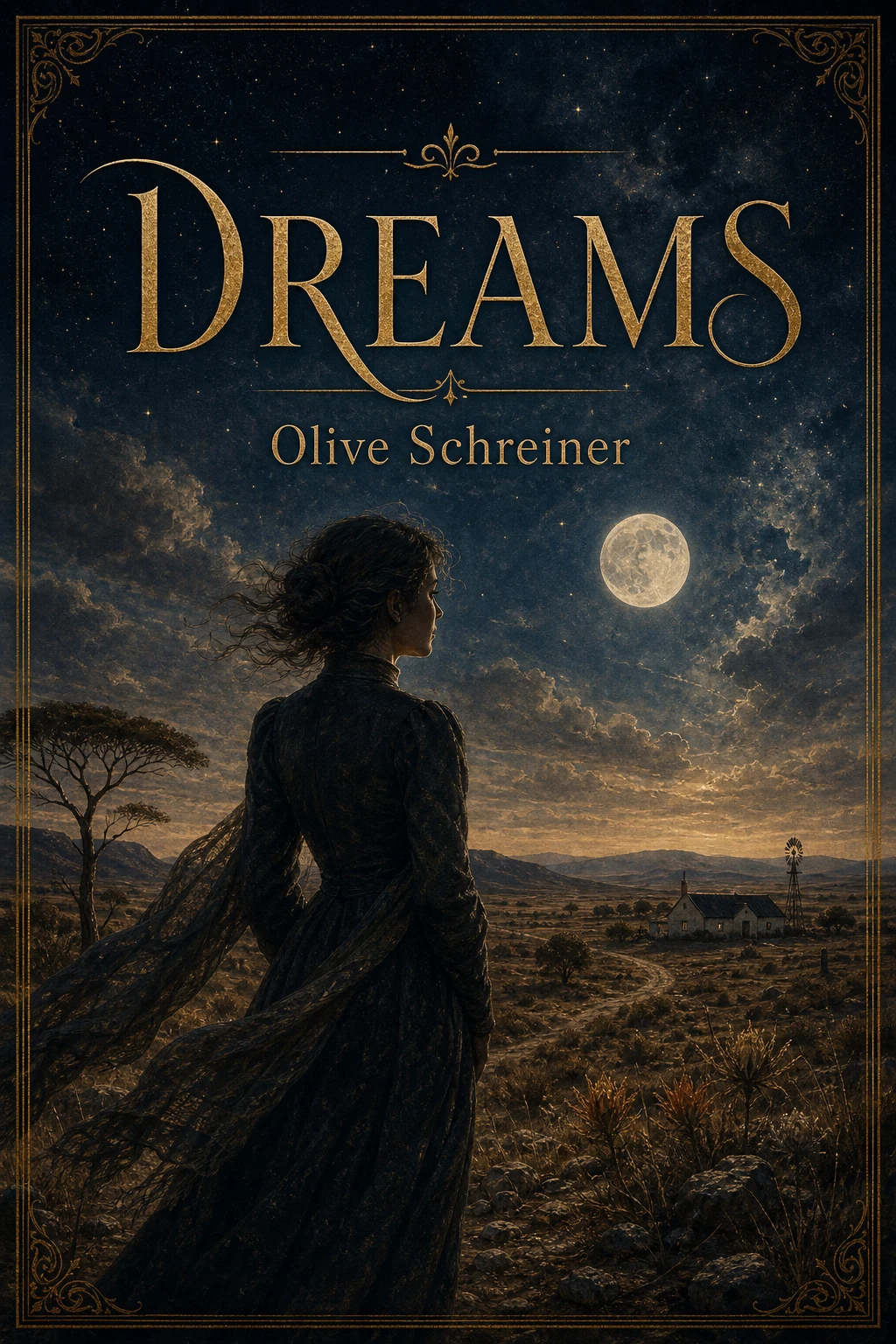
Coletânea de narrativas alegóricas de Olive Schreiner, publicada em 1890, apresentada no Literunico em sua versão original em inglês como obra representante da África do Sul na Copa do Mundo Literunico.
Ainda não há resenhas para esta obra. A primeira leitura comentada pode começar aqui.
Escolha a arte, confira a disponibilidade e adicione o produto ao carrinho sem sair da experiência.
Adquira Relíquias da Obra e deixe sua marca registrada, criando valor ao item!

Capa frontal, contracapa, Capa Aberta e Marca-Páginas pertencem à obra e acompanham este Universes.
Escolha uma Relíquia no painel principal para enviar uma proposta ao autor.
Capítulos disponíveis para continuar a leitura.
Nenhuma Relíquia desta obra foi adquirida ainda. Seja o primeiro a eternizar seu nome no acervo oficial!
Conhecer as 100 RelíquiasAinda não há resenhas para esta obra. A primeira leitura comentada pode começar aqui.
Nenhuma posse foi registrada publicamente para esta edição.
Durante a leitura, abra Menu para ajustar a experiência sem sair do capítulo. As preferências de aparência ficam salvas neste aparelho.
Recursos identificados como “em preparo” aparecem para antecipar a evolução do leitor, mas ainda não executam uma ação.
Posso mostrar leituras em destaque, clássicos e Relíquias disponíveis agora no Literúnico.
Escolha um caminho
Dúvidas desta página
As explicações do Aurélio são respostas cadastradas pelo Literúnico.