
Leia agora
Capítulo 1 · The Treasure

1. At Solberga Parsonage

1. At Solberga Parsonage In the days when King Frederik the Second of Denmark ruled over

Bohuslen [FOOTNOTE: Frederik the Second reigned from 1544 to

1588. At that time, Bohuslen, now a province of southwest Sweden,

formed part of Norway and was under the Danish Crown.--Trans.]

there dwelt at Marstrand a poor hawker of fish, whose name was

Torarin. This man was infirm and of humble condition; he had a

palsied arm, which made him unfit to take his place in a boat for

fishing or pulling an oar. As he could not earn his livelihood at sea

like all the other men of the skerries, he went about selling salted

and dried fish among the people of the mainland. Not many days

in the year did he spend at home; he was constantly on the road

from one village to another with his load of fish.

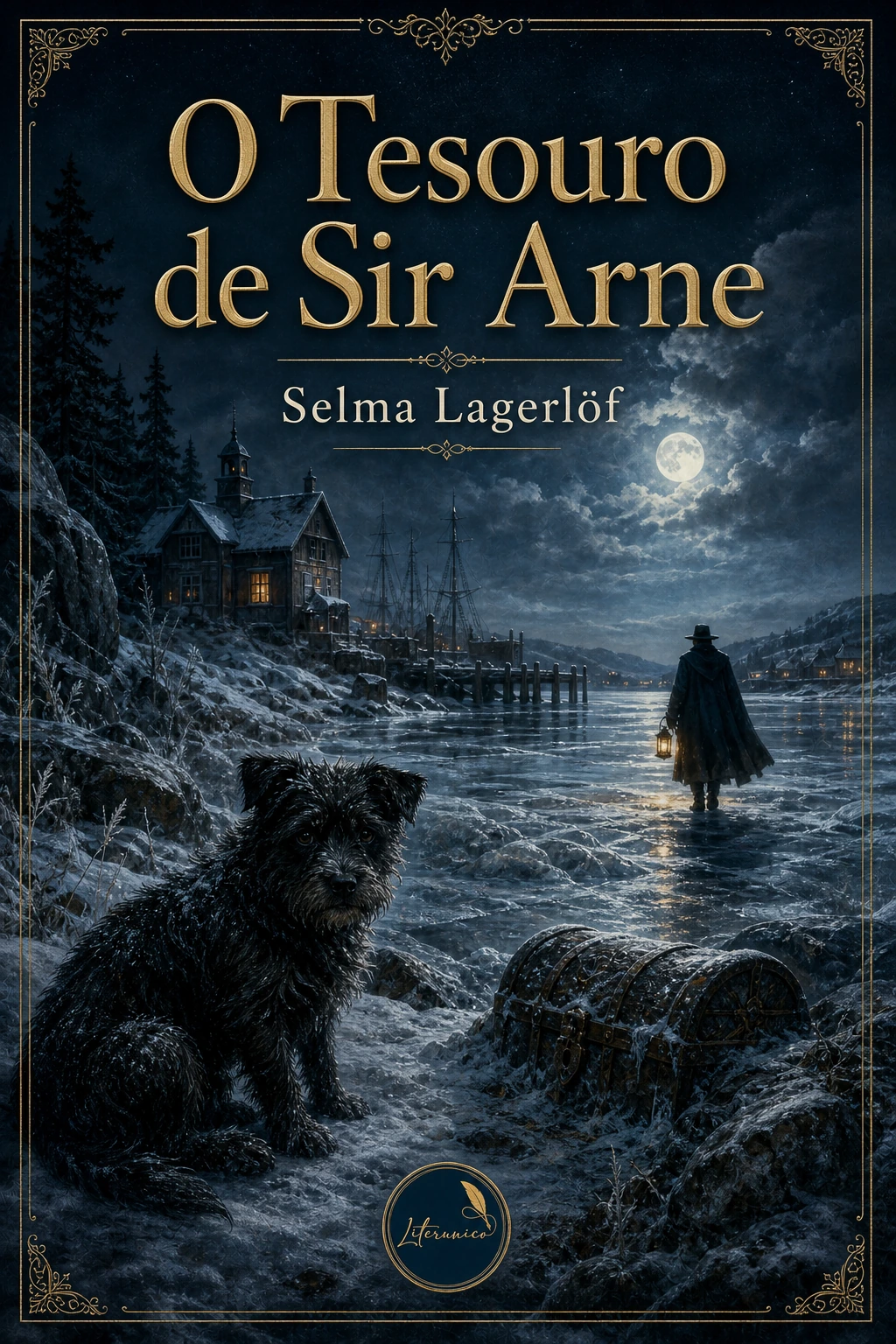
One February day, as dusk was drawing on, Torarin came driving

along the road which led from Kungshall up to the parish of

Solberga. The road was a lonely one, altogether deserted, but this

was no reason for Torarin to hold his tongue. Beside him on the

sledge he had a trusty friend with whom to chat. This was a little

black dog with shaggy coat, and Torarin called him Grim. He lay

still most of the time, with his head sunk between his feet, and

answered only by blinking to all his master said. But if his ear

caught anything that displeased him, he stood up on the load, put

his nose in the air, and howled worse than a wolf.

"Now I must tell you, Grim, my dog," said Torarin, "that I have

heard great news today. They told me both at Kungshall and at

Kareby that the sea was frozen. Fair, calm weather it has been

this long while, as you well know, who have been out in it every

day; and they say the sea is frozen fast not only in the creeks

and sounds, but far out over the Cattegat. There is no fairway now

for ship or boat among the islands, nothing but firm, hard ice, so

that a man may drive with horse and sledge as far as Marstrand and

Paternoster Skerries."

To all this the dog listened, and it seemed not to displease him.

He lay still and blinked at Torarin.

"We have no great store of fish left on our load," said Torarin,

as though trying to talk him over. "What would you say to turning

aside at the next crossways and going westward where the sea lies?

We shall pass by Solberga church and down to Odsmalskil, and after

that I think we have but seven or eight miles to Marstrand. It

would be a fine thing if we could reach home for once without

calling for boat or ferry."

They drove on over the long moor of Kareby, and although the

weather had been calm all day, a chill breeze came sweeping across

the moor, to the discomfort of the traveller.

"It may seem like softness to go home now when trade is at its

best," said Torarin, flinging out his arms to warm them. "But we

have been on the road for many weeks, you and I, and have a claim

to sit at home a day or two and thaw the cold out of our bodies."

As the dog continued to lie still, Torarin seemed to grow more

sure of his ground, and he went on in a more cheerful tone:

"Mother has been left alone in the cottage these many days. I

warrant she longs to see us. And Marstrand is a fine town in

winter-time, Grim, with streets and alleys full of foreign

fishermen and chapmen. There will be dancing in the wharves every

night of the week. And all the ale that will be flowing in the

taverns! That is a thing beyond your understanding."

As Torarin said this he bent down over the dog to see whether he

was listening to what was said to him.

But as the dog lay there wide awake and made no sign of

displeasure, Torarin turned off at the first road that led

westward to the sea. He flicked the horse with the slack of the

reins and made it quicken its pace.

"Since we shall pass by Solberga parsonage," said Torarin, "I will

even put in there and ask if it be true that the ice bears as far

as to Marstrand. The folk there must know how it is."

Torarin had said these words in a low voice, without thinking

whether the dog was listening or not. But scarcely were the words

uttered when the dog stood up on the load and raised a terrible

howl.

The horse made a bound to one side, and Torarin himself was

startled and looked about him to see whether wolves were in

pursuit. But when he found it was Grim who was howling, he tried

to calm him.

"What now?" he said to him. "How many times have you and I driven

into the parson's yard at Solberga! I know not whether Herr Arne

[FOOTNOTE: At the time of this story "Herr" was a title roughly

corresponding to "Sir."--Trans.] can tell us how it is with the ice,

but I will be bound he'll give us a good supper before we set out

on our sea voyage."

But his words were not able to quiet the dog, who raised his

muzzle and howled more dismally than ever.

At this Torarin himself was not far from yielding to an uncanny

feeling. It had now grown almost dark, but still Torarin could see

Solberga church and the wide plain around it, which was sheltered

by broad wooded heights to landward and by bare, rounded rocks

toward the sea. As he drove on in solitude over the vast white

plain, he felt he was a wretched little worm, while from the dark

forests and the mountain wastes came troops of great monsters and

trolls of every kind venturing into the open country on the fall

of darkness. And in the whole great plain there was none other for

them to fall upon than poor Torarin.

But at the same time he tried again to quiet the dog.

"Bless me, what is your quarrel with Herr Arne? He is the richest

man in the country. He is of noble birth, and had he not been a

priest there would have been a great lord of him."

But this could not avail to bring the dog to silence. Then Torarin

lost patience, so that he took Grim by the scruff of the neck and

threw him off the sledge.

The dog did not follow him as he drove on, but stood still upon

the road and howled without ceasing until Torarin drove under a

dark archway into the yard of the parsonage, which was surrounded

on its four sides by long, low wooden buildings.

II

At Solberga parsonage the priest, Herr Arne, sat at supper

surrounded by all his household. There was no stranger present but

Torarin.

Herr Arne was an old white-haired man, but he was still powerful

and erect. His wife sat beside him. To her the years had been

unkind; her head and her hands trembled, and she was nearly deaf.

On Herr Arne's other side sat his curate. He was a pale young man

with a look of trouble in his face, as though he was unable to

support all the learning he had gathered in during his years of

study at Wittenberg.

These three sat at the head of the table, a little apart from the

rest. Below them sat Torarin, and then the servants, who were old

like their master. There were three serving-men; their heads were

bald, their backs bent, and their eyes blinked and watered. Of

women there were but two. They were somewhat younger and more

able-bodied than the men, yet they too had a fragile look and were

afflicted with the infirmities of age.

At the farthest end of the table sat two children. One of them was

Herr Arne's niece, a child of no more than fourteen years. She was

fair-haired and of delicate build; her face had not yet reached

its fullness, but had a promise of beauty in it. She had another

little maid sitting beside her, a poor orphan without father or

mother, who had been given a home at the parsonage. The two sat

close together on the bench, and it could be seen that there was

great friendship between them.

All these folk sat at meat in the deepest silence. Torarin looked

from one to another, but none was disposed to talk during the

meal. All the old servants thought to themselves: "It is a goodly

thing to be given food and to be spared the sufferings of want and

hunger, which we have known so often in our lives. While we are

eating we ought to have no thought but of giving thanks to God for

His goodness."

Since Torarin found no one to talk to, his glance wandered up and

down the room. He turned his eyes from the great stove, built up

in many stages beside the entrance door, to the lofty four-post

bed which stood in the farthest corner of the room. He looked from

the fixed benches that ran round the room to the hole in the roof,

through which the smoke escaped and wintry air poured in.

As Torarin the fish hawker, who lived in the smallest and poorest

cabin on the outer isles, looked upon all these things, he

thought: "Were I a great man like Herr Arne I would not be content

to live in an ancient homestead with only one room. I should build

myself a house with high gables and many chambers, like those of

the burgomasters and aldermen of Marstrand."

But more often than not Torarin's eyes rested upon a great oaken

chest which stood at the foot of the four-post bed. And he looked

at it so long because he knew that in it Herr Arne kept all his

silver moneys, and he had heard they were so many that they filled

the chest to the very lid.

And Torarin, who was so poor that he hardly ever had a silver

piece in his pocket, said to himself: "And yet I would not have

all that money. They say Herr Arne took it from the great convents

that were in the land in former days, and that the old monks

foretold that this money would bring him misfortune."

While yet these thoughts were in the mind of Torarin, he saw the

old mistress of the house put her hand to her ear to listen. And

then she turned to Herr Arne and asked him: "Why are they whetting

knives at Branehog?"

So deep was the silence in the room that when the old lady asked

this question all gave a start and looked up in fright. When they

saw that she was listening for something, they kept their spoons

quiet and strained their ears.

For some moments there was dead stillness in the room, but while

it lasted the old woman became more and more uneasy. She laid her

hand on Herr Arne's arm and asked him: "How can it be that they

are whetting such long knives at Branehog this evening?"

Torarin saw that Herr Arne stroked her hand to calm her. But he

was in no mind to answer and ate on calmly as before.

The old woman still sat listening. Tears came into her eyes from

terror, and her hands and her head trembled more and more

violently.

Then the two little maids who sat at the end of the table began to

weep with fear. "Can you not hear them scraping and filing?" asked

the old mistress. "Can you not hear them hissing and grating?"

Herr Arne sat still, stroking his wife's hand. As long as he kept

silence no other dared utter a word.

But they were all assured that their old mistress had heard a

thing that was terrifying and boded ill. All felt the blood

curdling in their veins. No one at the table raised a bit of food

to his mouth, except old Herr Arne himself.

They were thinking of the old mistress, how it was she who for so

many years had had charge of the household. She had always stayed

at home and watched with wise and tender care over children and

servants, goods and cattle, so that all had prospered. Now she was

worn out and stricken in years, but still it was likely that she

and none other should feel a danger that threatened the house.

The old lady grew more and more terrified. She clasped her hands

in her helplessness and began to weep so sorely that the big tears

ran down her shrunken cheeks.

"Is it nothing to you, Arne Arneson, that I am so sore afraid?"

she complained.

Herr Arne bent his head to her and said: "I know not what it is

that affrights you."

"I am in fear of the long knives they are whetting at Branehog,"

she said.

"How can you hear them whetting knives at Branehog?" said Herr

Arne, smiling. "The place lies two miles from here. Take up your

spoon again and let us finish our supper."

The old woman made an effort to overcome her terror. She took up

her spoon and dipped it in the milk bowl, but in doing it her hand

shook so that all could hear the spoon rattle against the edge.

She put it down again at once. "How can I eat?" she said. "Do I

not hear the whining of the whetstone, do I not hear it grating?"

At this Herr Arne thrust the milk bowl away from him and clasped

his hands. All the others did the same, and the curate began to

say grace.

When this was ended, Herr Arne looked down at those who sat along

the table, and when he saw that they were pale and frightened, he

was angry.

He began to speak to them of the days when he had lately come to

Bohuslen to preach the Lutheran doctrine. Then he and his servants

were forced to fly from the Papists like wild beasts before the

hunter. "Have we not seen our enemies lie in wait for us as we

were on our way to the house of God? Have we not been driven out

of the parsonage, and have we not been compelled to take to the

woods like outlaws? Does it beseem us to play the coward and give

ourselves up for lost on account of an evil omen?"

As Herr Arne said this he looked like a valiant champion, and the

others took heart anew on hearing him.

"Ay, it is true," they thought. "God has protected Herr Arne

through the greatest perils. He holds His hand over him. He will

not let His servant perish."

III

As soon as Torarin drove out upon the road his dog Grim came up to

him and jumped up on to the load. When Torarin saw that the dog

had been waiting outside the parsonage his uneasiness came back.

"What, Grim, why do you stay outside the gate all the evening? Why

did you not go into the house and have your supper?" he said to

the dog. "Can there be aught of ill awaiting Herr Arne? Maybe I

have seen him for the last time. But even a strong man like him

must one day die, and he is near ninety years old."

He guided his horse into a road which led past the farm of

Branehog to Odsmalskil.

When he was come to Branehog he saw sledges standing in the yard

and lights shining through the cracks of the closed shutters.

Then Torarin said to Grim: "These folks are still up. I will go in

and ask if they have been sharpening knives here tonight."

He drove into the farmyard, but when he opened the door of the

house he saw that a feast was being held. Upon the benches by the

wall sat old men drinking ale, and in the middle of the room the

young people played and sang.

Torarin saw at once that no man here thought of making his weapon

ready for a deed of blood. He slammed the door again and would

have gone his way, but the host came after him. He asked Torarin

to stay, since he had come, and led him into the room.

Torarin sat for a good while enjoying himself and chatting with

the peasants. They were in high good humour, and Torarin was glad

to be rid of all his gloomy thoughts.

But Torarin was not the only latecomer to the feast that evening.

Long after him a man and a woman entered the door. They were

poorly clad and lingered bashfully in the corner between door and

fireplace.

The host at once came forward to his two guests. He took the hand

of each and led them up the room. Then he said to the others: "Is

it not truly said that the shorter the way the more the delay?

These are our nearest neighbors. Branehog had no other tenants

besides them and me."

"Say rather there are none but you," said the man. "You cannot

call me a tenant. I am only a poor charcoal-burner whom you have

allowed to settle on your land."

The man seated himself beside Torarin and they began to converse.

The newcomer told Torarin how it was he came so late to the feast.

It was because their cabin had been visited by three strangers

whom they durst not leave, three journeymen tanners who had been

with them all day. When they came in the morning they were worn

out and ailing; they said they had lost their way in the forest

and had wandered about for a whole week. But after they had eaten

and slept they soon recovered their strength, and when evening

came they had asked which was the greatest and richest house

thereabout, for thither they would go and seek for work. The wife

had answered that the parsonage, where Herr Arne dwelt, was the

best place. Then at once they had taken long knives out of their

packs and begun to sharpen them. They were at this a good while,

with such ferocious looks that the charcoal-burner and his wife

durst not leave their home. "I can still see them as they sat

grinding their knives," said the man. "They looked terrible with

their great beards that had not been cut or tended for many a day,

and they were clad in rough coats of skin, which were tattered and

befouled. I thought I had three werewolves in the house with me,

and I was glad when at last they took themselves off."

When Torarin heard this he told the charcoal-burner what he

himself had witnessed at the parsonage.

"So it was true enough that this night they whetted knives at

Branehog," said Torarin, laughing. He had drunk deeply, because of

the sorrow and heaviness that were upon him when he came, seeking

to comfort himself as best he could. "Now I am of good cheer

again," said he, "since I am well assured it was no evil omen the

parson's lady heard, but only these tanners making ready their

gear."

IV

Long after midnight a couple of men came out of the house at

Branehog to harness their horses and drive home.

When they had come into the yard they saw a great fire flaring up

against the sky in the north. They hastened back into the house

and cried out: "Come out! Come out! Solberga parsonage is on

fire!"

There were many folks at the feast, and those who had a horse

leapt upon his back and made haste to the parsonage; but those who

had to run with their own swift feet were there almost as soon.

When the people came to the parsonage nobody was to be seen, nor

was there any sign of movement; all seemed to be asleep, though

the flames rose high into the air.

Yet it was none of the houses that burned, but a great pile of

wood and straw and faggots that had been stacked against the wall

of the old dwelling. It had not been burning long. The flames had

done no more than blacken the sound timber of the wall and melt

the snow on the thatched roof. But now they had begun to take hold

of the thatch.

Everyone saw at once that this was arson. They began to wonder

whether Herr Arne and his wife were really asleep, or whether some

evil had befallen them.

But before the rescuers entered the house they took long poles and

pulled away the burning faggots from the wall and clambered up to

the roof to tear off the thatch, which had begun to smoke and was

ready to catch fire.

Then some of the men went to the door of the house to enter and

call Herr Arne; but when the first man came to the threshold he

turned aside and made way for him who came next.

The second man took a step forward, but as he was about to grasp

the door-handle he turned away and made room for those who stood

behind him.

It seemed a ghastly door to open, for a broad stream of blood

trickled over the threshold and the handle was besmeared with

blood.

Then the door opened in their faces and Herr Arne's curate came

out. He staggered toward the men with a deep wound in his head,

and he was drenched with blood. For an instant he stood upright

and raised his hand to command silence. Whereupon he spoke with

the death rattle in his voice: "This night Herr Arne and all his

household have been murdered by three men who climbed down through

the smoke-hole in the roof and were clad in rough skins. They

threw themselves upon us like wild beasts and slew us."

He could utter no more. He fell down at the men's feet and was

dead.

They then entered the room and found all as the curate had said.

The great oaken chest in which Herr Arne kept his money was gone,

and Herr Arne's horse had been taken from the stable and his

sledge from the shed.

Sledge tracks led from the yard across the glebe meadows down to

the sea, and twenty men hastened away to seize the murderers. But

the women set themselves to laying out the dead and carried them

from the bloody room out upon the pure snow.

Not all of Herr Arne's household could be found; there was one

missing. It was the poor little maid whom Herr Arne had taken into

his house. There was much wondering whether, perchance, she had

been able to escape, or whether the robbers had taken her with

them.

But when they made careful search through the room they found her

hidden away between the great stove and the wall. She had kept

herself concealed there throughout the struggle and had taken no

hurt at all, but she was so sick with terror that she could

neither speak nor answer a question.

The Treasure

Sinopse

Public-domain English source edition of The Treasure by Selma Lagerlöf, organized for Aurora as the linked source of the Literunico Portuguese version.

The Treasure

Resenhas do livro

0 publicadas

Ainda não há resenhas para esta obra. A primeira leitura comentada pode começar aqui.

Ir para o carrinho
Mercado de The Treasure

Leve um fragmento deste universo

Escolha a arte, confira a disponibilidade e adicione o produto ao carrinho sem sair da experiência.

Nenhum livro físico está disponível neste universo.
Relíquias de The Treasure

Adquira Relíquias do Livro como colaboração ao autor e deixe sua marca registrada, criando valor ao item!

Central de RelíquiasDescubra coleções de outros universos e obras.
ver todas
Sinopse do universo · 1 livro conectado 1/1
Abrir leitor completo

Resenhas do livro

0 publicadas

Ainda não há resenhas para esta obra. A primeira leitura comentada pode começar aqui.

Entrar para resenhar

Posses do livro

0 Leitores com posse
0 Unidades registradas

Nenhuma posse foi registrada publicamente para esta edição.

Adicionais do Universo

Visual ClássicoAbra a leitura editorial, no estilo de uma página de livro
ler
Visual AuroraApresentação imersiva do universo da obra
abrir