
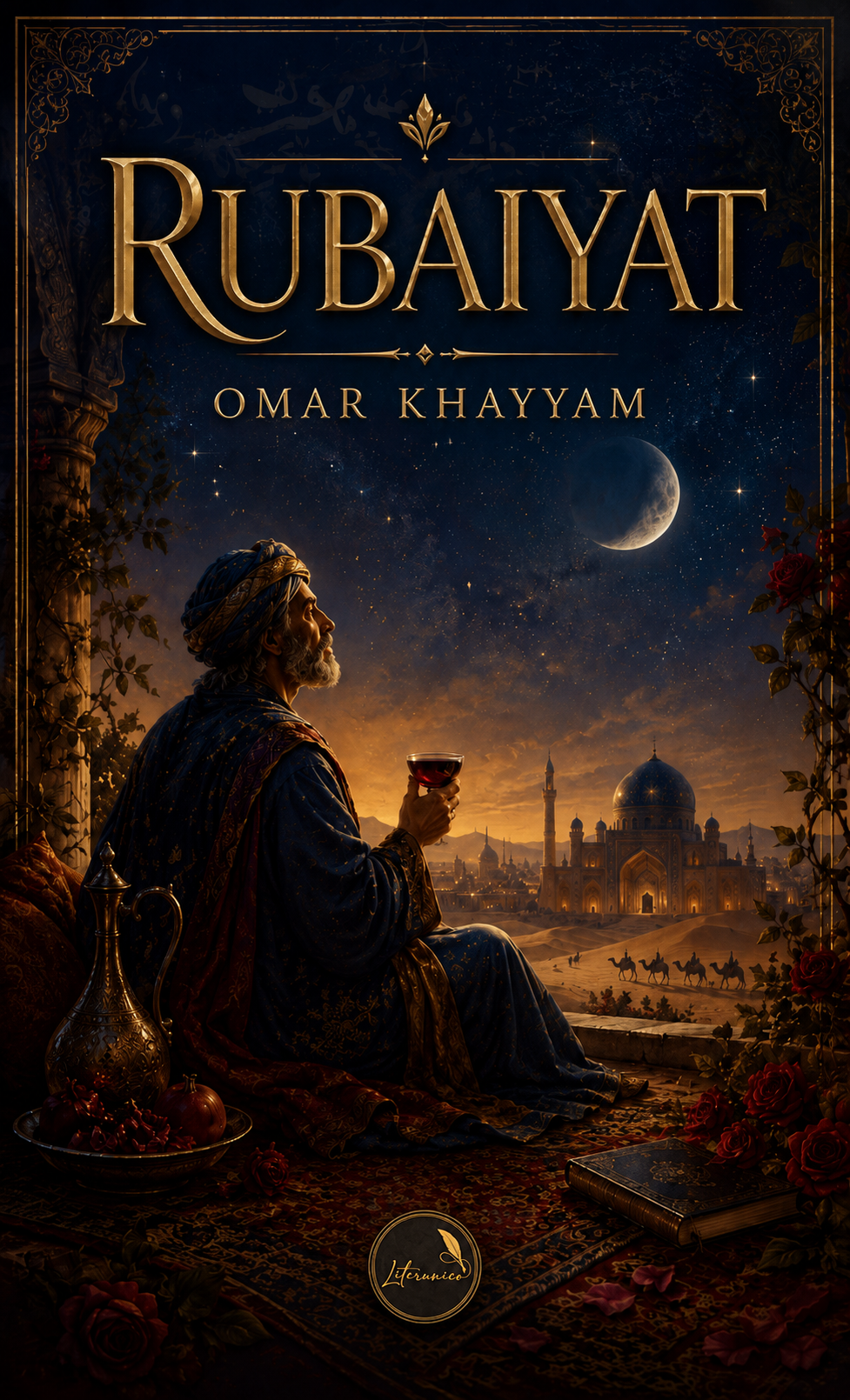
Leia agora
Capítulo 1 · The Rubaiyat of Omar Khayyam

Introduction

Introduction Omar Khayyam, The Astronomer-Poet of Persia.

Omar Khayyam was born at Naishapur in Khorassan in the latter half of

our Eleventh, and died within the First Quarter of our Twelfth

Century. The Slender Story of his Life is curiously twined about that

of two other very considerable Figures in their Time and Country: one

of whom tells the Story of all Three. This was Nizam ul Mulk, Vizier

to Alp Arslan the Son, and Malik Shah the Grandson, of Toghrul Beg the

Tartar, who had wrested Persia from the feeble Successor of Mahmud the

Great, and founded that Seljukian Dynasty which finally roused Europe

into the Crusades. This Nizam ul Mulk, in his Wasiyat--or

Testament--which he wrote and left as a Memorial for future

Statesmen--relates the following, as quoted in the Calcutta Review,

No. 59, from Mirkhond's History of the Assassins.

"'One of the greatest of the wise men of Khorassan was the Imam

Mowaffak of Naishapur, a man highly honored and reverenced,--may God

rejoice his soul; his illustrious years exceeded eighty-five, and it

was the universal belief that every boy who read the Koran or studied

the traditions in his presence, would assuredly attain to honor and

happiness. For this cause did my father send me from Tus to Naishapur

with Abd-us-samad, the doctor of law, that I might employ myself in

study and learning under the guidance of that illustrious teacher.

Towards me he ever turned an eye of favor and kindness, and as his

pupil I felt for him extreme affection and devotion, so that I passed

four years in his service. When I first came there, I found two other

pupils of mine own age newly arrived, Hakim Omar Khayyam, and the ill-

fated Ben Sabbah. Both were endowed with sharpness of wit and the

highest natural powers; and we three formed a close friendship

together. When the Imam rose from his lectures, they used to join me,

and we repeated to each other the lessons we had heard. Now Omar was

a native of Naishapur, while Hasan Ben Sabbah's father was one Ali, a

man of austere life and practise, but heretical in his creed and

doctrine. One day Hasan said to me and to Khayyam, "It is a universal

belief that the pupils of the Imam Mowaffak will attain to fortune.

Now, even if we all do not attain thereto, without doubt one of us

will; what then shall be our mutual pledge and bond?" We answered,

"Be it what you please." "Well," he said, "let us make a vow, that to

whomsoever this fortune falls, he shall share it equally with the

rest, and reserve no pre-eminence for himself." "Be it so," we both

replied, and on those terms we mutually pledged our words. Years

rolled on, and I went from Khorassan to Transoxiana, and wandered to

Ghazni and Cabul; and when I returned, I was invested with office, and

rose to be administrator of affairs during the Sultanate of Sultan Alp

Arslan.'

"He goes on to state, that years passed by, and both his old school-

friends found him out, and came and claimed a share in his good

fortune, according to the school-day vow. The Vizier was generous and

kept his word. Hasan demanded a place in the government, which the

Sultan granted at the Vizier's request; but discontented with a

gradual rise, he plunged into the maze of intrigue of an oriental

court, and, failing in a base attempt to supplant his benefactor, he

was disgraced and fell. After many mishaps and wanderings, Hasan

became the head of the Persian sect of the Ismailians,--a party of

fanatics who had long murmured in obscurity, but rose to an evil

eminence under the guidance of his strong and evil will. In A.D.

1090, he seized the castle of Alamut, in the province of Rudbar, which

lies in the mountainous tract south of the Caspian Sea; and it was

from this mountain home he obtained that evil celebrity among the

Crusaders as the OLD MAN OF THE MOUNTAINS, and spread terror through

the Mohammedan world; and it is yet disputed where the word Assassin,

which they have left in the language of modern Europe as their dark

memorial, is derived from the hashish, or opiate of hemp-leaves (the

Indian bhang), with which they maddened themselves to the sullen pitch

of oriental desperation, or from the name of the founder of the

dynasty, whom we have seen in his quiet collegiate days, at Naishapur.

One of the countless victims of the Assassin's dagger was Nizam ul

Mulk himself, the old school-boy friend.[1]

"Omar Khayyam also came to the Vizier to claim his share; but not to

ask for title or office. 'The greatest boon you can confer on me,' he

said, 'is to let me live in a corner under the shadow of your fortune,

to spread wide the advantages of Science, and pray for your long life

and prosperity.' The Vizier tells us, that when he found Omar was

really sincere in his refusal, he pressed him no further, but granted

him a yearly pension of 1200 mithkals of gold from the treasury of

Naishapur.

"At Naishapur thus lived and died Omar Khayyam, 'busied,' adds the

Vizier, 'in winning knowledge of every kind, and especially in

Astronomy, wherein he attained to a very high pre-eminence. Under the

Sultanate of Malik Shah, he came to Merv, and obtained great praise

for his proficiency in science, and the Sultan showered favors upon

him.'

"When the Malik Shah determined to reform the calendar, Omar was one

of the eight learned men employed to do it; the result was the Jalali

era (so called from Jalal-ud-din, one of the king's names)--'a

computation of time,' says Gibbon, 'which surpasses the Julian, and

approaches the accuracy of the Gregorian style.' He is also the

author of some astronomical tables, entitled 'Ziji-Malikshahi,' and

the French have lately republished and translated an Arabic Treatise

of his on Algebra.

"His Takhallus or poetical name (Khayyam) signifies a Tent-maker, and

he is said to have at one time exercised that trade, perhaps before

Nizam-ul-Mulk's generosity raised him to independence. Many Persian

poets similarly derive their names from their occupations; thus we

have Attar, 'a druggist,' Assar, 'an oil presser,' etc.[2] Omar

himself alludes to his name in the following whimsical lines:--

"'Khayyam, who stitched the tents of science,

Has fallen in grief's furnace and been suddenly burned;

The shears of Fate have cut the tent ropes of his life,

And the broker of Hope has sold him for nothing!'

"We have only one more anecdote to give of his Life, and that relates

to the close; it is told in the anonymous preface which is sometimes

prefixed to his poems; it has been printed in the Persian in the

Appendix to Hyde's Veterum Persarum Religio, p. 499; and D'Herbelot

alludes to it in his Bibliotheque, under Khiam.[3]--

"'It is written in the chronicles of the ancients that this King of

the Wise, Omar Khayyam, died at Naishapur in the year of the Hegira,

517 (A.D. 1123); in science he was unrivaled,--the very paragon of his

age. Khwajah Nizami of Samarcand, who was one of his pupils, relates

the following story: "I often used to hold conversations with my

teacher, Omar Khayyam, in a garden; and one day he said to me,

'My tomb shall be in a spot where the north wind may scatter roses

over it.' I wondered at the words he spake, but I knew that his were

no idle words.[4] Years after, when I chanced to revisit Naishapur, I

went to his final resting-place, and lo! it was just outside a garden,

and trees laden with fruit stretched their boughs over the garden

wall, and dropped their flowers upon his tomb, so that the stone was

hidden under them."'"

Thus far--without fear of Trespass--from the Calcutta Review. The

writer of it, on reading in India this story of Omar's Grave, was

reminded, he says, of Cicero's Account of finding Archimedes' Tomb at

Syracuse, buried in grass and weeds. I think Thorwaldsen desired to

have roses grow over him; a wish religiously fulfilled for him to the

present day, I believe. However, to return to Omar.

Though the Sultan "shower'd Favors upon him," Omar's Epicurean

Audacity of Thought and Speech caused him to be regarded askance in

his own Time and Country. He is said to have been especially hated

and dreaded by the Sufis, whose Practise he ridiculed, and whose Faith

amounts to little more than his own, when stript of the Mysticism and

formal recognition of Islamism under which Omar would not hide. Their

Poets, including Hafiz, who are (with the exception of Firdausi) the

most considerable in Persia, borrowed largely, indeed, of Omar's

material, but turning it to a mystical Use more convenient to

Themselves and the People they addressed; a People quite as quick of

Doubt as of Belief; as keen of Bodily sense as of Intellectual; and

delighting in a cloudy composition of both, in which they could float

luxuriously between Heaven and Earth, and this World and the Next, on

the wings of a poetical expression, that might serve indifferently for

either. Omar was too honest of Heart as well of Head for this.

Having failed (however mistakenly) of finding any Providence but

Destiny, and any World but This, he set about making the most of it;

preferring rather to soothe the Soul through the Senses into

Acquiescence with Things as he saw them, than to perplex it with vain

disquietude after what they might be. It has been seen, however, that

his Worldly Ambition was not exorbitant; and he very likely takes a

humorous or perverse pleasure in exalting the gratification of Sense

above that of the Intellect, in which he must have taken great

delight, although it failed to answer the Questions in which he, in

common with all men, was most vitally interested.

For whatever Reason, however, Omar as before said, has never been

popular in his own Country, and therefore has been but scantily

transmitted abroad. The MSS. of his Poems, mutilated beyond the

average Casualties of Oriental Transcription, are so rare in the East

as scarce to have reacht Westward at all, in spite of all the

acquisitions of Arms and Science. There is no copy at the India

House, none at the Bibliotheque Nationale of Paris. We know but of

one in England: No. 140 of the Ouseley MSS. at the Bodleian, written

at Shiraz, A.D. 1460. This contains but 158 Rubaiyat. One in the

Asiatic Society's Library at Calcutta (of which we have a Copy),

contains (and yet incomplete) 516, though swelled to that by all kinds

of Repetition and Corruption. So Von Hammer speaks of his Copy as

containing about 200, while Dr. Sprenger catalogues the Lucknow MS. at

double that number.[5] The Scribes, too, of the Oxford and Calcutta

MSS. seem to do their Work under a sort of Protest; each beginning

with a Tetrastich (whether genuine or not), taken out of its

alphabetical order; the Oxford with one of Apology; the Calcutta with

one of Expostulation, supposed (says a Notice prefixed to the MS.)

to have arisen from a Dream, in which Omar's mother asked about his

future fate. It may be rendered thus:--

"O Thou who burn'st in Heart for those who burn

In Hell, whose fires thyself shall feed in turn,

How long be crying, 'Mercy on them, God!'

Why, who art Thou to teach, and He to learn?"

The Bodleian Quatrain pleads Pantheism by way of Justification.

"If I myself upon a looser Creed

Have loosely strung the Jewel of Good deed,

Let this one thing for my Atonement plead:

That One for Two I never did misread."

The Reviewer,[6] to whom I owe the Particulars of Omar's Life,

concludes his Review by comparing him with Lucretius, both as to

natural Temper and Genius, and as acted upon by the Circumstances in

which he lived. Both indeed were men of subtle, strong, and

cultivated Intellect, fine Imagination, and Hearts passionate for

Truth and Justice; who justly revolted from their Country's false

Religion, and false, or foolish, Devotion to it; but who fell short of

replacing what they subverted by such better Hope as others, with no

better Revelation to guide them, had yet made a Law to themselves.

Lucretius indeed, with such material as Epicurus furnished, satisfied

himself with the theory of a vast machine fortuitously constructed,

and acting by a Law that implied no Legislator; and so composing

himself into a Stoical rather than Epicurean severity of Attitude, sat

down to contemplate the mechanical drama of the Universe which he was

part Actor in; himself and all about him (as in his own sublime

description of the Roman Theater) discolored with the lurid reflex of

the Curtain suspended between the Spectator and the Sun. Omar, more

desperate, or more careless of any so complicated System as resulted

in nothing but hopeless Necessity, flung his own Genius and Learning

with a bitter or humorous jest into the general Ruin which their

insufficient glimpses only served to reveal; and, pretending sensual

pleasure, as the serious purpose of Life, only diverted himself with

speculative problems of Deity, Destiny, Matter and Spirit, Good and

Evil, and other such questions, easier to start than to run down, and

the pursuit of which becomes a very weary sport at last!

With regard to the present Translation. The original Rubaiyat (as,

missing an Arabic Guttural, these Tetrastichs are more musically

called) are independent Stanzas, consisting each of four Lines of

equal, though varied, Prosody; sometimes all rhyming, but oftener (as

here imitated) the third line a blank. Somewhat as in the Greek

Alcaic, where the penultimate line seems to lift and suspend the Wave

that falls over in the last. As usual with such kind of Oriental

Verse, the Rubaiyat follow one another according to Alphabetic

Rhyme--a strange succession of Grave and Gay. Those here selected are

strung into something of an Eclogue, with perhaps a less than equal

proportion of the "Drink and make-merry," which (genuine or not)

recurs over-frequently in the Original. Either way, the Result is sad

enough: saddest perhaps when most ostentatiously merry: more apt to

move Sorrow than Anger toward the old Tentmaker, who, after vainly

endeavoring to unshackle his Steps from Destiny, and to catch some

authentic Glimpse of TO-MORROW, fell back upon TO-DAY (which has

outlasted so many To-morrows!) as the only Ground he had got to stand

upon, however momentarily slipping from under his Feet.

[From the Third Edition.]

While the second Edition of this version of Omar was preparing,

Monsieur Nicolas, French Consul at Resht, published a very careful and

very good Edition of the Text, from a lithograph copy at Teheran,

comprising 464 Rubaiyat, with translation and notes of his own.

Mons. Nicolas, whose Edition has reminded me of several things, and

instructed me in others, does not consider Omar to be the material

Epicurean that I have literally taken him for, but a Mystic, shadowing

the Deity under the figure of Wine, Wine-bearer, &c., as Hafiz is

supposed to do; in short, a Sufi Poet like Hafiz and the rest.

I cannot see reason to alter my opinion, formed as it was more than a

dozen years ago when Omar was first shown me by one to whom I am

indebted for all I know of Oriental, and very much of other,

literature. He admired Omar's Genius so much, that he would gladly

have adopted any such Interpretation of his meaning as Mons. Nicolas'

if he could.[7] That he could not, appears by his Paper in the

Calcutta Review already so largely quoted; in which he argues from the

Poems themselves, as well as from what records remain of the Poet's

Life.

And if more were needed to disprove Mons. Nicolas' Theory, there is

the Biographical Notice which he himself has drawn up in direct

contradiction to the Interpretation of the Poems given in his Notes.

(See pp. 13-14 of his Preface.) Indeed I hardly knew poor Omar was so

far gone till his Apologist informed me. For here we see that,

whatever were the Wine that Hafiz drank and sang, the veritable Juice

of the Grape it was which Omar used, not only when carousing with his

friends, but (says Mons. Nicolas) in order to excite himself to that

pitch of Devotion which others reached by cries and "hurlemens." And

yet, whenever Wine, Wine-bearer, &c., occur in the Text--which is

often enough--Mons. Nicolas carefully annotates "Dieu," "La Divinite,"

&c.: so carefully indeed that one is tempted to think that he was

indoctrinated by the Sufi with whom he read the Poems. (Note to Rub.

ii. p. 8.) A Persian would naturally wish to vindicate a

distinguished Countryman; and a Sufi to enroll him in his own sect,

which already comprises all the chief Poets of Persia.

What historical Authority has Mons. Nicolas to show that Omar gave

himself up "avec passion a l'etude de la philosophie des Soufis"?

(Preface, p. xiii.) The Doctrines of Pantheism, Materialism,

Necessity, &c., were not peculiar to the Sufi; nor to Lucretius before

them; nor to Epicurus before him; probably the very original

Irreligion of Thinking men from the first; and very likely to be the

spontaneous growth of a Philosopher living in an Age of social and

political barbarism, under shadow of one of the Two and Seventy

Religions supposed to divide the world. Von Hammer (according to

Sprenger's Oriental Catalogue) speaks of Omar as "a Free-thinker, and

a great opponent of Sufism;" perhaps because, while holding much of

their Doctrine, he would not pretend to any inconsistent severity of

morals. Sir W. Ouseley has written a note to something of the same

effect on the fly-leaf of the Bodleian MS. And in two Rubaiyat of

Mons. Nicolas' own Edition Suf and Sufi are both disparagingly named.

No doubt many of these Quatrains seem unaccountable unless mystically

interpreted; but many more as unaccountable unless literally. Were

the Wine spiritual, for instance, how wash the Body with it when dead?

Why make cups of the dead clay to be filled with--"La Divinite," by

some succeeding Mystic? Mons. Nicolas himself is puzzled by some

"bizarres" and "trop Orientales" allusions and images--"d'une

sensualite quelquefois revoltante" indeed--which "les convenances" do

not permit him to translate; but still which the reader cannot but

refer to "La Divinite."[8] No doubt also many of the Quatrains in the

Teheran, as in the Calcutta, Copies, are spurious; such Rubaiyat being

the common form of Epigram in Persia. But this, at best, tells as

much one way as another; nay, the Sufi, who may be considered the

Scholar and Man of Letters in Persia, would be far more likely than

the careless Epicure to interpolate what favours his own view of the

Poet. I observed that very few of the more mystical Quatrains are in

the Bodleian MS., which must be one of the oldest, as dated at Shiraz,

A.H. 865, A.D. 1460. And this, I think, especially distinguishes Omar

(I cannot help calling him by his--no, not Christian--familiar name)

from all other Persian Poets: That, whereas with them the Poet is lost

in his Song, the Man in Allegory and Abstraction; we seem to have the

Man--the Bon-homme--Omar himself, with all his Humours and Passions,

as frankly before us as if we were really at Table with him, after the

Wine had gone round.

I must say that I, for one, never wholly believed in the Mysticism of

Hafiz. It does not appear there was any danger in holding and singing

Sufi Pantheism, so long as the Poet made his Salaam to Mohammed at the

beginning and end of his Song. Under such conditions Jelaluddin,

Jami, Attar, and others sang; using Wine and Beauty indeed as Images

to illustrate, not as a Mask to hide, the Divinity they were

celebrating. Perhaps some Allegory less liable to mistake or abuse

had been better among so inflammable a People: much more so when, as

some think with Hafiz and Omar, the abstract is not only likened to,

but identified with, the sensual Image; hazardous, if not to the

Devotee himself, yet to his weaker Brethren; and worse for the Profane

in proportion as the Devotion of the Initiated grew warmer. And all

for what? To be tantalized with Images of sensual enjoyment which

must be renounced if one would approximate a God, who according to the

Doctrine, is Sensual Matter as well as Spirit, and into whose Universe

one expects unconsciously to merge after Death, without hope of any

posthumous Beatitude in another world to compensate for all one's self-

denial in this. Lucretius' blind Divinity certainly merited, and

probably got, as much self-sacrifice as this of the Sufi; and the

burden of Omar's Song--if not "Let us eat"--is assuredly--"Let us

drink, for To-morrow we die!" And if Hafiz meant quite otherwise by a

similar language, he surely miscalculated when he devoted his Life and

Genius to so equivocal a Psalmody as, from his Day to this, has been

said and sung by any rather than spiritual Worshippers.

However, as there is some traditional presumption, and certainly the

opinion of some learned men, in favour of Omar's being a Sufi--and

even something of a Saint--those who please may so interpret his Wine

and Cup-bearer. On the other hand, as there is far more historical

certainty of his being a Philosopher, of scientific Insight and

Ability far beyond that of the Age and Country he lived in; of such

moderate worldly Ambition as becomes a Philosopher, and such moderate

wants as rarely satisfy a Debauchee; other readers may be content to

believe with me that, while the Wine Omar celebrates is simply the

Juice of the Grape, he bragg'd more than he drank of it, in very

defiance perhaps of that Spiritual Wine which left its Votaries sunk

in Hypocrisy or Disgust.

Edward J. Fitzgerald

Footnotes:

[Footnote 1: Some of Omar's Rubaiyat warn us of the danger of Greatness, the

instability of Fortune, and while advocating Charity to all Men,

recommending us to be too intimate with none. Attar makes Nizam-ul-Mulk

use the very words of his friend Omar [Rub. xxviii.], "When Nizam-ul-

Mulk was in the Agony (of Death) he said, 'Oh God! I am passing away in

the hand of the wind.'"]

[Footnote 2: Though all these, like our Smiths, Archers, Millers, Fletchers, etc.,

may simply retain the Surname of an hereditary calling.]

[Footnote 3: "Philosophe Musulman qui a vecu en Odeur de Saintete dans sa

Religion, vers la Fin du premier et le Commencement du second Siecle,"

no part of which, except the "Philosophe," can apply to our Khayyam.]

[Footnote 4: The Rashness of the Words, according to D'Herbelot, consisted in

being so opposed to those in the Koran: "No Man knows where he shall

die."--This story of Omar reminds me of another so naturally--and when

one remembers how wide of his humble mark the noble sailor aimed--so

pathetically told by Captain Cook--not by Doctor Hawkworth--in his

Second Voyage (i. 374). When leaving Ulietea, "Oreo's last request was

for me to return. When he saw he could not obtain that promise, he

asked the name of my Marai (burying-place). As strange a question as

this was, I hesitated not a moment to tell him 'Stepney'; the parish in

which I live when in London. I was made to repeat it several times over

till they could pronounce it; and then 'Stepney Marai no Toote' was

echoed through an hundred mouths at once. I afterwards found the same

question had been put to Mr. Forster by a man on shore; but he gave a

different, and indeed more proper answer, by saying, 'No man who used

the sea could say where he should be buried.'"]

[Footnote 5: "Since this paper was written" (adds the Reviewer in a note), "we

have met with a Copy of a very rare Edition, printed at Calcutta in

1836. This contains 438 Tetrastichs, with an Appendix containing 54

others not found in some MSS."]

[Footnote 6: Professor Cowell.]

[Footnote 7: Perhaps would have edited the Poems himself some years ago. He may

now as little approve of my Version on one side, as of Mons. Nicolas'

Theory on the other.]

[Footnote 8: A note to Quatrain 234 admits that, however clear the mystical

meaning of such Images must be to Europeans, they are not quoted without

"rougissant" even by laymen in Persia--"Quant aux termes de tendresse

qui commencent ce quatrain, comme tant d'autres dans ce recueil, nos

lecteurs, habitues maintenant a 1'etrangete des expressions si souvent

employees par Kheyam pour rendre ses pensees sur l'amour divin, et a la

singularite des images trop orientales, d'une sensualite quelquefois

revoltante, n'auront pas de peine a se persuader qu'il s'agit de la

Divinite, bien que cette conviction soit vivement discutee par les

moullahs musulmans, et meme par beaucoup de laiques, qui rougissent

veritablement d'une pareille licence de leur compatriote a 1'egard des

choses spirituelles."]

The Rubaiyat of Omar Khayyam

Sinopse

Texto original/edição-fonte em EN preservado no Literunico para leitura comparada com a edição/tradução da Copa Literunico. Fonte-base: https://www.gutenberg.org/ebooks/246

The Rubaiyat of Omar Khayyam

Resenhas do livro

0 publicadas

Ainda não há resenhas para esta obra. A primeira leitura comentada pode começar aqui.

Ir para o carrinho
Mercado de The Rubaiyat of Omar Khayyam

Leve um fragmento deste universo

Escolha a arte, confira a disponibilidade e adicione o produto ao carrinho sem sair da experiência.

Nenhum livro físico está disponível neste universo.
Relíquias de The Rubaiyat of Omar Khayyam

Adquira Relíquias do Livro como colaboração ao autor e deixe sua marca registrada, criando valor ao item!

Central de RelíquiasDescubra coleções de outros universos e obras.
ver todas
Sinopse do universo · 1 livro conectado 1/1
Abrir leitor completo

Resenhas do livro

0 publicadas

Ainda não há resenhas para esta obra. A primeira leitura comentada pode começar aqui.

Entrar para resenhar

Posses do livro

0 Leitores com posse
0 Unidades registradas

Nenhuma posse foi registrada publicamente para esta edição.

Adicionais do Universo

Visual ClássicoAbra a leitura editorial, no estilo de uma página de livro
ler
Visual AuroraApresentação imersiva do universo da obra
abrir