
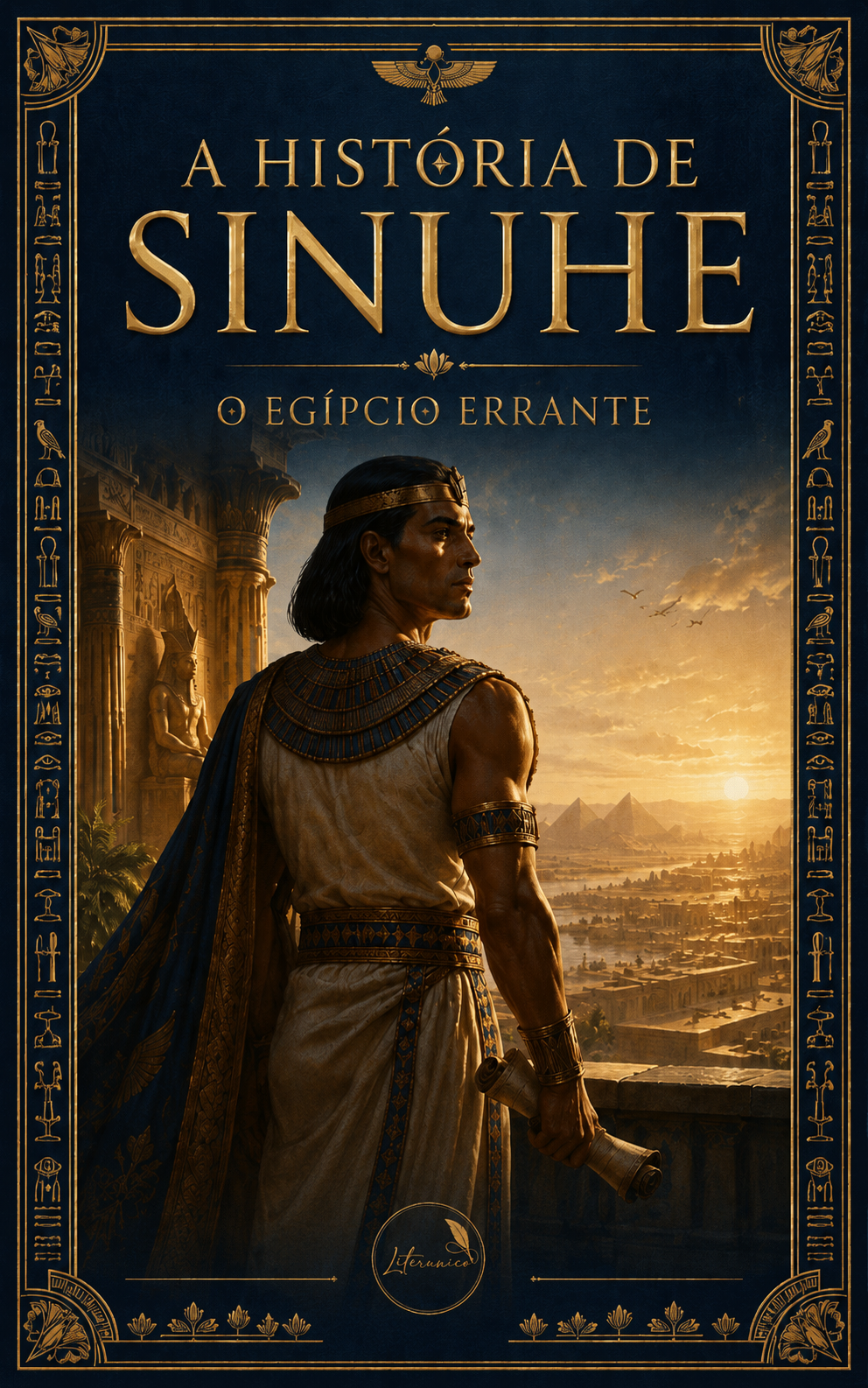
Leia agora
Capítulo 1 · The Adventures of Sanehat

INTRODUCTION

INTRODUCTION IT is strange that while literature occupies so much attention as at

present, and while fiction is the largest division of our book-work, the

oldest literature and fiction of the world should yet have remained

unpresented to English readers. The tales of ancient Egypt have appeared

collectively only in French, in the charming volume of Maspero's "Contes

Populaires"; while some have been translated into English at scattered

times in volumes of the "Records of the Past." But research moves

forward; and translations that were excellent twenty years ago may now

be largely improved, as we attain more insight into the language.

For another reason also there is a wide ground for the present volume.

In no case have any illustrations been attempted, to give that basis for

imagination which is all the more needed when reading of an age and a

land unfamiliar to our ideas. When following a narrative, whether of

real events or of fiction, many persons--perhaps most--find themselves

unconsciously framing in their minds the scenery and the beings of which

they are reading. To give a correct picture of the character of each of

the various ages to which these tales belong, has been the aim of the

present illustrations. A definite period has been assigned to each tale,

in accordance with the indications, or the history, involved in it; and,

so far as our present knowledge goes, all the details of life in the

scenes here illustrated are rendered in accord with the period of the

story.

To some purely scholastic minds it may seem presumptuous to

intermingle translations of notable documents with fanciful

illustrations. But, considering the greater precision with which in

recent years we have been able to learn the changes and the fashions

of ancient life in Egypt, and the essentially unhistorical nature of

most of these tales, there seems ample reason to provide such material

for the reader's imagination in following the stories; it may-give

them more life and reality, and may emphasise the differences which

existed between the different periods to which these tales refer.

It will be noticed how the growth of the novel is shadowed out in the

varied grounds and treatment of the tales. The earliest is purely a

collection of marvels or fabulous incidents of the simplest kind. Then

we advance to contrasts between town and country, between Egypt and

foreign lands. Then personal adventure, and the interest in schemes

and successes, becomes the staple material; while only in the later

periods does character come in as the groundwork. The same may be seen

in English literature--first the tales of wonders and strange lands,

then the novel of adventure, and lastly the novel of character.

In translating these documents into English I have freely used the

various translations already published in other languages; but in all

cases more or less revision and retranslation from the original has

been made. In this matter I am indebted to Mr. F. Ll. Griffith, who has

in some cases--as in Anpu and Bata--almost entirely retranslated the

original papyrus. The material followed in each instance will be found

stated in the notes accompanying the tales. As to the actual

phraseology, I am alone responsible for that. How far original idiom

should be retained in any translation is always a debated question, and

must entirely depend on the object in view. Here the purpose of

rendering the work intelligible to ordinary readers required the

modifying of some idioms and the paraphrasing of others. But so far

as possible the style and tone of the original has been preserved, and

whatever could be easily followed has been left to speak for itself. In

many plainnesses of speech the old Egyptian resembled the modern

Oriental, or our own forefathers, more than ourselves in this age of

squeamishness as yet unparalleled in the world. To avoid offence a few

little modifications of words have been made; but rather than give a

false impression by tampering with any of the narrative, I have omitted

the sequel of the last tale and given only an outline of it. The diction

adopted has been the oldest that could be used without affectation when

dealing with the early times. It has been purposely modified in the

later tales; and in the last--which is of Ptolemaic authorship--a

modern style has been followed as more compatible with the later tone of

the narrative.

For the illustrations Mr. Tristram Ellis's familiarity with Egypt has

been of good account in his life-like scenes here used. For each

drawing I have searched for the material among the monuments and

remains of the age in question. The details of the dresses, the

architecture, and the utensils, are all in accord with the period of

each tale. In the tale of Setnau two different styles are introduced.

Ahura is probably of the time of Amenhotep III., whereas Setnau is a

son of Ramessu II.; and the change of fashion between the two

different dynasties has been followed as distinctive of the two

persons, one a _ka_ or double of the deceased, the other a living man.

To the reader who starts with the current idea that all Egyptians were

alike, this continual change from one period to another may seem

almost fanciful. But it rests on such certain authority that we may

hope that this little volume may have its use as an object-lesson in

practical archaeology.

The use and abuse of notes is a matter of dispute. To be constantly

interrupted in reading by some needless and elementary explanation is

an impertinence both to the author and the reader: the one cannot

resent it, the other therefore resents it for both. But what is to be

deemed needless entirely depends on the reader: I have been asked in

what country Pompei is, as it is not in the English Gazetteer. Rather

than intrude, then, on the reader when he is in high discourse with

the ancients, I humbly set up my interpreter's booth next door; and if

he cares to call in, and ask about any difficulties, I shall be glad

to help him if I can. Not even numbers are intruded to refer to notes;

for how often an eager reader has been led off his trail, and turned

blithely to refer to 37 or 186 only to find, "See J. Z. xxxviii.

377," at which he gnashed his teeth and cursed such interruptions. So

those to whom the original tales are obscure are humbly requested to

try for some profit from the remarks after them, that have been

gleaned by the translator.

Much might be said by a "folk-lorist"--in proportion to his ardour. But

as there are folk-lorists and folk-lorists, and the schools of Rabbi

Andrew and Rabbi Joseph write different targums, I have left each to

make his own commentary without prejudice.

TALES OF THE MAGICIANS One day, when King Khufu reigned over all the land, he said to his

chancellor, who stood before him, "Go call me my sons and my

councillors, that I may ask of them a thing." And his sons and his

councillors came and stood before him, and he said to them, "Know ye a

man who can tell me tales of the deeds of the magicians?"

Then the royal son Khafra stood forth and said, "I will tell thy majesty

a tale of the days of thy forefather Nebka, the blessed; of what came to

pass when he went into the temple of Ptah of Ankhtaui."

KHAFRA'S TALE "His majesty was walking unto the temple of Ptah, and went unto the

house of the chief reciter Uba-aner, with his train. Now when the wife

of Uba-aner saw a page, among those who stood behind the king, her heart

longed after him; and she sent her servant unto him, with a present of a

box full of garments.

"And he came then with the servant. Now there was a lodge in the garden

of Uba-aner; and one day the page said to the wife of Uba-aner, 'In the

garden of Uba-aner there is now a lodge; behold, let us therein take our

pleasure.' So the wife of Uba-aner sent to the steward who had charge

over the garden, saying, 'Let the lodge which is in the garden be made

ready.' And she remained there, and rested and drank with the page until

the sun went down.

"And when the even was now come the page went forth to bathe. And the

steward said, 'I must go and tell Uba-aner of this matter.' Now when

this day was past, and another day came, then went the steward to

Uba-aner, and told him of all these things.

"Then said Uba-aner, 'Bring me my casket of ebony and electrum.' And

they brought it; and he fashioned a crocodile of wax, seven fingers

long: and he enchanted it, and said, 'When the page comes and bathes in

my lake, seize on him.' And he gave it to the steward, and said to him,

'When the page shall go down into the lake to bathe, as he is daily wont

to do, then throw in this crocodile behind him.' And the steward went

forth bearing the crocodile.

"And the wife of Uba-aner sent to the steward who had charge over the

garden, saying, 'Let the lodge which is in the garden be made ready, for

I come to tarry there.'

"And the lodge was prepared with all good things; and she came and made

merry therein with the page. And when the even was now come, the page

went forth to bathe as he was wont to do. And the steward cast in the

wax crocodile after him into the water; and, behold! it became a

great crocodile seven cubits in length, and it seized on the page.

"And Uba-aner abode yet seven days with the king of Upper and Lower

Egypt, Nebka, the blessed, while the page was stifled in the crocodile.

And after the seven days were passed, the king of Upper and Lower Egypt,

Nebka, the blessed, went forth, and Uba-aner went before him.

"And Uba-aner said unto his majesty, 'Will your majesty come and see

this wonder that has come to pass in your days unto a page?' And the

king went with Uba-aner. And Uba-aner called unto the crocodile and

said, 'Bring forth the page.' And the crocodile came forth from the lake

with the page. Uba-aner said unto the king, 'Behold, whatever I command

this crocodile he will do it.' And his majesty said, 'I pray you send back

this crocodile." And Uba-aner stooped and took up the crocodile, and it

became in his hand a crocodile of wax. And then Uba-aner told the king

that which had passed in his house with the page and his wife. And his

majesty said unto the crocodile, 'Take to thee thy prey.' And the

crocodile plunged into the lake with his prey, and no man knew whither

he went.

"And his majesty the king of Upper and Lower Egypt, Nebka, the blessed,

commanded, and they brought forth the wife of Uba-aner to the north side

of the harem, and burnt her with fire, and cast her ashes in the

river.

"This is a wonder that came to pass in the days of thy forefather the

king of Upper and Lower Egypt, Nebka, of the acts of the chief reciter

Uba-aner."

His majesty the king of Upper and Lower Egypt, Khufu, then said, "Let

there be presented to the king Nebka, the blessed, a thousand loaves, a

hundred draughts of beer, an ox, two jars of incense; and let there be

presented a loaf, a jar of beer, a jar of incense, and a piece of meat

to the chief reciter Uba-aner; for I have seen the token of his

learning." And they did all things as his majesty commanded.

BAUFRA'S TALE The royal sou Bau-f-ra then stood forth and spake. He said, "I will tell

thy majesty of a wonder which came to pass in the days of thy father

Seneferu, the blessed, of the deeds of the chief reciter Zazamankh. One

day King Seneferu, being weary, went throughout his palace seeking for a

pleasure to lighten his heart, but he found none. And he said,

'Haste, and bring before me the chief reciter and scribe of the rolls

Zazamankh'; and they straightway brought him. And the king said, 'I have

sought in my palace for some delight, but I have found none.' Then said

Zazamankh to him, 'Let thy majesty go upon the lake of the palace, and

let there be made ready a boat, with all the fair maidens of the harem

of thy palace; and the heart of thy majesty shall be refreshed with

the sight, in seeing their rowing up and down the water, and seeing

the goodly pools of the birds upon the lake, and beholding its sweet

fields and grassy shores; thus will thy heart be lightened. And I also

will go with thee. Bring me twenty oars of ebony, inlayed with gold,

with blades of light wood, inlayed with electrum; and bring me twenty

maidens, fair in their limbs, their bosoms and their hair, all

virgins; and bring me twenty nets, and give these nets unto the

maidens for their garments.' And they did according to all the

commands of his majesty.

"And they rowed down the stream and up the stream, and the heart of his

majesty was glad with the sight of their rowing. But one of them at the

steering struck her hair, and her jewel of new malachite fell into the

water. And she ceased her song, and rowed not; and her companions

ceased, and rowed not. And his majesty said, 'Row you not further?' And

they replied, 'Our little steerer here stays and rows not.' His majesty

then said to her, 'Wherefore rowest thou not?' She replied, 'It is for

my jewel of new malachite which is fallen in the water.' And he said to

her, 'Row on, for behold I will replace it.' And she answered, 'But I

want my own piece back in its setting.' And his majesty said, 'Haste,

bring me the chief reciter Zazamankh,' and they brought him. And his

majesty said, 'Zazamankh, my brother, I have done as thou sayedst, and

the heart of his majesty is refreshed with the sight of their rowing.

But now a jewel of new malachite of one of the little ones is fallen in

the water, and she ceases and rows not, and she has spoilt the rowing of

her side. And I said to her, "Wherefore rowest thou not?" and she

answered to me, "It is for my jewel of new malachite which is fallen in

the water." I replied to her, "Row on, for behold I will replace it";

and she answered to me, "But I want my own piece again back in its

setting."' Then the chief reciter Zazamankh spake his magic speech. And

he placed one part of the waters of the lake upon the other, and

discovered the jewel lying upon a shard; and he took it up and gave it

unto its mistress. And the water, which was twelve cubits deep in the

middle, reached now to twenty-four cubits after he turned it. And he

spake, and used his magic speech; and he brought again the water of the

lake to its place. And his majesty spent a joyful day with the whole of

the royal house. Then rewarded he the chief reciter Zazamankh with all

good things. Behold, this is a wonder that came to pass in the days of

thy father, the king of Upper and Lower Egypt, Seneferu, of the deeds of

the chief reciter, the scribe of the rolls, Zazamankh." Then said the

majesty of the king of Upper and Lower Egypt, Khufu, the blessed, "Let

there be presented an offering of a thousand cakes, one hundred draughts

of beer, an ox, and two jars of incense to the king of Upper and Lower

Egypt, Sene-feru, the blessed; and let there be given a loaf, a jar of

beer, and a jar of incense to the chief reciter, the scribe of the

rolls, Zazamankh; for I have seen the token of his learning." And they

did all things as his majesty commanded.

HORDEDEF'S TALE The royal son Hordedef then stood forth and spake. He said, "Hitherto

hast thou only heard tokens of those who have gone before, and of

which no man knoweth their truth But I will show thy majesty a man of

thine own days." And his majesty said, "Who is he, Hordedef?" And the

royal son Hordedef answered, "It is a certain man named Dedi, who

dwells at Dedsneferu. He is a man of one hundred and ten years old;

and he eats five hundred loaves of bread, and a side of beef, and

drinks one hundred draughts of beer, unto this day. He knows how to

restore the head that is smitten off; he knows how to cause the lion

to follow him trailing his halter on the ground; he knows the designs

of the dwelling of Tahuti. The majesty of the king of Upper and Lower

Egypt, Khufu, the blessed, has long sought for the designs of the

dwelling of Tahuti, that he may make the like of them in his pyramid."

And his majesty said, "Thou, thyself, Hordedef, my son, bring him to

me." Then were the ships made ready for the king's son Hordedef, and he

went up the stream to Dedsneferu. And when the ships had moored at the

haven, he landed, and sat him in a litter of ebony, the poles of which

were of cedar wood overlayed with gold. Now when he drew near to Dedi,

they set down the litter. And he arose to greet Dedi, and found him

lying on a palmstick couch at the door of his house; one servant held

his head and rubbed him, and another rubbed his feet.

And the king's son Hordedef said, "Thy state is that of one who lives to

good old age; for old age is the end of our voyage, the time of

embalming, the time of burial. Lie, then, in the sun, free of

infirmities, without the babble of dotage: this is the salutation to

worthy age. I come from far to call thee, with a message from my father

Khufu, the blessed, for thou shalt eat of the best which the king gives,

and of the food which those have who follow after him; that he may bring

thee in good estate to thy fathers who are in the tomb."

And Dedi replied to him, "Peace to thee! Peace to thee! Hordedef, son of

the king, beloved of his father. May thy father Khufu, the blessed,

praise thee, may he advance thee amongst the elders, may thy _ka_ prevail

against the enemy, may thy soul know the right road to the gate of him

who clothes the afflicted; this is the salutation to the king's son."

Then the king's son, Hordedef, stretched forth his hands to him, and

raised him up, and went with him to the haven, giving unto him his arm.

Then said Dedi, "Let there he given me a boat, to bring me my youths and

my books." And they made ready for him two boats with their rowers. And

Dedi went down the river in the barge in which was the king's son

Hordedef. And when he had reached the palace, the king's son, Hordedef,

entered in to give account unto his majesty the king of Upper and Lower

Egypt, Khufu, the blessed. Then said the king's son Hordedef, "O king,

life, wealth, and health! My lord, I have brought Dedi." His majesty

replied, "Bring him to me speedily." And his majesty went into the hall

of columns of Pharaoh (life, wealth, and health), and Dedi was led

before him. And his majesty said, "Wherefore is it, Dedi, that I have

not yet seen thee?" And Dedi answered, "He who is called it is that

comes; the king (life, wealth, and health) calls me, and behold I

come," And his majesty said, "Is it true, that which men say, that

thou canst restore the head which is smitten off?" And Dedi replied,

"Truly, I know that, O king (life, wealth, and health), my lord." And

his majesty said, "Let one bring me a prisoner who is in prison, that

his punishment may be fulfilled." And Dedi said, "Let it not be a man,

O king, my lord; behold we do not even thus to our cattle." And a duck

was brought unto him, and its head was cut off. And the duck was laid

on the west side of the hall, and its head on the east side of the

hall. And Dedi spake his magic speech. And the duck fluttered along

the ground, and its head came likewise; and when it had come part to

part the duck stood and quacked. And they brought likewise a goose

before him, and he did even so unto it. His majesty caused an ox to be

brought, and its head cast on the ground. And Dedi spake his magic

speech. And the ox stood upright behind him, and followed him with his

halter trailing on the ground.

And King Khufu said, "And is it true what is said, that thou knowest the

number of the designs of the dwelling of Tahuti?" And Dedi replied,

"Pardon me, I know not their number, O king (life, wealth, and health),

but I know where they are." And his majesty said, "Where is that?" And

Dedi replied, "There is a chest of whetstone in a chamber named the

plan-room, in Heli-opolis; they are in this chest." And Dedi said

further unto him, "O king (life, wealth, and health), my lord, it is not

I that is to bring them to thee." And his m'jesty said, "Who, then, is

it that shall bring them to me?" And Dedi answered to him, "It is the

eldest of the three children who are in the body of Rud-didet who

shall bring them to thee." And his majesty said, "Would that it may be

as thou sayest! And who is this Rud-didet?" And Dedi replied, "She is

the wife of a priest of Ra, lord of Sakhebu. And she has conceived

these three sons by Ra, lord of Sakhebu, and the god has promised her

that they shall fulfil this noble office (of reigning) over all this

land, and that the eldest of them shall be high priest in Heliopolis."

And his majesty's heart became troubled for this; but Dedi spake unto

him, "What is this that thou thinkest, O king (life, wealth, health),

my lord? Is it because of these three children? I tell thee thy son

shall reign, and thy son's son, and then one of them." His majesty

said, "And when shall Rud-didet bear these?" And he replied, "She

shall bear them on the 26th of the month Tybi." And his majesty said,

"When the banks of the canal of Letopolis are cut, I will walk there

that I may see the temple of Ra, lord of Sakhebu." And Dedi replied,

"Then I will cause that there be four cubits of water by the banks of

the canal of Letopolis." When his majesty returned to his palace, his

majesty said, "Let them place Dedi in the house of the royal son

Hordedef, that he may dwell with him, and let them give him a daily

portion of a thousand loaves, a hundred draughts of beer, an ox, and a

hundred bunches of onions." And they did everything as his majesty

commanded.

And one day it came to pass that Rud-didet felt the pains of birth. And

the majesty of Ra, lord of Sakhebu, said unto Isis, to Nebhat, to

Meskhent, to Hakt, and to Khnumu, "Go ye, and deliver Rud-didet of these

three children that she shall bear, who are to fulfil this noble office

over all this land; that they may build up your temples, furnish your

altars with offerings, supply your tables of libation, and increase your

endowments." Then went these deities; their fashion they made as that of

dancing-girls, and Khnumu was with them as a porter. They drew near

unto the house of Ra-user, and found him standing, with his girdle

fallen. And they played before him with their instruments of music.

But he said unto them, "My ladies, behold, here is a woman who feels

the pains of birth." They said to him, "Let us see her, for we know

how to help her." And he replied, "Come, then." And they entered in

straightway to Rud-didet, and they closed the door on her and on

themselves. Then Isis stood before her, and Nebhat stood behind her,

and Hakt helped her. And Isis said, "O child, by thy name of User-ref,

do not do violence." And the child came upon her hands, as a child of

a cubit; its bones were strong, the beauty of its limbs was like gold,

and its hair was like true lapis lazuli. They washed him, and prepared

him, and placed him on a carpet on the brickwork. Then Meskhent

approached him and said, "This is a king who shall reign over all the

land." And Khnumu gave strength to his limbs. Then Isis stood before

her, and Nebhat stood behind her, and Hakt helped her. And Isis said,

"O child, by thy name of Sah-ra, stay not in her." Then the child came

upon her hands, a child of a cubit; its bones were strong, the beauty

of its limbs was like gold, and its hair was like true lapis lazuli.

They washed him, and prepared him, and layed him on a carpet on the

brickwork. Then Meskhent approached him and said, "This is a king who

shall reign over all the land." And Khnumu gave strength to his limbs.

Then Isis stood before her, and Nebhat stood behind her, and Hakt

helped her. And Isis said, "O child, by thy name of Kaku, remain not

in darkness in her." And the child came upon her hands, a child of a

cubit; its bones were strong, the beauty of its limbs was like gold,

and its hair was like true lapis lazuli. And Meskhent approached him

and said, "This is a king who shall reign over all the land." And

Khnumu gave strength to his limbs. And they washed him, and prepared

him, and layed him on a carpet on the brickwork.

And the deities went out, having delivered Rud-didet of the three

children. And they said, "Rejoice! O Ra-user, for behold three children

are born unto thee." And he said unto them, "My ladies, and what shall I

give unto ye? Behold, give this bushel of barley here unto your porter,

that ye may take it as your reward to the brew-house." And Khnumu loaded

himself with the bushel of barley. And they went away toward the place

from which they came. And Isis spake unto these goddesses, and said,

"Wherefore have we come without doing a marvel for these children, that

we may tell it to their father who has sent us?" Then made they the

divine diadems of the king (life, wealth, and health), and laid them in

the bushel of barley. And they caused the clouds to come with wind and

rain; and they turned back again unto the house. And they said, "Let us

put this barley in a closed chamber, sealed up, until we return

northward, dancing." And they placed the barley in a close chamber.

And Rud-didet purified herself, with a purification of fourteen days.

And she said to her handmaid, "Is the house made ready?" And she

replied, "All things are made ready, but the brewing barley is not yet

brought." And Rud-didet said, "Wherefore is the brewing barley not yet

brought?" And the servant answered, "It would all of it long since

be ready if the barley had not been given to the dancing-girls, and lay

in the chamber under their seal." Rud didet said, "Go down, and bring of

it, and Ra-user shall give them in its stead when he shall come," And

the handmaid went, and opened the chamber. And she heard talking and

singing, music and dancing, quavering, and all things which are

performed for a king in his chamber. And she returned and told to

Rud-didet all that she had heard. And she went through the chamber, but

she found not the place where the sound was. And she layed her temple to

the sack, and found that the sounds were in it. She placed it in a

chest, and put that in another locker, and tied it fast with leather,

and layed it in the store-room, where the things were, and sealed it.

And Ra-user came returning from the field; and Rud-didet repeated unto

him these things; and his heart was glad above all things; and they sat

down and made a joyful day.

And after these days it came to pass that Rud-didet was wroth with her

servant, and beat her with stripes. And the servant said unto those that

were in the house, "Shall it be done thus unto me? She has borne three

kings, and I will go and tell this to his majesty King Khufu the

blessed." And she went, and found the eldest brother of her mother, who

was binding his flax on the floor. And he said to her, "Whither goest

thou, my little maid?" And she told him of all these things. And her

brother said to her, "Wherefore comest thou thus to me? Shall I agree

to treachery?" And he took a bunch of the flax to her, and laid on

her a violent blow. And the servant went to fetch a handful of water,

and a crocodile carried her away.

Her uncle went therefore to tell of this to Rud-didet; and he found

Rud-didet sitting, her head on her knees, and her heart beyond measure

sad. And he said to her, "My lady, why makest thou thy heart thus?" And

she answered, "It is because of this little wretch that was in the

house; behold she went out saying, 'I will go and tell it.'" And he

bowed his head unto the ground, and said, "My lady, she came and told me

of these things, and made her complaint unto me; and I laid on her a

violent blow. And she went forth to draw water, and a crocodile carried

her away."

_(The rest of the tale is lost.)_

The Adventures of Sanehat

Sinopse

Edição-fonte em EN preservada no Literunico para leitura comparada com a edição/tradução da Copa Literunico. Fonte-base: https://www.gutenberg.org/ebooks/7386

The Adventures of Sanehat

Resenhas do livro

0 publicadas

Ainda não há resenhas para esta obra. A primeira leitura comentada pode começar aqui.

Ir para o carrinho
Mercado de The Adventures of Sanehat

Leve um fragmento deste universo

Escolha a arte, confira a disponibilidade e adicione o produto ao carrinho sem sair da experiência.

Nenhum livro físico está disponível neste universo.
Relíquias de The Adventures of Sanehat

Adquira Relíquias do Livro como colaboração ao autor e deixe sua marca registrada, criando valor ao item!

Central de RelíquiasDescubra coleções de outros universos e obras.
ver todas
Sinopse do universo · 1 livro conectado 1/1
Abrir leitor completo

Resenhas do livro

0 publicadas

Ainda não há resenhas para esta obra. A primeira leitura comentada pode começar aqui.

Entrar para resenhar

Posses do livro

0 Leitores com posse
0 Unidades registradas

Nenhuma posse foi registrada publicamente para esta edição.

Adicionais do Universo

Visual ClássicoAbra a leitura editorial, no estilo de uma página de livro
ler
Visual AuroraApresentação imersiva do universo da obra
abrir