
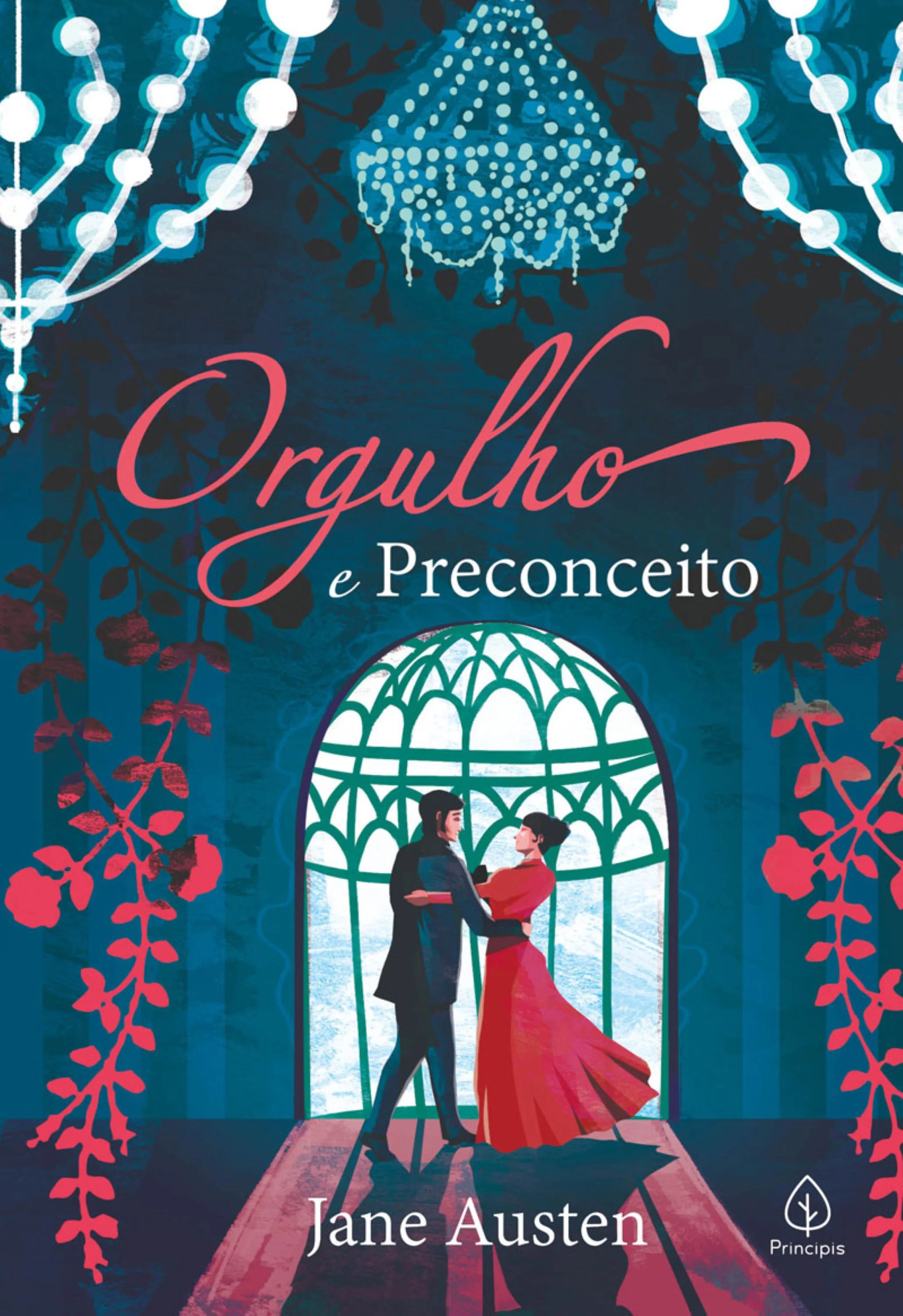
Universo da obra
Universo da obra
[Illustration]
Mr. Bennet was among the earliest of those who waited on Mr. Bingley. He
had always intended to visit him, though to the last always assuring his
wife that he should not go; and till the evening after the visit was
paid she had no knowledge of it. It was then disclosed in the following
manner. Observing his second daughter employed in trimming a hat, he
suddenly addressed her with,--
“I hope Mr. Bingley will like it, Lizzy.”
“We are not in a way to know what Mr. Bingley likes,” said her mother,
resentfully, “since we are not to visit.”
“But you forget, mamma,” said Elizabeth, “that we shall meet him at the
assemblies, and that Mrs. Long has promised to introduce him.”
“I do not believe Mrs. Long will do any such thing. She has two nieces
of her own. She is a selfish, hypocritical woman, and I have no opinion
of her.”
“No more have I,” said Mr. Bennet; “and I am glad to find that you do
not depend on her serving you.”
Mrs. Bennet deigned not to make any reply; but, unable to contain
herself, began scolding one of her daughters.
“Don’t keep coughing so, Kitty, for heaven’s sake! Have a little
compassion on my nerves. You tear them to pieces.”
“Kitty has no discretion in her coughs,” said her father; “she times
them ill.”
“I do not cough for my own amusement,” replied Kitty, fretfully. “When
is your next ball to be, Lizzy?”
“To-morrow fortnight.”
“Ay, so it is,” cried her mother, “and Mrs. Long does not come back till
the day before; so, it will be impossible for her to introduce him, for
she will not know him herself.”
“Then, my dear, you may have the advantage of your friend, and introduce
Mr. Bingley to her.”
“Impossible, Mr. Bennet, impossible, when I am not acquainted with him
myself; how can you be so teasing?”
“I honour your circumspection. A fortnight’s acquaintance is certainly
very little. One cannot know what a man really is by the end of a
fortnight. But if we do not venture, somebody else will; and after
all, Mrs. Long and her nieces must stand their chance; and, therefore,
as she will think it an act of kindness, if you decline the office, I
will take it on myself.”
The girls stared at their father. Mrs. Bennet said only, “Nonsense,
nonsense!”
“What can be the meaning of that emphatic exclamation?” cried he. “Do
you consider the forms of introduction, and the stress that is laid on
them, as nonsense? I cannot quite agree with you there. What say you,
Mary? For you are a young lady of deep reflection, I know, and read
great books, and make extracts.”
Mary wished to say something very sensible, but knew not how.
“While Mary is adjusting her ideas,” he continued, “let us return to Mr.
Bingley.”
“I am sick of Mr. Bingley,” cried his wife.
“I am sorry to hear that; but why did you not tell me so before? If I
had known as much this morning, I certainly would not have called on
him. It is very unlucky; but as I have actually paid the visit, we
cannot escape the acquaintance now.”
The astonishment of the ladies was just what he wished--that of Mrs.
Bennet perhaps surpassing the rest; though when the first tumult of joy
was over, she began to declare that it was what she had expected all the
while.
“How good it was in you, my dear Mr. Bennet! But I knew I should
persuade you at last. I was sure you loved your girls too well to
neglect such an acquaintance. Well, how pleased I am! And it is such a
good joke, too, that you should have gone this morning, and never said a
word about it till now.”
“Now, Kitty, you may cough as much as you choose,” said Mr. Bennet; and,
as he spoke, he left the room, fatigued with the raptures of his wife.
“What an excellent father you have, girls,” said she, when the door was
shut. “I do not know how you will ever make him amends for his kindness;
or me either, for that matter. At our time of life, it is not so
pleasant, I can tell you, to be making new acquaintances every day; but
for your sakes we would do anything. Lydia, my love, though you are
the youngest, I dare say Mr. Bingley will dance with you at the next
ball.”
“Oh,” said Lydia, stoutly, “I am not afraid; for though I am the
youngest, I’m the tallest.”
The rest of the evening was spent in conjecturing how soon he would
return Mr. Bennet’s visit, and determining when they should ask him to
dinner.
“He rode a black horse”
]
Original English text of Pride and Prejudice, Jane Austen’s novel of manners, social judgment, reputation and romantic intelligence. Source edition published as the original-language companion to the Literunico Brazilian translation.
Ainda não há resenhas para esta obra. A primeira leitura comentada pode começar aqui.
Uma seleção criada para acompanhar a atmosfera, os personagens e os caminhos desta obra.
Escolha a arte, confira a disponibilidade e adicione o produto ao carrinho sem sair da experiência.
Adquira Relíquias da Obra e deixe sua marca registrada, criando valor ao item!

Capa frontal, contracapa, Capa Aberta e Marca-Páginas pertencem à obra e acompanham este Universes.
Escolha uma Relíquia no painel principal para enviar uma proposta ao autor.
Capítulos disponíveis para continuar a leitura.
Nenhuma Relíquia desta obra foi adquirida ainda. Seja o primeiro a eternizar seu nome no acervo oficial!
Conhecer as 100 RelíquiasAinda não há resenhas para esta obra. A primeira leitura comentada pode começar aqui.
Nenhuma posse foi registrada publicamente para esta edição.
Durante a leitura, abra Menu para ajustar a experiência sem sair do capítulo. As preferências de aparência ficam salvas neste aparelho.
Recursos identificados como “em preparo” aparecem para antecipar a evolução do leitor, mas ainda não executam uma ação.
Posso mostrar leituras em destaque, clássicos e Relíquias disponíveis agora no Literúnico.
Escolha um caminho
Dúvidas desta página
As explicações do Aurélio são respostas cadastradas pelo Literúnico.