
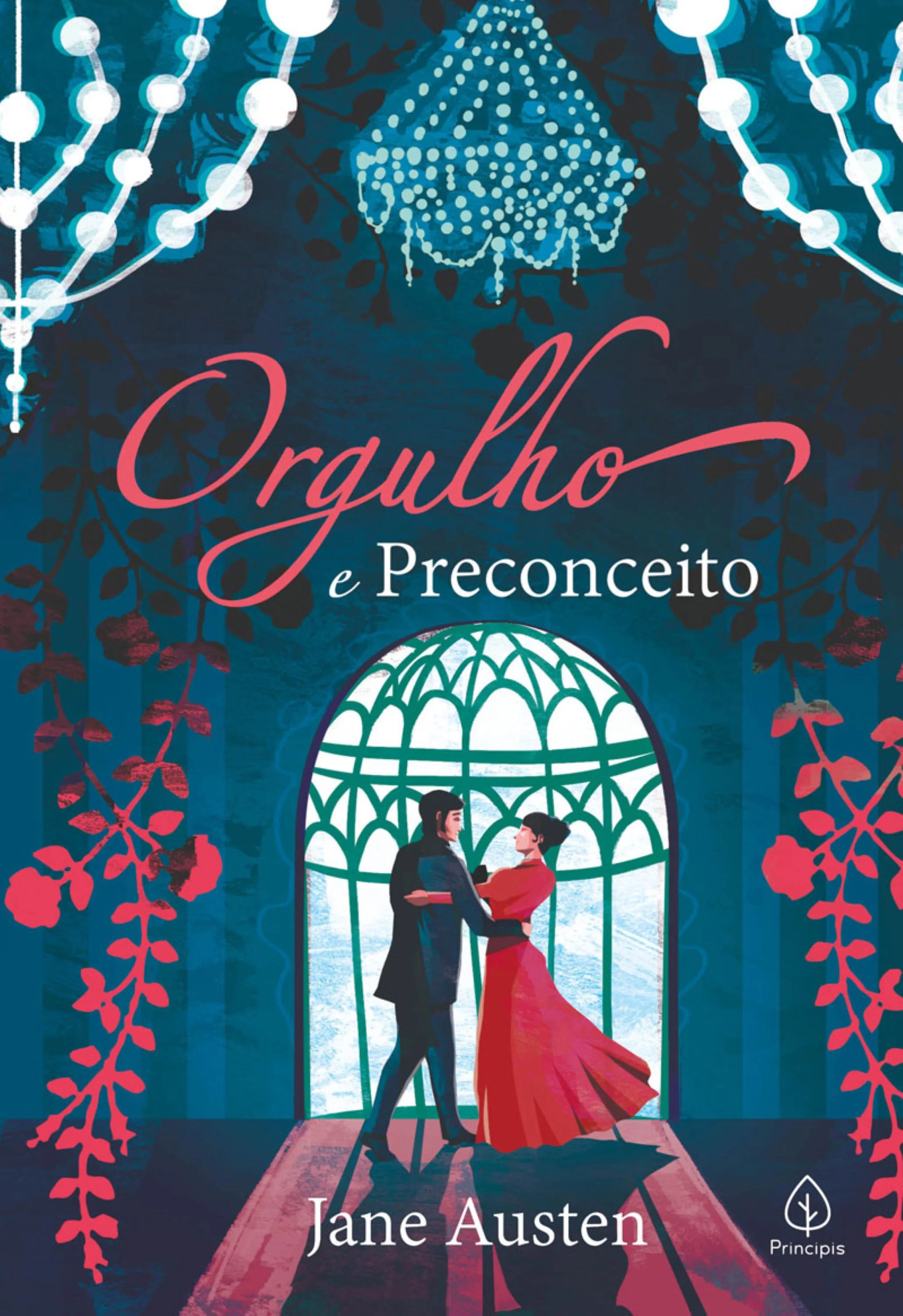
Universo da obra
Universo da obra
[Illustration]
Within a short walk of Longbourn lived a family with whom the Bennets
were particularly intimate. Sir William Lucas had been formerly in trade
in Meryton, where he had made a tolerable fortune, and risen to the
honour of knighthood by an address to the king during his mayoralty. The
distinction had, perhaps, been felt too strongly. It had given him a
disgust to his business and to his residence in a small market town;
and, quitting them both, he had removed with his family to a house about
a mile from Meryton, denominated from that period Lucas Lodge; where he
could think with pleasure of his own importance, and, unshackled by
business, occupy himself solely in being civil to all the world. For,
though elated by his rank, it did not render him supercilious; on the
contrary, he was all attention to everybody. By nature inoffensive,
friendly, and obliging, his presentation at St. James’s had made him
courteous.
Lady Lucas was a very good kind of woman, not too clever to be a
valuable neighbour to Mrs. Bennet. They had several children. The eldest
of them, a sensible, intelligent young woman, about twenty-seven, was
Elizabeth’s intimate friend.
That the Miss Lucases and the Miss Bennets should meet to talk over a
ball was absolutely necessary; and the morning after the assembly
brought the former to Longbourn to hear and to communicate.
“You began the evening well, Charlotte,” said Mrs. Bennet, with civil
self-command, to Miss Lucas. “You were Mr. Bingley’s first choice.”
“Yes; but he seemed to like his second better.”
“Oh, you mean Jane, I suppose, because he danced with her twice. To be
sure that did seem as if he admired her--indeed, I rather believe he
did--I heard something about it--but I hardly know what--something
about Mr. Robinson.”
“Perhaps you mean what I overheard between him and Mr. Robinson: did not
I mention it to you? Mr. Robinson’s asking him how he liked our Meryton
assemblies, and whether he did not think there were a great many pretty
women in the room, and which he thought the prettiest? and his
answering immediately to the last question, ‘Oh, the eldest Miss Bennet,
beyond a doubt: there cannot be two opinions on that point.’”
“Upon my word! Well, that was very decided, indeed--that does seem as
if--but, however, it may all come to nothing, you know.”
“My overhearings were more to the purpose than yours, Eliza,” said
Charlotte. “Mr. Darcy is not so well worth listening to as his friend,
is he? Poor Eliza! to be only just tolerable.”
“I beg you will not put it into Lizzy’s head to be vexed by his
ill-treatment, for he is such a disagreeable man that it would be quite
a misfortune to be liked by him. Mrs. Long told me last night that he
sat close to her for half an hour without once opening his lips.”
“Are you quite sure, ma’am? Is not there a little mistake?” said Jane.
“I certainly saw Mr. Darcy speaking to her.”
“Ay, because she asked him at last how he liked Netherfield, and he
could not help answering her; but she said he seemed very angry at being
spoke to.”
“Miss Bingley told me,” said Jane, “that he never speaks much unless
among his intimate acquaintance. With them he is remarkably
agreeable.”
“I do not believe a word of it, my dear. If he had been so very
agreeable, he would have talked to Mrs. Long. But I can guess how it
was; everybody says that he is eat up with pride, and I dare say he had
heard somehow that Mrs. Long does not keep a carriage, and had to come
to the ball in a hack chaise.”
“I do not mind his not talking to Mrs. Long,” said Miss Lucas, “but I
wish he had danced with Eliza.”
“Another time, Lizzy,” said her mother, “I would not dance with him,
if I were you.”
“I believe, ma’am, I may safely promise you never to dance with him.”
“His pride,” said Miss Lucas, “does not offend me so much as pride
often does, because there is an excuse for it. One cannot wonder that so
very fine a young man, with family, fortune, everything in his favour,
should think highly of himself. If I may so express it, he has a right
to be proud.”
“That is very true,” replied Elizabeth, “and I could easily forgive
his pride, if he had not mortified mine.”
“Pride,” observed Mary, who piqued herself upon the solidity of her
reflections, “is a very common failing, I believe. By all that I have
ever read, I am convinced that it is very common indeed; that human
nature is particularly prone to it, and that there are very few of us
who do not cherish a feeling of self-complacency on the score of some
quality or other, real or imaginary. Vanity and pride are different
things, though the words are often used synonymously. A person may be
proud without being vain. Pride relates more to our opinion of
ourselves; vanity to what we would have others think of us.”
“If I were as rich as Mr. Darcy,” cried a young Lucas, who came with his
sisters, “I should not care how proud I was. I would keep a pack of
foxhounds, and drink a bottle of wine every day.”
“Then you would drink a great deal more than you ought,” said Mrs.
Bennet; “and if I were to see you at it, I should take away your bottle
directly.”
The boy protested that she should not; she continued to declare that she
would; and the argument ended only with the visit.
[Illustration]
[Illustration]
Original English text of Pride and Prejudice, Jane Austen’s novel of manners, social judgment, reputation and romantic intelligence. Source edition published as the original-language companion to the Literunico Brazilian translation.
Ainda não há resenhas para esta obra. A primeira leitura comentada pode começar aqui.
Uma seleção criada para acompanhar a atmosfera, os personagens e os caminhos desta obra.
Escolha a arte, confira a disponibilidade e adicione o produto ao carrinho sem sair da experiência.
Adquira Relíquias da Obra e deixe sua marca registrada, criando valor ao item!

Capa frontal, contracapa, Capa Aberta e Marca-Páginas pertencem à obra e acompanham este Universes.
Escolha uma Relíquia no painel principal para enviar uma proposta ao autor.
Capítulos disponíveis para continuar a leitura.
Nenhuma Relíquia desta obra foi adquirida ainda. Seja o primeiro a eternizar seu nome no acervo oficial!
Conhecer as 100 RelíquiasAinda não há resenhas para esta obra. A primeira leitura comentada pode começar aqui.
Nenhuma posse foi registrada publicamente para esta edição.
Durante a leitura, abra Menu para ajustar a experiência sem sair do capítulo. As preferências de aparência ficam salvas neste aparelho.
Recursos identificados como “em preparo” aparecem para antecipar a evolução do leitor, mas ainda não executam uma ação.
Posso mostrar leituras em destaque, clássicos e Relíquias disponíveis agora no Literúnico.
Escolha um caminho
Dúvidas desta página
As explicações do Aurélio são respostas cadastradas pelo Literúnico.