
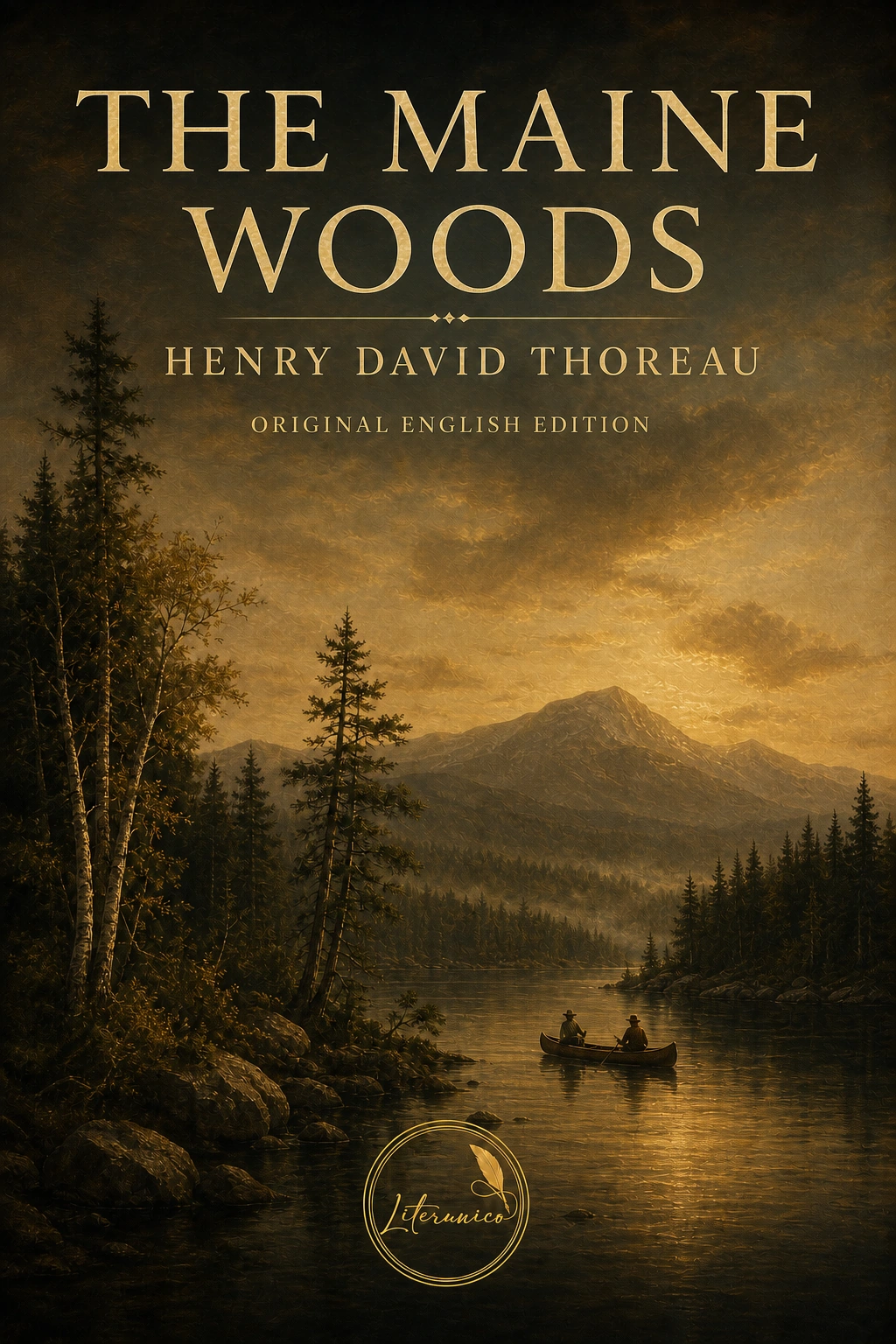
Universo da obra
Universo da obra
The prevailing trees (I speak only of what I saw) on the east and west branches of the Penobscot and on the upper part of the Allegash were the fir, spruce (both black and white), and arbor-vitæ, or “cedar.” The fir has the darkest foliage, and, together with the spruce, makes a very dense “black growth,” especially on the upper parts of the rivers. A dealer in lumber with whom I talked called the former a weed, and it is commonly regarded as fit neither for timber nor fuel. But it is more sought after as an ornamental tree than any other evergreen of these woods except the arbor-vitæ. The black spruce is much more common than the white. Both are tall and slender trees. The arbor-vitæ, which is of a more cheerful hue, with its light-green fans, is also tall and slender, though sometimes two feet in diameter. It often fills the swamps.
Mingled with the former, and also here and there forming extensive and more open woods by themselves, indicating, it is said, a better soil, were canoe and yellow birches (the former was always at hand for kindling a fire,--we saw no small white birches in that wilderness), and sugar and red maples.
The aspen (Populus tremuloides) was very common on burnt grounds. We saw many straggling white pines, commonly unsound trees, which had therefore been skipped by the choppers; these were the largest trees we saw; and we occasionally passed a small wood in which this was the prevailing tree; but I did not notice nearly so many of these trees as I can see in a single walk in Concord. The speckled or hoary alder (Alnus incana) abounds everywhere along the muddy banks of rivers and lakes, and in swamps. Hemlock could commonly be found for tea, but was nowhere abundant. Yet F. A. Michaux states that in Maine, Vermont, and the upper part of New Hampshire, etc., the hemlock forms three fourths of the evergreen woods, the rest being black spruce. It belongs to cold hillsides.
The elm and black ash were very common along the lower and stiller parts of the streams, where the shores were flat and grassy or there were low gravelly islands. They made a pleasing variety in the scenery, and we felt as if nearer home while gliding past them.
The above fourteen trees made the bulk of the woods which we saw.
The larch (juniper), beech, and Norway pine (Pinus resinosa, red pine) were only occasionally seen in particular places. The Pinus Banksiana (gray or Northern scrub pine), and a single small red oak (Quercus rubra) only, are on islands in Grand Lake, on the East Branch.
The above are almost all peculiarly Northern trees, and found chiefly, if not solely, on mountains southward.
It appears that in a forest like this the great majority of flowers, shrubs, and grasses are confined to the banks of the rivers and lakes, and to the meadows, more open swamps, burnt lands, and mountain-tops; comparatively very few indeed penetrate the woods. There is no such dispersion even of wild-flowers as is commonly supposed, or as exists in a cleared and settled country. Most of our wild-flowers, so called, may be considered as naturalized in the localities where they grow. Rivers and lakes are the great protectors of such plants against the aggressions of the forest, by their annual rise and fall keeping open a narrow strip where these more delicate plants have light and space in which to grow. They are the protégés of the rivers. These narrow and straggling bands and isolated groups are, in a sense, the pioneers of civilization. Birds, quadrupeds, insects, and man also, in the main, follow the flowers, and the latter in his turn makes more room for them and for berry-bearing shrubs, birds, and small quadrupeds. One settler told me that not only blackberries and raspberries but mountain maples came in, in the clearing and burning.
Though plants are often referred to primitive woods as their locality, it cannot be true of very many, unless the woods are supposed to include such localities as I have mentioned. Only those which require but little light, and can bear the drip of the trees, penetrate the woods, and these have commonly more beauty in their leaves than in their pale and almost colorless blossoms.
The prevailing flowers and conspicuous small plants of the woods, which I noticed, were: Clintonia borealis, linnæa, checkerberry (Gaultheria procumbens), Aralia nudicaulis (wild sarsaparilla), great round-leaved orchis, Dalibarda repens, Chiogenes hispidula (creeping snowberry), Oxalis Acetosella (common wood-sorrel), Aster acuminatus, Pyrola secunda (one-sided pyrola), Medeola Virginica (Indian cucumber-root), small Circæa (enchanter’s nightshade), and perhaps Cornus Canadensis (dwarf cornel).
Of these, the last of July, 1858, only the Aster acuminatus and great round-leaved orchis were conspicuously in bloom.
The most common flowers of the river and lake shores were: Thalictrum cornuti (meadow-rue); Hypericum ellipticum, mutilum, and Canadense (St. John’s-wort); horsemint; horehound, Lycopus Virginicus and Europæus, var. sinuatus (bugle-weed); Scutellaria galericulata (skullcap); Solidago lanceolata and squarrosa, East Branch, (goldenrod); Diplopappus umbellatus (double-bristled aster); Aster Radula; Cicuta maculata and bulbifera (water hemlock); meadow-sweet; Lysimachia stricta and ciliata (loosestrife); Galium trifidum (small bed-straw); Lilium Canadense (wild yellow lily); Platanthera peramœna and psycodes (great purple orchis and small purple fringed orchis); Mimulus ringens (monkey-flower); dock (water); blue flag; Hydrocotyle Americana (marsh pennywort); Sanicula Canadensis (?) (black snake-root); Clematis Virginiana (?) (common virgin’s-bower); Nasturtium palustre (marsh cress); Ranunculus recurvatus (hooked crow-foot); Asclepias incarnata (swamp milkweed); Aster Tradescanti (Tradescant’s aster); Aster miser, also longifolius; Eupatorium purpureum, apparently, lake shores, (Joe-Pye-weed); Apocynum Cannabinum, East Branch, (Indian hemp); Polygonum cilinode (bindweed); and others. Not to mention, among inferior orders, wool-grass and the sensitive fern.
In the water, Nuphar advena (yellow pond-lily), some potamogetons (pond-weed), Sagittaria variabilis (arrowhead), Sium lineare (?) (water-parsnip).
Of these, those conspicuously in flower the last of July, 1857, were: rue, Solidago lanceolata and squarrosa, Diplopappus umbellatus, Aster Radula, Lilium Canadense, great and small purple orchis, Mimulus ringens, blue flag, virgin’s-bower, etc.
The characteristic flowers in swamps were: Rubus triflorus (dwarf raspberry); Calla palustris (water-arum); and Sarracenia purpurea (pitcher-plant). On burnt grounds: Epilobium angustifolium, in full bloom, (great willow-herb); and Erechthites hieracifolia (fire-weed). On cliffs: Campanula rotundifolia (harebell); Cornus Canadensis (dwarf cornel); Arctostaphylos Uva-Ursi (bear-berry); Potentilla tridentata (mountain cinquefoil); Pteris aquilina (common brake). At old camps, carries, and logging-paths: Cirsium arvense (Canada thistle); Prunella vulgaris (common self-heal); clover; herd’s-grass; Achillea millefolium (common yarrow); Leucanthemum vulgare (whiteweed); Aster macrophyllus; Halenia deflexa, East Branch, (spurred gentian); Antennaria margaritacea (pearly everlasting); Actæa rubra and alba, wet carries, (red and white cohosh); Desmodium Canadense (tick-trefoil); sorrel.
The handsomest and most interesting flowers were the great purple orchises, rising ever and anon, with their great purple spikes perfectly erect, amid the shrubs and grasses of the shore. It seemed strange that they should be made to grow there in such profusion, seen of moose and moose-hunters only, while they are so rare in Concord. I have never seen this species flowering nearly so late with us, or with the small one.
The prevailing underwoods were: Dirca palustris (moose-wood), Acer spicatum (mountain maple), Virburnum lantanoides (hobble-bush), and frequently Taxus baccata, var. Canadensis (American yew).
The prevailing shrubs and small trees along the shore were: osier rouge and alders (before mentioned); sallows, or small willows, of two or three kinds, as Salis humilis, rostrata, and discolor (?); Sambucus Canadensis (black elder); rose; Viburnum Opulus and nudum (cranberry-tree and withe-rod); Pyrus Americana (American mountain-ash); Corylus rostrata (beaked hazelnut); Diervilla trifida (bush honeysuckle); Prunus Virginiana (choke-cherry); Myrica gale (sweet-gale); Nemopanthes Canadensis (mountain holly); Cephalanthus occidentalis (button-bush); Ribes prostratum, in some places, (fetid currant).
More particularly of shrubs and small trees in swamps: some willows, Kalmia glauca (pale laurel), Ledum latifolium and palustre (Labrador tea), Ribes lacustre (swamp gooseberry), and in one place Betula pumila (low birch). At camps and carries: raspberry, Vaccinium Canadense (Canada blueberry), Prunus Pennsylvanica (also alongshore) (wild red cherry), Amelanchier Canadensis (shad-bush), Sambucus pubens (red-berried elder). Among those peculiar to the mountains would be the Vaccinium Vitis-Idæa (cow-berry).
Of plants commonly regarded as introduced from Europe, I observed at Ansel Smith’s clearing, Chesuncook, abundant in 1857: Ranunculus acris (buttercups); Plantago major (common plantain); Chenopodium album (lamb’s-quarters); Capsella Bursa-pastoris, 1853, (shepherd’s-purse); Spergula arvensis, also north shore of Moosehead in 1853, and elsewhere, 1857, (corn-spurry); Taraxacum Dens-leonis--regarded as indigenous by Gray, but evidently introduced there--(common dandelion); Polygonum Persicaria and hydropiper, by a logging-path in woods at Smith’s, (lady’s-thumb and smart-weed); Rumex Acetosella, common at carries, (sheep sorrel); Trifolium pratense, 1853, on carries, frequent, (red clover); Leucanthemum vulgare, carries, (whiteweed); Phleum pratense, carries, 1853 and 1857, (herd’s-grass); Verbena hastata (blue vervain); Cirsium arvense, abundant at camps, 1857, (Canada thistle); Rumex crispus (?), West Branch, 1853 (?), (curled dock); Verbascum Thapsus, between Bangor and lake, 1853, (common mullein).
It appears that I saw about a dozen plants which had accompanied man as far into the woods as Chesuncook, and had naturalized themselves there, in 1853. Plants begin thus early to spring by the side of a logging-path,--a mere vista through the woods, which can only be used in the winter, on account of the stumps and fallen trees,--which at length are the roadside plants in old settlements. The pioneers of such are planted in part by the first cattle, which cannot be summered in the woods.
The complete original English text of The Maine Woods by Henry David Thoreau, published from the public-domain Project Gutenberg edition.
Ainda não há resenhas para esta obra. A primeira leitura comentada pode começar aqui.
Escolha a arte, confira a disponibilidade e adicione o produto ao carrinho sem sair da experiência.
Adquira Relíquias da Obra e deixe sua marca registrada, criando valor ao item!

Capa frontal, contracapa, Capa Aberta e Marca-Páginas pertencem à obra e acompanham este Universes.
Escolha uma Relíquia no painel principal para enviar uma proposta ao autor.
Capítulos disponíveis para continuar a leitura.
Nenhuma Relíquia desta obra foi adquirida ainda. Seja o primeiro a eternizar seu nome no acervo oficial!
Conhecer as 100 RelíquiasAinda não há resenhas para esta obra. A primeira leitura comentada pode começar aqui.
Nenhuma posse foi registrada publicamente para esta edição.
Durante a leitura, abra Menu para ajustar a experiência sem sair do capítulo. As preferências de aparência ficam salvas neste aparelho.
Recursos identificados como “em preparo” aparecem para antecipar a evolução do leitor, mas ainda não executam uma ação.
Posso mostrar leituras em destaque, clássicos e Relíquias disponíveis agora no Literúnico.
Escolha um caminho
Dúvidas desta página
As explicações do Aurélio são respostas cadastradas pelo Literúnico.