
Universo da obra
Universo da obra
Nothing more happened on the passage worthy the mentioning; so, after a fine run, we safely arrived in Nantucket.
Nantucket! Take out your map and look at it. See what a real corner of the world it occupies; how it stands there, away off shore, more lonely than the Eddystone lighthouse. Look at it—a mere hillock, and elbow of sand; all beach, without a background. There is more sand there than you would use in twenty years as a substitute for blotting paper. Some gamesome wights will tell you that they have to plant weeds there, they don’t grow naturally; that they import Canada thistles; that they have to send beyond seas for a spile to stop a leak in an oil cask; that pieces of wood in Nantucket are carried about like bits of the true cross in Rome; that people there plant toadstools before their houses, to get under the shade in summer time; that one blade of grass makes an oasis, three blades in a day’s walk a prairie; that they wear quicksand shoes, something like Laplander snowshoes; that they are so shut up, belted about, every way enclosed, surrounded, and made an utter island of by the ocean, that to their very chairs and tables small clams will sometimes be found adhering, as to the backs of sea turtles. But these extravaganzas only show that Nantucket is no Illinois.
Look now at the wondrous traditional story of how this island was settled by the red-men. Thus goes the legend. In olden times an eagle swooped down upon the New England coast, and carried off an infant Indian in his talons. With loud lament the parents saw their child borne out of sight over the wide waters. They resolved to follow in the same direction. Setting out in their canoes, after a perilous passage they discovered the island, and there they found an empty ivory casket—the poor little Indian’s skeleton.
What wonder, then, that these Nantucketers, born on a beach, should take to the sea for a livelihood! They first caught crabs and quohogs in the sand; grown bolder, they waded out with nets for mackerel; more experienced, they pushed off in boats and captured cod; and at last, launching a navy of great ships on the sea, explored this watery world; put an incessant belt of circumnavigations round it; peeped in at Bering’s Straits; and in all seasons and all oceans declared everlasting war with the mightiest animated mass that has survived the flood; most monstrous and most mountainous! That Himalayan, salt-sea Mastodon, clothed with such portentousness of unconscious power, that his very panics are more to be dreaded than his most fearless and malicious assaults!
And thus have these naked Nantucketers, these sea hermits, issuing from their anthill in the sea, overrun and conquered the watery world like so many Alexanders; parcelling out among them the Atlantic, Pacific, and Indian oceans, as the three pirate powers did Poland. Let America add Mexico to Texas, and pile Cuba upon Canada; let the English overswarm all India, and hang out their blazing banner from the sun; two thirds of this terraqueous globe are the Nantucketer’s. For the sea is his; he owns it, as Emperors own empires; other seamen having but a right of way through it. Merchant ships are but extension bridges; armed ones but floating forts; even pirates and privateers, though following the sea as highwaymen the road, they but plunder other ships, other fragments of the land like themselves, without seeking to draw their living from the bottomless deep itself. The Nantucketer, he alone resides and riots on the sea; he alone, in Bible language, goes down to it in ships; to and fro ploughing it as his own special plantation. There is his home; there lies his business, which a Noah’s flood would not interrupt, though it overwhelmed all the millions in China. He lives on the sea, as prairie cocks in the prairie; he hides among the waves, he climbs them as chamois hunters climb the Alps. For years he knows not the land; so that when he comes to it at last, it smells like another world, more strangely than the moon would to an Earthsman. With the landless gull, that at sunset folds her wings and is rocked to sleep between billows; so at nightfall, the Nantucketer, out of sight of land, furls his sails, and lays him to his rest, while under his very pillow rush herds of walruses and whales.
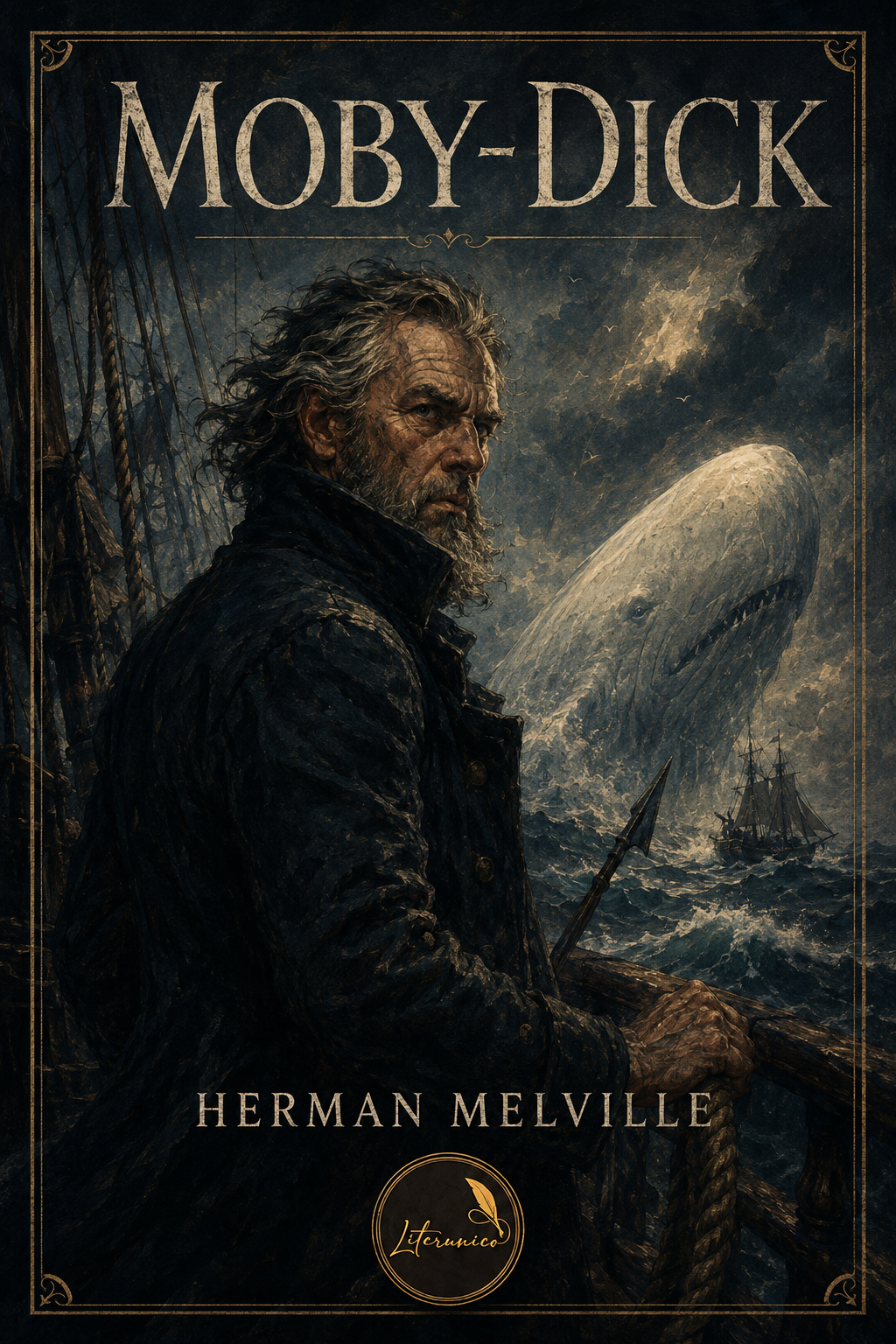
Moby-Dick; or, The Whale is an 1851 novel by American writer Herman Melville. Narrated by Ishmael, it follows Captain Ahab's obsessive pursuit of Moby Dick, the giant white sperm whale that had taken part of Ahab's leg on a previous voyage of the whaling ship Pequod. Now regarded as one of the central works of the American Renaissance and a Great American Novel, the book received mixed reviews and was a commercial failure during Melville's lifetime. Its opening line, "Call me Ishmael", is among the most famous in world literature.
Ainda não há resenhas para esta obra. A primeira leitura comentada pode começar aqui.
Escolha a arte, confira a disponibilidade e adicione o produto ao carrinho sem sair da experiência.
Adquira Relíquias da Obra e deixe sua marca registrada, criando valor ao item!

Capa frontal, contracapa, Capa Aberta e Marca-Páginas pertencem à obra e acompanham este Universes.
Escolha uma Relíquia no painel principal para enviar uma proposta ao autor.
Capítulos disponíveis para continuar a leitura.
Nenhuma Relíquia desta obra foi adquirida ainda. Seja o primeiro a eternizar seu nome no acervo oficial!
Conhecer as 100 RelíquiasAinda não há resenhas para esta obra. A primeira leitura comentada pode começar aqui.
Nenhuma posse foi registrada publicamente para esta edição.
Durante a leitura, abra Menu para ajustar a experiência sem sair do capítulo. As preferências de aparência ficam salvas neste aparelho.
Recursos identificados como “em preparo” aparecem para antecipar a evolução do leitor, mas ainda não executam uma ação.
Posso mostrar leituras em destaque, clássicos e Relíquias disponíveis agora no Literúnico.
Escolha um caminho
Dúvidas desta página
As explicações do Aurélio são respostas cadastradas pelo Literúnico.