
Universo da obra
Universo da obra
Not seldom in this life, when, on the right side, fortune’s favourites sail close by us, we, though all adroop before, catch somewhat of the rushing breeze, and joyfully feel our bagging sails fill out. So seemed it with the Pequod. For next day after encountering the gay Bachelor, whales were seen and four were slain; and one of them by Ahab.
It was far down the afternoon; and when all the spearings of the crimson fight were done: and floating in the lovely sunset sea and sky, sun and whale both stilly died together; then, such a sweetness and such plaintiveness, such inwreathing orisons curled up in that rosy air, that it almost seemed as if far over from the deep green convent valleys of the Manilla isles, the Spanish land-breeze, wantonly turned sailor, had gone to sea, freighted with these vesper hymns.
Soothed again, but only soothed to deeper gloom, Ahab, who had sterned off from the whale, sat intently watching his final wanings from the now tranquil boat. For that strange spectacle observable in all sperm whales dying—the turning sunwards of the head, and so expiring—that strange spectacle, beheld of such a placid evening, somehow to Ahab conveyed a wondrousness unknown before.
“He turns and turns him to it—how slowly, but how steadfastly, his homage-rendering and invoking brow, with his last dying motions. He too worships fire; most faithful, broad, baronial vassal of the sun!—Oh that these too-favouring eyes should see these too-favouring sights. Look! here, far water-locked; beyond all hum of human weal or woe; in these most candid and impartial seas; where to traditions no rocks furnish tablets; where for long Chinese ages, the billows have still rolled on speechless and unspoken to, as stars that shine upon the Niger’s unknown source; here, too, life dies sunwards full of faith; but see! no sooner dead, than death whirls round the corpse, and it heads some other way.
“Oh, thou dark Hindu half of nature, who of drowned bones hast builded thy separate throne somewhere in the heart of these unverdured seas; thou art an infidel, thou queen, and too truly speakest to me in the wide-slaughtering Typhoon, and the hushed burial of its after calm. Nor has this thy whale sunwards turned his dying head, and then gone round again, without a lesson to me.
“Oh, trebly hooped and welded hip of power! Oh, high aspiring, rainbowed jet!—that one strivest, this one jettest all in vain! In vain, oh whale, dost thou seek intercedings with yon all-quickening sun, that only calls forth life, but gives it not again. Yet dost thou, darker half, rock me with a prouder, if a darker faith. All thy unnamable imminglings float beneath me here; I am buoyed by breaths of once living things, exhaled as air, but water now.
“Then hail, forever hail, O sea, in whose eternal tossings the wild fowl finds his only rest. Born of earth, yet suckled by the sea; though hill and valley mothered me, ye billows are my foster-brothers!”
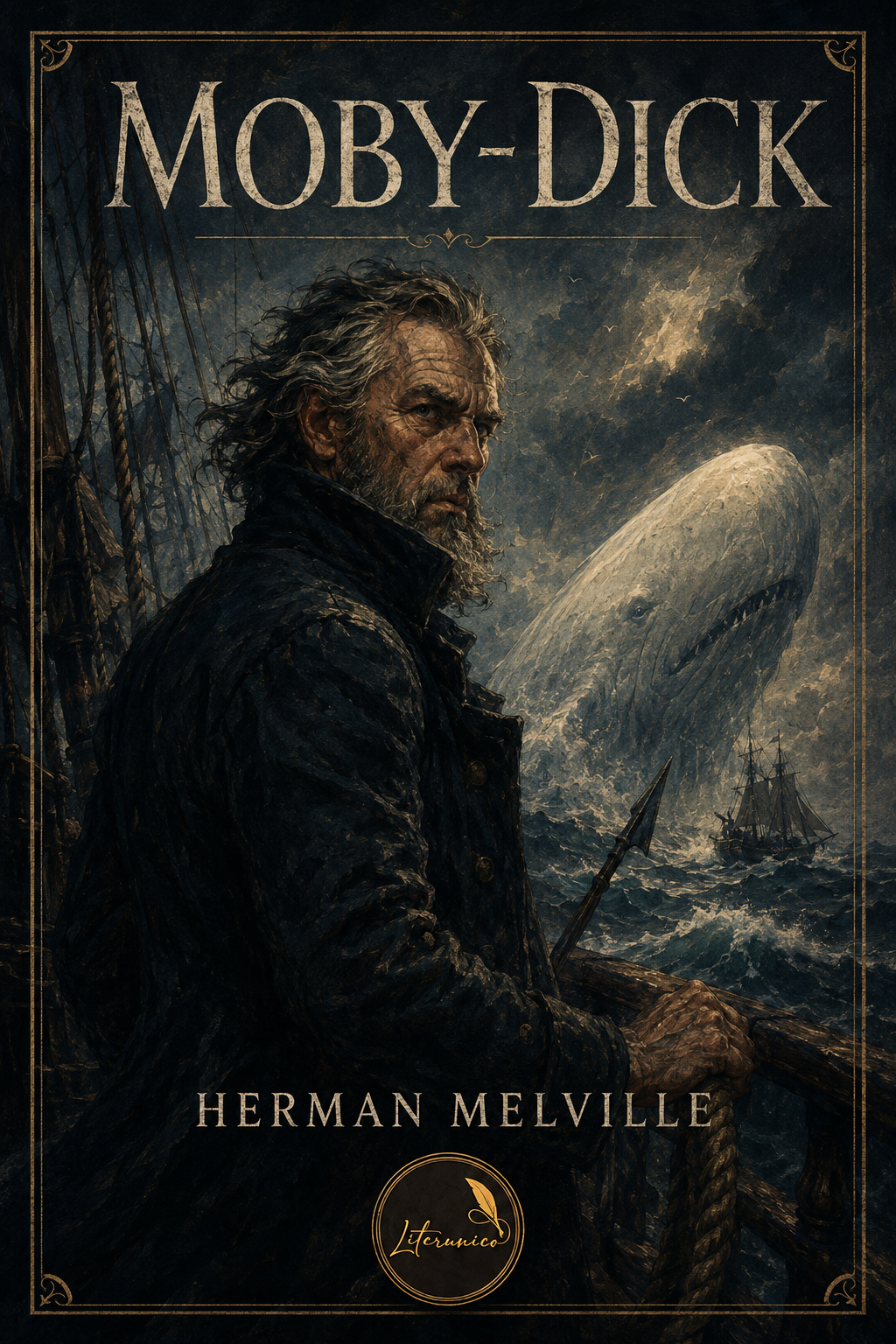
Moby-Dick; or, The Whale is an 1851 novel by American writer Herman Melville. Narrated by Ishmael, it follows Captain Ahab's obsessive pursuit of Moby Dick, the giant white sperm whale that had taken part of Ahab's leg on a previous voyage of the whaling ship Pequod. Now regarded as one of the central works of the American Renaissance and a Great American Novel, the book received mixed reviews and was a commercial failure during Melville's lifetime. Its opening line, "Call me Ishmael", is among the most famous in world literature.
Ainda não há resenhas para esta obra. A primeira leitura comentada pode começar aqui.
Escolha a arte, confira a disponibilidade e adicione o produto ao carrinho sem sair da experiência.
Adquira Relíquias da Obra e deixe sua marca registrada, criando valor ao item!

Capa frontal, contracapa, Capa Aberta e Marca-Páginas pertencem à obra e acompanham este Universes.
Escolha uma Relíquia no painel principal para enviar uma proposta ao autor.
Capítulos disponíveis para continuar a leitura.
Nenhuma Relíquia desta obra foi adquirida ainda. Seja o primeiro a eternizar seu nome no acervo oficial!
Conhecer as 100 RelíquiasAinda não há resenhas para esta obra. A primeira leitura comentada pode começar aqui.
Nenhuma posse foi registrada publicamente para esta edição.
Durante a leitura, abra Menu para ajustar a experiência sem sair do capítulo. As preferências de aparência ficam salvas neste aparelho.
Recursos identificados como “em preparo” aparecem para antecipar a evolução do leitor, mas ainda não executam uma ação.
Posso mostrar leituras em destaque, clássicos e Relíquias disponíveis agora no Literúnico.
Escolha um caminho
Dúvidas desta página
As explicações do Aurélio são respostas cadastradas pelo Literúnico.