
Universo da obra
Universo da obra
The intense Pequod sailed on; the rolling waves and days went by; the life-buoy-coffin still lightly swung; and another ship, most miserably misnamed the Delight, was descried. As she drew nigh, all eyes were fixed upon her broad beams, called shears, which, in some whaling-ships, cross the quarterdeck at the height of eight or nine feet; serving to carry the spare, unrigged, or disabled boats.
Upon the stranger’s shears were beheld the shattered, white ribs, and some few splintered planks, of what had once been a whaleboat; but you now saw through this wreck, as plainly as you see through the peeled, half-unhinged, and bleaching skeleton of a horse.
“Hast seen the White Whale?”
“Look!” replied the hollow-cheeked captain from his taffrail; and with his trumpet he pointed to the wreck.
“Hast killed him?”
“The harpoon is not yet forged that ever will do that,” answered the other, sadly glancing upon a rounded hammock on the deck, whose gathered sides some noiseless sailors were busy in sewing together.
“Not forged!” and snatching Perth’s levelled iron from the crotch, Ahab held it out, exclaiming—“Look ye, Nantucketer; here in this hand I hold his death! Tempered in blood, and tempered by lightning are these barbs; and I swear to temper them triply in that hot place behind the fin, where the White Whale most feels his accursed life!”
“Then God keep thee, old man—see’st thou that”—pointing to the hammock—“I bury but one of five stout men, who were alive only yesterday; but were dead ere night. Only that one I bury; the rest were buried before they died; you sail upon their tomb.” Then turning to his crew—“Are ye ready there? place the plank then on the rail, and lift the body; so, then—Oh! God”—advancing towards the hammock with uplifted hands—“may the resurrection and the life—”
“Brace forward! Up helm!” cried Ahab like lightning to his men.
But the suddenly started Pequod was not quick enough to escape the sound of the splash that the corpse soon made as it struck the sea; not so quick, indeed, but that some of the flying bubbles might have sprinkled her hull with their ghostly baptism.
As Ahab now glided from the dejected Delight, the strange life-buoy hanging at the Pequod’s stern came into conspicuous relief.
“Ha! yonder! look yonder, men!” cried a foreboding voice in her wake. “In vain, oh, ye strangers, ye fly our sad burial; ye but turn us your taffrail to show us your coffin!”
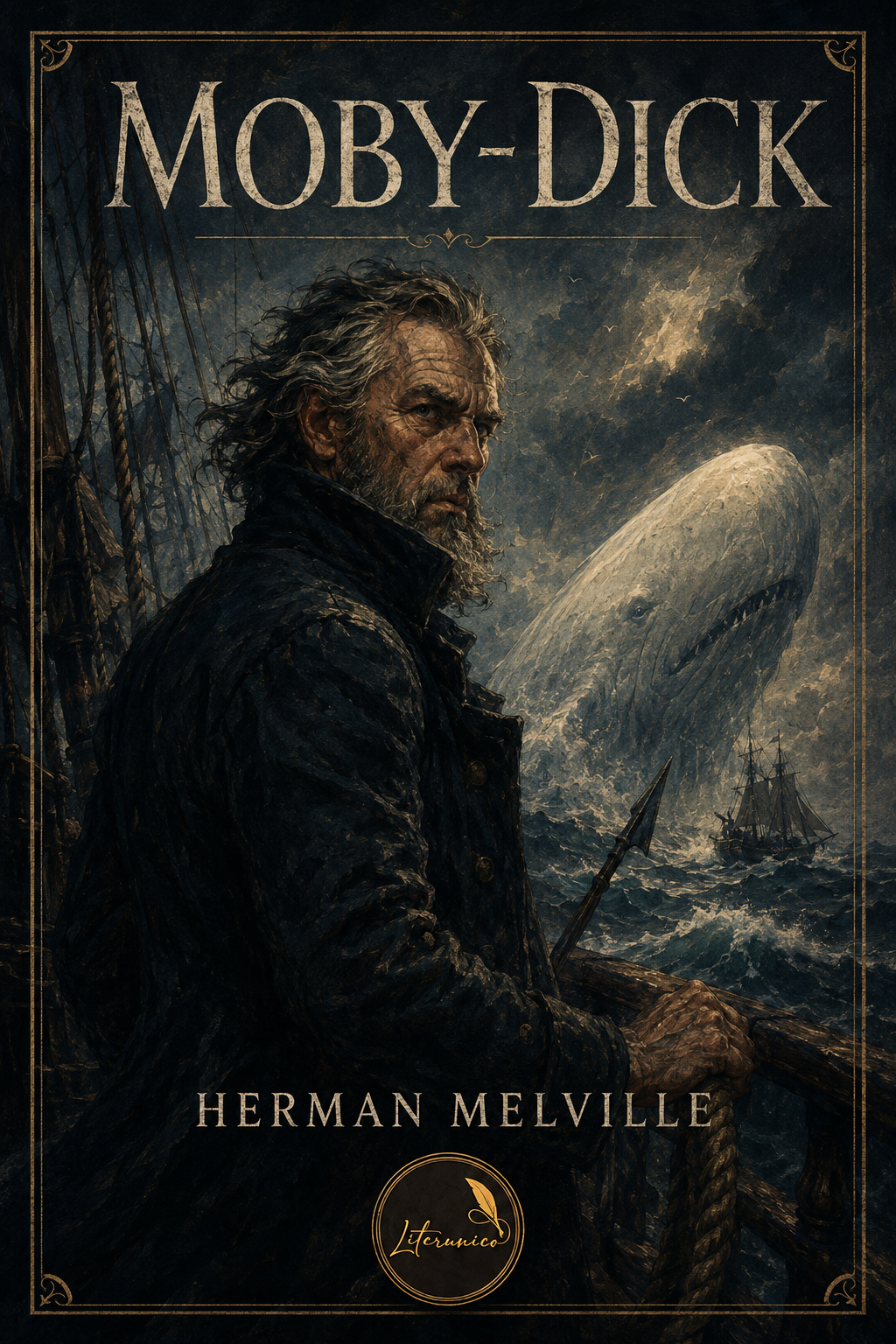
Moby-Dick; or, The Whale is an 1851 novel by American writer Herman Melville. Narrated by Ishmael, it follows Captain Ahab's obsessive pursuit of Moby Dick, the giant white sperm whale that had taken part of Ahab's leg on a previous voyage of the whaling ship Pequod. Now regarded as one of the central works of the American Renaissance and a Great American Novel, the book received mixed reviews and was a commercial failure during Melville's lifetime. Its opening line, "Call me Ishmael", is among the most famous in world literature.
Ainda não há resenhas para esta obra. A primeira leitura comentada pode começar aqui.
Escolha a arte, confira a disponibilidade e adicione o produto ao carrinho sem sair da experiência.
Adquira Relíquias da Obra e deixe sua marca registrada, criando valor ao item!

Capa frontal, contracapa, Capa Aberta e Marca-Páginas pertencem à obra e acompanham este Universes.
Escolha uma Relíquia no painel principal para enviar uma proposta ao autor.
Capítulos disponíveis para continuar a leitura.
Nenhuma Relíquia desta obra foi adquirida ainda. Seja o primeiro a eternizar seu nome no acervo oficial!
Conhecer as 100 RelíquiasAinda não há resenhas para esta obra. A primeira leitura comentada pode começar aqui.
Nenhuma posse foi registrada publicamente para esta edição.
Durante a leitura, abra Menu para ajustar a experiência sem sair do capítulo. As preferências de aparência ficam salvas neste aparelho.
Recursos identificados como “em preparo” aparecem para antecipar a evolução do leitor, mas ainda não executam uma ação.
Posso mostrar leituras em destaque, clássicos e Relíquias disponíveis agora no Literúnico.
Escolha um caminho
Dúvidas desta página
As explicações do Aurélio são respostas cadastradas pelo Literúnico.