
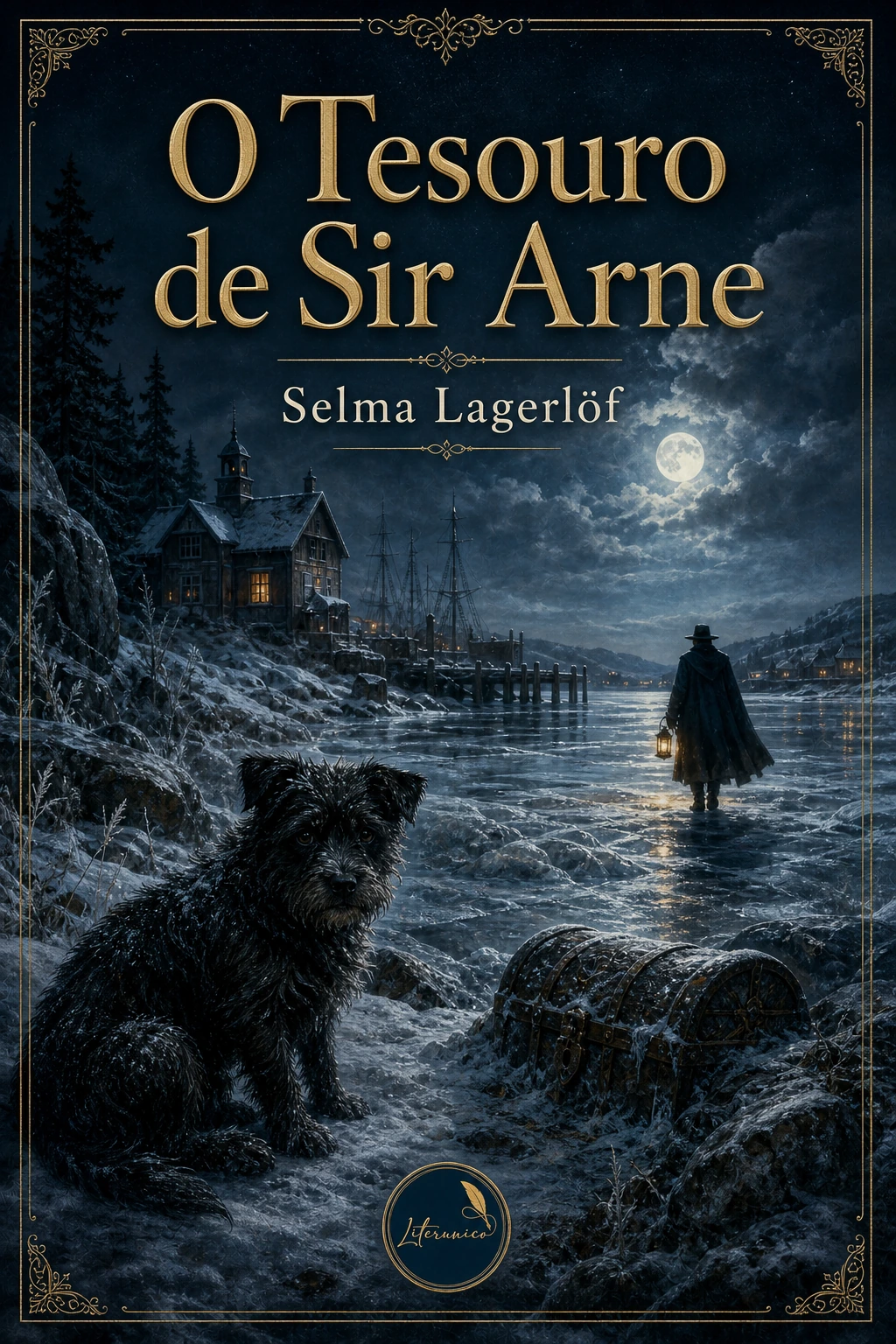
Universo da obra
Universo da obra
All night the skipper of the great gallias walked back and forth
on his lofty poop. It was dark, and the gale howled around him,
lashing him with sleet and rain. But the ice still lay firm and
fast about the vessel, so that the skipper might just as well have
slept quietly in his berth.
But he stayed up the whole night. Time after time he put his hand
to his ear and listened.
It was not easy to say what he was listening for. He had all his
crew on board, as well as all the passengers he was to carry over
to Scotland. Every one of them lay below decks fast asleep, and
there was no sound of talk to which the skipper might be
listening.
As the storm came sweeping over the icebound gallias it threw
itself upon the vessel, as though from old habit it would drive
her through the water. And as the ship still stood fast the wind
took hold of her again and again. It rattled all the little
icicles that hung from her ropes and tackles, it made her timbers
creak and groan. Her masts were strained and gave loud cracks, as
though they would go by the board.
It was no quiet night. There was a muffled rustling in the air, as
the snow came whizzing past; there was a patter and splash as the
rain came pelting down.
And in the ice one crack after another opened with a noise like
thunder, as though ships of war had been at sea exchanging heavy
salvoes.
But to none of this was the skipper listening.
He stayed up the whole night, until a gray dawn spread over the
sky; but still he did not hear the sound he was waiting for.
At last a singing, monotonous murmur was borne upon the night air,
a rocking, caressing sound as of distant music.
Then the skipper hurried across the rowers' thwarts amidships to
the lofty forecastle where his crew slept. "Turn out," he called
to them, "and take your oars and boat-hooks! The time is almost
come when we shall be free. I hear the roar of open water. I hear
the song of the free waves."
The men left sleeping and came out at once. They posted themselves
along the ship's sides, while the day slowly dawned.
When at last it was light enough for them to see what changes the
night had brought, they found that all the creeks and channels
were open far out to sea, but in the bay where they were frozen in
not a fissure could be seen in the ice, which lay firm and
unbroken.
And in the channel which led out of this bay the ice had piled
itself up into a high wall. The waves in their free play outside
continually cast up floating ice upon it.
In the sound between the skerries there was a swarm of sails. All
the fishing-boats which had lain icebound off Marstrand were now
streaming out. The sea ran high and blocks of ice still floated
among the waves, but the fishermen seemed to think they had no
time to wait for safe and calm water, and they had set sail. They
stood in the bows of their boats and kept a sharp lookout. Small
blocks of ice they fended off with an oar, but when the big ones
came they put the helm over and bore away. On the high poop of the
gallias the skipper stood and watched them. He could see that they
had their troubles, but he saw too that one boat after another
wriggled through and came out into the open sea.
And when the skipper saw the sails gliding over the blue water, he
felt his disappointment so bitterly that tears came into his eyes.
But his ship lay still, and before him the wall of ice was piling
up higher and higher.
The sea outside bore not only ships and boats, but sometimes small
white icebergs came floating past. They were big ice-floes that
had been thrown one upon another and were now sailing southward.
They shone like silver in the morning sun, and now and then they
showed as pink as though they had been strewed with roses.
But high up among the whistling of the wind loud cries were heard,
now like singing voices, now like pealing trumpets. There was a
sound of jubilation in these cries, swelling the heart of him who
heard them. They came from a long flight of swans on their way
from the south.
But when the skipper saw the icebergs moving southward and the
swans flying to the north such longing seized him that he wrung
his hands. "Woe's me, that I must lie here!" he said. "Will the
ice never break up in this bay? I may lie waiting here many days
yet."
Just as he said this, he saw a man come driving on the ice. He
came out of a narrow channel on the Marstrand side, and he drove
as calmly on the ice as if he did not know the waves had begun
once more to carry ships and boats.
As he drove under the stern of the gallias he hailed the skipper:
"Ho, you there, frozen in the ice, do you lack food aboard? Will
you buy my salt herring or dried ling or smoked eel?"
The skipper did not trouble to answer him. He only shook his fist
at him and swore.
Then the fish hawker stepped off his load. He took a bunch of hay
from the sledge and laid it in front of his horse. Then he climbed
up on the deck of the gallias. When he faced the skipper he said
to him very earnestly:
"Today I have not come to sell fish. But I know that you are a
God-fearing man. Therefore I have come to ask your help to find a
maiden whom the Scotsmen brought out to your ship with them
yester-night."
"I know naught of their bringing any maiden with them," said the
skipper. "I have heard no woman's voice aboard the ship tonight."
"I am Torarin the fish hawker," said the other; "maybe you have
heard of me? It was I who supped with Herr Arne at Solberga
parsonage the same night he was murdered. Since then I have had
Herr Arne's foster daughter under my roof, but last night she was
stolen away by his murderers, and they have surely brought her
with them to your vessel."
"Are Herr Arne's murderers aboard my vessel?" asked the skipper in
dismay.
"You see that I am a poor and feeble man," said Torarin. "I have a
palsied arm, and therefore I am fearful of taking upon myself any
bold and hazardous thing. I have known these many days who were
Herr Arne's murderers, but I have not dared to bring them to
justice. And because I have held my peace they have made their
escape and have found occasion to carry the maiden with them. But
now I have said to myself that I will have no more of my
conscience in this matter. At least I will try to save the little
maid."
"If Herr Arne's murderers are on board my ship, why does not the
watch come out and arrest them?"
"I have begged and prayed them all this night and morning," said
Torarin, "but the watch durst not come out. They say there are a
hundred men-at-arms on board, and with them they durst not
contend. Then I thought, in God's name I must come out here alone
and beg you help me to find the maiden, for I know you to be a
God-fearing man."
But the skipper paid no heed to his question of the maiden; his
mind was full of the other matter. "What makes you sure that the
murderers are on board?" he said.
Torarin pointed to a great oaken chest which stood between the
rowers' thwarts. "I have seen that chest too often in Herr Arne's
house to be mistaken," he said. "In it is Herr Arne's money, and
where his money is, there you will find his murderers."
"That chest belongs to Sir Archie and his two friends, Sir
Reginald and Sir Philip," said the skipper.
"Ay," said Torarin, looking at him fixedly; "that is so. It
belongs to Sir Archie and Sir Philip and Sir Reginald."
The skipper stood silent awhile and looked this way and that.
"When think you the ice will break up in this bay?" he said to
Torarin.
"There is something strange in it this year," said Torarin. "In
this bay we have always seen the ice break up early, for there is
a strong current. But as it shapes now you must have a care that
you be not thrust against the land when the ice begins to move."
"I think of naught else," said the skipper.
Again he stood silent for a while and turned his face toward the
sea. The morning sun shone high in the sky, and the waves
reflected its radiance. The liberated vessels scudded this way and
that, and the sea birds came flying from the south with joyous
cries. The fish lay near the surface and glittered in the sun as
they leapt high out of the water, wanton after their long
imprisonment under the ice. The gulls, which had been circling out
beyond the edge of the ice, came in great flocks toward land to
fish in their old waters.
The skipper could not endure this sight. "Shall I be counted the
friend of murderers and evildoers?" he said. "Can I close my eyes
and refuse to see why God keeps the gates of the sea barred
against my vessel? Shall I be destroyed for the sake of the
unrighteous who have taken refuge with me?"
And the skipper went forward and said to his men: "Now I know why
we have been held back while all other ships have put to sea. It
is because we have murderers and evildoers on board."
Then the skipper went to the Scottish men-at-arms, who still lay
asleep in the ship's hold. "Listen," he said to them; "keep you
quiet yet awhile, no matter what cries or tumult you may hear on
board. We must follow God's commandment and not suffer evildoers
amongst us. If you obey me I promise to bring you the chest which
holds Herr Arne's money, and you shall share it among you."
But to Torarin the skipper said: "Go down to your sledge and cast
your fish out on the ice. You shall have other freight anon."
Then the skipper and his men broke into the cabin where Sir Archie
and his friends slept. And they threw themselves upon them to bind
them while they still lay asleep.
And when the three Scotsmen tried to defend themselves, they smote
them hard with their axes and handspikes, and the skipper said to
them: "You are murderers and evildoers. How could you think to
escape punishment? Know you not that it is for your sake God keeps
all the gates of the sea closed?"
Then the three men cried aloud to their comrades, bidding them
come and help them.
"You need not call to them," said the skipper. "They will not
come. They have gotten Herr Arne's hoard to share amongst them,
and are even now measuring out silver coin in their hats. For the
sake of this money the evil deed was done, and this money has now
brought retribution upon you."
And before Torarin had finished unloading the fish from his
sledge, the skipper and his men came down on to the ice. They
brought with them three men securely bound. They were grievously
hurt and fainting from their wounds.
"God has not called on me in vain," said the skipper. "As soon as
His will was clear to me, I hearkened to it."
They laid the prisoners on the sledge, and Torarin drove with them
by creeks and narrow sounds where the ice still lay firm, until he
came to Marstrand.
Now late in the afternoon the skipper stood on the lofty poop of
his vessel and looked out to seaward. Nothing was changed around
the vessel, and the wall of ice towered ever higher before her.
Then the skipper saw a long procession of people coming out to his
ship. All the women of Marstrand were there, both young and old.
They all wore mourning weeds, and they brought with them a group
of boys who carried a bier.
When they were come to the gallias, they said to the skipper: "We
are come to fetch a young maiden who is dead. Those murderers have
confessed that she gave her life to hinder their escape, and now
we, all the women of Marstrand, are come to bring her to our town
with all the honour that is her due."
Then Elsalill was found and brought down to the ice and borne in
to Marstrand; and all the women in the place wept over the young
maid, who had loved an evildoer and given her life to destroy him
she loved. But even as the line of women advanced, the wind and
waves broke in behind them and tore up the ice over which they had
but lately passed; and when they came to Marstrand with Elsalill,
all the gates of the sea stood open.
THE END
FOREWORD
The Treasure is an opposite fairy tale, presenting Prince Charming
as he really is: an orphan girl is cleaning fish and foreseeing
her life of poverty; a man well-dressed in seductive splendor woos
her and offers her ... forever after. There is only one catch: she
must betray her sister.
Although Selma Lagerlof won the Nobel Prize for literature in
1909, her name is known in this country--if at all--as author of a
children's book only. All her other works, including novels and
feminist essays, have been unavailable in English for almost fifty
years.
In 1911, she made a speech entitled "Home and State" to the
International Woman Suffrage Alliance Congress. She argued, first,
that the Home was the creation of woman and the place where the
values of women were nourished and protected. The Home was a
community where "punishment is not for the sake of revenge, but
for training and education," where "there is a use for all
talents, but [she] who is without can make [her] self as much
loved as the cleverest." It was the "storehouse for the songs and
legends of our fore-fathers," and, she said, "there is nothing
more mobile, more merciful amongst the creations of [humankind]."
Although not all homes are good, good and happy homes do sometimes
exist. Men by themselves, on the other hand, were responsible for
creating the State which "continually gives cause for discontent
and bitterness." There has never been a State which could satisfy
all its members, which did not ask to be reformed from its very
foundations. Yet it is through the State that humankind will reach
its highest hopes. Her conclusion: women must add their special
virtues, what she calls "God's spirit," to the "law and order"
goals of men.
Selma Lagerlof's own home was a community of family and servants,
within which she experienced profound affections--for the
nursemaid who carried her as a crippled child upon her back, for
the old housekeeper, her younger sister, her grandmother who told
the children stories every afternoon. She never married; she spent
her entire life within communities of women, and her career could
be described as the author being handed up to greatness by a
procession of women who gave encouragement, advice, editorial
help, criticism, contacts, companionship. She called Frederika
Bremer the first feminist and "last old Mamsell" of Sweden,
meaning that Frederika Bremer's life's work had banished the "old
maid" from the realm of pitiful figures. Selma Lagerlof was
herself proof of her statement.
In The Treasure, written midway between her farewell to Frederika
Bremer and her plea for woman suffrage, the men are interested in
money, murder, and revenge. They miss the evil apparent even to
their dogs. When the old mistress (and who should know better that
the home is threatened?) warns that knives are being sharpened two
miles away, her lord refuses to believe that she could hear what
he cannot. The fishpeddler's dog has instinct enough to balk and
howl, sensing death; the fishpeddler's wife and the woman
tavern-keeper respond to the supernatural however little they
understand; the men turn their backs on understanding even when
they are being implored.
But the thrust of the story deals with the maiden Elsalill's
painful struggle to choose between her dearest sister, who has had
to wander so long on earth "she has worn her feet to bleeding" and
can find grave's rest only if her murderer is apprehended; and Sir
Archie, the murderer himself, whom Elsalill loves with all her
heart.
Sir Archie is a subtle Prince Charming; he understands innocence
and tempts Elsalill mightily: "You are a poor orphan, so forlorn
and friendless that none will care what becomes of you. But if you
come with me, I will make you a noble lady. I am a powerful man in
my own country. You shall be clad in silk and gold, and you shall
tread a measure at the King's court."
Even after Elsalill knows that her love is the murderer of her
sister, she still hopes to escape the action this knowledge
demands: she tries to persuade herself that because he wants to
make up to Elsalill for the evil he did to her sister, she should
give him a chance to save his soul. She thinks that her sister
does not know he will atone for his sin and become a good man; her
sister could not wish her unhappiness; how can she ask that
Elsalill betray the man she loves?
But she hears her sister weep and she sees her sister's blood on
the snow, and she turns him in quickly, hoping that will be
enough. It isn't. Her choice requires that she give her life.
At the book's end Sir Archie, still clinging to his belief in
money-power, still trying to use her saintliness to save his own
soul, says he will erect a grand monument to her memory. He
believes that if he leaves her body in Marstand she will have only
a pauper's grave and be soon forgotten. An exactly opposite event
occurs. A long procession walks out across the ice toward the
ship; all the women of Marstand, young and old, are coming to
retrieve Elsalill's body and carry her back "with all the honor
that is her due."
The Treasure is a fable, a fairytale, an allegory of sisterhood
itself. There is good reason that this book has been out of print
for two generations. Daughters, Inc. is proud to retrieve Selma
Lagerlof and publish her in English once again--with all the honor
that is her due.
June Arnold Plainfield, Vermont 1973
Public-domain English source edition of The Treasure by Selma Lagerlöf, organized for Aurora as the linked source of the Literunico Portuguese version.
Ainda não há resenhas para esta obra. A primeira leitura comentada pode começar aqui.
Escolha a arte, confira a disponibilidade e adicione o produto ao carrinho sem sair da experiência.
Adquira Relíquias da Obra e deixe sua marca registrada, criando valor ao item!

Capa frontal, contracapa, Capa Aberta e Marca-Páginas pertencem à obra e acompanham este Universes.
Escolha uma Relíquia no painel principal para enviar uma proposta ao autor.
Capítulos disponíveis para continuar a leitura.
Nenhuma Relíquia desta obra foi adquirida ainda. Seja o primeiro a eternizar seu nome no acervo oficial!
Conhecer as 100 RelíquiasAinda não há resenhas para esta obra. A primeira leitura comentada pode começar aqui.
Nenhuma posse foi registrada publicamente para esta edição.
Durante a leitura, abra Menu para ajustar a experiência sem sair do capítulo. As preferências de aparência ficam salvas neste aparelho.
Recursos identificados como “em preparo” aparecem para antecipar a evolução do leitor, mas ainda não executam uma ação.
Posso mostrar leituras em destaque, clássicos e Relíquias disponíveis agora no Literúnico.
Escolha um caminho
Dúvidas desta página
As explicações do Aurélio são respostas cadastradas pelo Literúnico.