
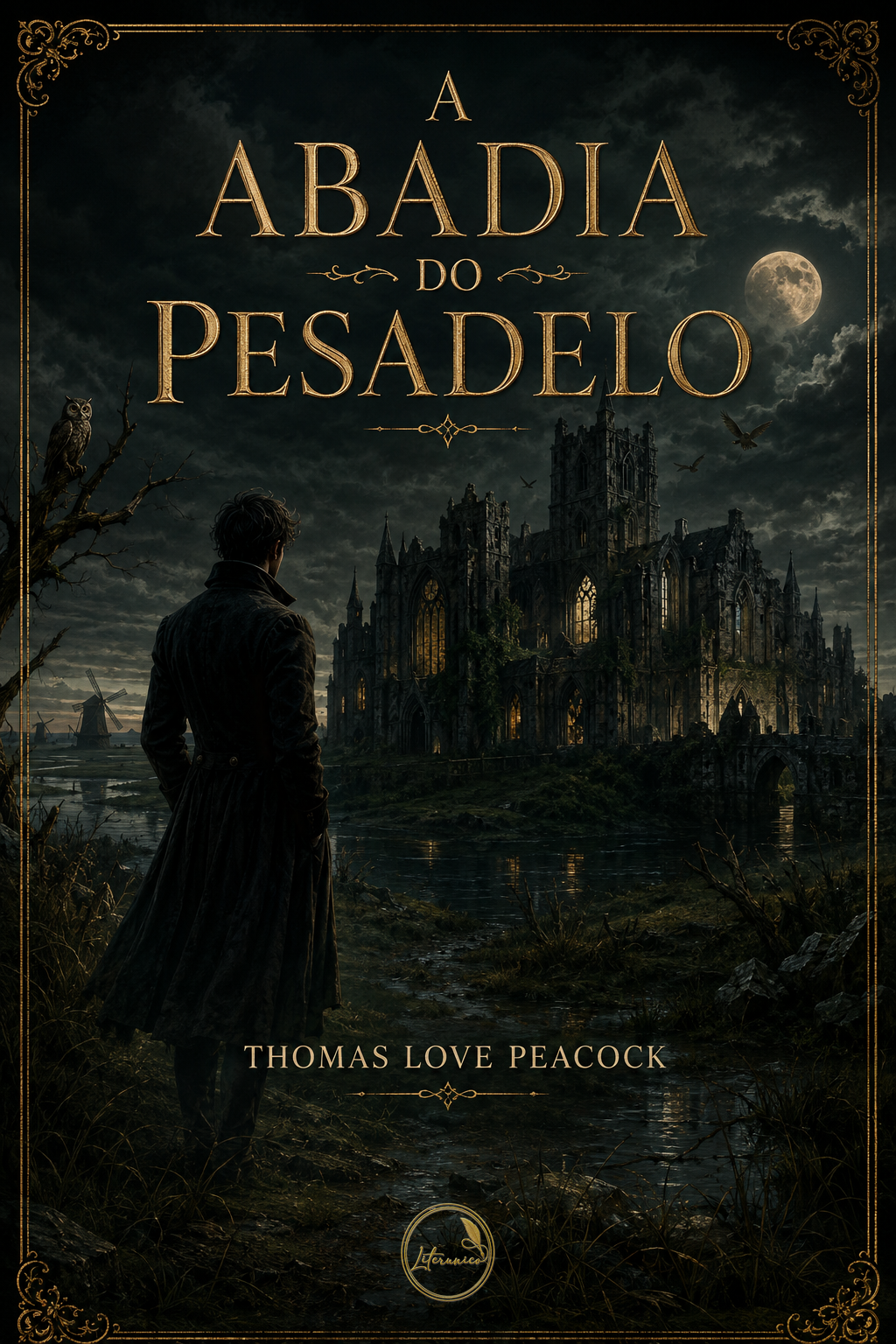
Leia agora
Capítulo 1 · Nightmare Abbey

Chapter I

Chapter I Nightmare Abbey, a venerable family-mansion, in a highly picturesque

state of semi-dilapidation, pleasantly situated on a strip of dry land

between the sea and the fens, at the verge of the county of Lincoln,

had the honour to be the seat of Christopher Glowry, Esquire. This

gentleman was naturally of an atrabilarious temperament, and much

troubled with those phantoms of indigestion which are commonly called

blue devils. He had been deceived in an early friendship: he had

been crossed in love; and had offered his hand, from pique, to a lady,

who accepted it from interest, and who, in so doing, violently tore

asunder the bonds of a tried and youthful attachment. Her vanity was

gratified by being the mistress of a very extensive, if not very

lively, establishment; but all the springs of her sympathies were

frozen. Riches she possessed, but that which enriches them, the

participation of affection, was wanting. All that they could purchase

for her became indifferent to her, because that which they could not

purchase, and which was more valuable than themselves, she had, for

their sake, thrown away. She discovered, when it was too late, that

she had mistaken the means for the end--that riches, rightly used, are

instruments of happiness, but are not in themselves happiness. In this

wilful blight of her affections, she found them valueless as means:

they had been the end to which she had immolated all her affections,

and were now the only end that remained to her. She did not confess

this to herself as a principle of action, but it operated through the

medium of unconscious self-deception, and terminated in inveterate

avarice. She laid on external things the blame of her mind's internal

disorder, and thus became by degrees an accomplished scold. She often

went her daily rounds through a series of deserted apartments, every

creature in the house vanishing at the creak of her shoe, much more

at the sound of her voice, to which the nature of things affords no

simile; for, as far as the voice of woman, when attuned by gentleness

and love, transcends all other sounds in harmony, so far does

it surpass all others in discord, when stretched into unnatural

shrillness by anger and impatience.

Mr Glowry used to say that his house was no better than a spacious

kennel, for every one in it led the life of a dog. Disappointed both

in love and in friendship, and looking upon human learning as vanity,

he had come to a conclusion that there was but one good thing in the

world, videlicet, a good dinner; and this his parsimonious lady

seldom suffered him to enjoy: but, one morning, like Sir Leoline in

Christabel, 'he woke and found his lady dead,' and remained a very

consolate widower, with one small child.

This only son and heir Mr Glowry had christened Scythrop, from the

name of a maternal ancestor, who had hanged himself one rainy day in a

fit of toedium vitae, and had been eulogised by a coroner's jury in

the comprehensive phrase of felo de se; on which account, Mr Glowry

held his memory in high honour, and made a punchbowl of his skull.

When Scythrop grew up, he was sent, as usual, to a public school,

where a little learning was painfully beaten into him, and from thence

to the university, where it was carefully taken out of him; and he was

sent home like a well-threshed ear of corn, with nothing in his head:

having finished his education to the high satisfaction of the

master and fellows of his college, who had, in testimony of their

approbation, presented him with a silver fish-slice, on which his name

figured at the head of a laudatory inscription in some semi-barbarous

dialect of Anglo-Saxonised Latin.

His fellow-students, however, who drove tandem and random in great

perfection, and were connoisseurs in good inns, had taught him to

drink deep ere he departed. He had passed much of his time with these

choice spirits, and had seen the rays of the midnight lamp tremble

on many a lengthening file of empty bottles. He passed his vacations

sometimes at Nightmare Abbey, sometimes in London, at the house of

his uncle, Mr Hilary, a very cheerful and elastic gentleman, who had

married the sister of the melancholy Mr Glowry. The company that

frequented his house was the gayest of the gay. Scythrop danced with

the ladies and drank with the gentlemen, and was pronounced by both a

very accomplished charming fellow, and an honour to the university.

At the house of Mr Hilary, Scythrop first saw the beautiful Miss Emily

Girouette. He fell in love; which is nothing new. He was favourably

received; which is nothing strange. Mr Glowry and Mr Girouette had

a meeting on the occasion, and quarrelled about the terms of the

bargain; which is neither new nor strange. The lovers were torn

asunder, weeping and vowing everlasting constancy; and, in three weeks

after this tragical event, the lady was led a smiling bride to the

altar, by the Honourable Mr Lackwit; which is neither strange nor new.

Scythrop received this intelligence at Nightmare Abbey, and was half

distracted on the occasion. It was his first disappointment, and

preyed deeply on his sensitive spirit. His father, to comfort him,

read him a Commentary on Ecclesiastes, which he had himself composed,

and which demonstrated incontrovertibly that all is vanity. He

insisted particularly on the text, 'One man among a thousand have I

found, but a woman amongst all those have I not found.'

'How could he expect it,' said Scythrop, 'when the whole thousand were

locked up in his seraglio? His experience is no precedent for a free

state of society like that in which we live.'

'Locked up or at large,' said Mr Glowry, 'the result is the same:

their minds are always locked up, and vanity and interest keep the

key. I speak feelingly, Scythrop.'

'I am sorry for it, sir,' said Scythrop. 'But how is it that their

minds are locked up? The fault is in their artificial education, which

studiously models them into mere musical dolls, to be set out for sale

in the great toy-shop of society.'

'To be sure,' said Mr Glowry, 'their education is not so well finished

as yours has been; and your idea of a musical doll is good. I bought

one myself, but it was confoundedly out of tune; but, whatever be the

cause, Scythrop, the effect is certainly this, that one is pretty

nearly as good as another, as far as any judgment can be formed of

them before marriage. It is only after marriage that they show

their true qualities, as I know by bitter experience. Marriage is,

therefore, a lottery, and the less choice and selection a man bestows

on his ticket the better; for, if he has incurred considerable pains

and expense to obtain a lucky number, and his lucky number proves a

blank, he experiences not a simple, but a complicated disappointment;

the loss of labour and money being superadded to the disappointment of

drawing a blank, which, constituting simply and entirely the grievance

of him who has chosen his ticket at random, is, from its simplicity,

the more endurable.' This very excellent reasoning was thrown away

upon Scythrop, who retired to his tower as dismal and disconsolate as

before.

The tower which Scythrop inhabited stood at the south-eastern angle of

the Abbey; and, on the southern side, the foot of the tower opened on

a terrace, which was called the garden, though nothing grew on it but

ivy, and a few amphibious weeds. The south-western tower, which was

ruinous and full of owls, might, with equal propriety, have been

called the aviary. This terrace or garden, or terrace-garden, or

garden-terrace (the reader may name it ad libitum), took in an

oblique view of the open sea, and fronted a long tract of level

sea-coast, and a fine monotony of fens and windmills.

The reader will judge, from what we have said, that this building was

a sort of castellated abbey; and it will, probably, occur to him to

inquire if it had been one of the strong-holds of the ancient church

militant. Whether this was the case, or how far it had been indebted

to the taste of Mr Glowry's ancestors for any transmutations from its

original state, are, unfortunately, circumstances not within the pale

of our knowledge.

The north-western tower contained the apartments of Mr Glowry. The

moat at its base, and the fens beyond, comprised the whole of his

prospect. This moat surrounded the Abbey, and was in immediate contact

with the walls on every side but the south.

The north-eastern tower was appropriated to the domestics, whom Mr

Glowry always chose by one of two criterions,--a long face, or a

dismal name. His butler was Raven; his steward was Crow; his valet was

Skellet. Mr Glowry maintained that the valet was of French extraction,

and that his name was Squelette. His grooms were Mattocks and Graves.

On one occasion, being in want of a footman, he received a letter

from a person signing himself Diggory Deathshead, and lost no time in

securing this acquisition; but on Diggory's arrival, Mr Glowry was

horror-struck by the sight of a round ruddy face, and a pair of

laughing eyes. Deathshead was always grinning,--not a ghastly smile,

but the grin of a comic mask; and disturbed the echoes of the hall

with so much unhallowed laughter, that Mr Glowry gave him his

discharge. Diggory, however, had staid long enough to make conquests

of all the old gentleman's maids, and left him a flourishing colony of

young Deathsheads to join chorus with the owls, that had before been

the exclusive choristers of Nightmare Abbey.

The main body of the building was divided into rooms of state,

spacious apartments for feasting, and numerous bed-rooms for visitors,

who, however, were few and far between.

Family interests compelled Mr Glowry to receive occasional visits from

Mr and Mrs Hilary, who paid them from the same motive; and, as the

lively gentleman on these occasions found few conductors for his

exuberant gaiety, he became like a double-charged electric jar, which

often exploded in some burst of outrageous merriment to the signal

discomposure of Mr Glowry's nerves.

Another occasional visitor, much more to Mr Glowry's taste, was Mr

Flosky,[1] a very lachrymose and morbid gentleman, of some note in

the literary world, but in his own estimation of much more merit than

name. The part of his character which recommended him to Mr Glowry

was his very fine sense of the grim and the tearful. No one could

relate a dismal story with so many minutiae of supererogatory

wretchedness. No one could call up a raw-head and bloody-bones with

so many adjuncts and circumstances of ghastliness. Mystery was his

mental element. He lived in the midst of that visionary world in which

nothing is but what is not. He dreamed with his eyes open, and saw

ghosts dancing round him at noontide. He had been in his youth

an enthusiast for liberty, and had hailed the dawn of the French

Revolution as the promise of a day that was to banish war and slavery,

and every form of vice and misery, from the face of the earth. Because

all this was not done, he deduced that nothing was done; and from this

deduction, according to his system of logic, he drew a conclusion

that worse than nothing was done; that the overthrow of the feudal

fortresses of tyranny and superstition was the greatest calamity that

had ever befallen mankind; and that their only hope now was to rake

the rubbish together, and rebuild it without any of those loopholes

by which the light had originally crept in. To qualify himself for a

coadjutor in this laudable task, he plunged into the central

opacity of Kantian metaphysics, and lay perdu several years in

transcendental darkness, till the common daylight of common sense

became intolerable to his eyes. He called the sun an ignis fatuus;

and exhorted all who would listen to his friendly voice, which were

about as many as called 'God save King Richard,' to shelter themselves

from its delusive radiance in the obscure haunt of Old Philosophy.

This word Old had great charms for him. The good old times were always

on his lips; meaning the days when polemic theology was in its prime,

and rival prelates beat the drum ecclesiastic with Herculean vigour,

till the one wound up his series of syllogisms with the very orthodox

conclusion of roasting the other.

But the dearest friend of Mr Glowry, and his most welcome guest,

was Mr Toobad, the Manichaean Millenarian. The twelfth verse of the

twelfth chapter of Revelations was always in his mouth: 'Woe to the

inhabiters of the earth and of the sea! for the devil is come among

you, having great wrath, because he knoweth that he hath but a short

time.' He maintained that the supreme dominion of the world was, for

wise purposes, given over for a while to the Evil Principle; and that

this precise period of time, commonly called the enlightened age, was

the point of his plenitude of power. He used to add that by and by he

would be cast down, and a high and happy order of things succeed; but

he never omitted the saving clause, 'Not in our time'; which last

words were always echoed in doleful response by the sympathetic Mr

Glowry.

Another and very frequent visitor, was the Reverend Mr Larynx, the

vicar of Claydyke, a village about ten miles distant;--a good-natured

accommodating divine, who was always most obligingly ready to take a

dinner and a bed at the house of any country gentleman in distress

for a companion. Nothing came amiss to him,--a game at billiards, at

chess, at draughts, at backgammon, at piquet, or at all-fours in

a tete-a-tete,--or any game on the cards, round, square, or

triangular, in a party of any number exceeding two. He would even

dance among friends, rather than that a lady, even if she were on the

wrong side of thirty, should sit still for want of a partner. For a

ride, a walk, or a sail, in the morning,--a song after dinner, a ghost

story after supper,--a bottle of port with the squire, or a cup of

green tea with his lady,--for all or any of these, or for any thing

else that was agreeable to any one else, consistently with the dye of

his coat, the Reverend Mr Larynx was at all times equally ready. When

at Nightmare Abbey, he would condole with Mr Glowry,--drink Madeira

with Scythrop,--crack jokes with Mr Hilary,--hand Mrs Hilary to the

piano, take charge of her fan and gloves, and turn over her music with

surprising dexterity,--quote Revelations with Mr Toobad,--and lament

the good old times of feudal darkness with the transcendental Mr

Flosky.

* * * * *

* * *

Nightmare Abbey

Sinopse

Original English text of Nightmare Abbey, Thomas Love Peacock’s gothic and philosophical satire, published as the source edition linked to the Brazilian Portuguese translation on Aurora Literunico.

Nightmare Abbey

Resenhas do livro

0 publicadas

Ainda não há resenhas para esta obra. A primeira leitura comentada pode começar aqui.

Nightmare Abbey

Trilha sonora oficial

Uma seleção criada para acompanhar a atmosfera, os personagens e os caminhos desta obra.

Abrir no Spotify
Ir para o carrinho
Mercado de Nightmare Abbey

Leve um fragmento deste universo

Escolha a arte, confira a disponibilidade e adicione o produto ao carrinho sem sair da experiência.

Nenhum livro físico está disponível neste universo.
Relíquias de Nightmare Abbey

Adquira Relíquias do Livro como colaboração ao autor e deixe sua marca registrada, criando valor ao item!

Central de RelíquiasDescubra coleções de outros universos e obras.
ver todas
Sinopse do universo · 1 livro conectado 1/1
Abrir leitor completo

Resenhas do livro

0 publicadas

Ainda não há resenhas para esta obra. A primeira leitura comentada pode começar aqui.

Entrar para resenhar

Livro Vivo e Sebo

Cada exemplar registrado recebe identidade própria. Sua passagem por leitores, memórias e futuras vendas pode continuar nesta mesma página.

0 Leitores com posse
0 Unidades registradas
0 À venda no Sebo

Nenhuma posse foi registrada publicamente para esta edição.

Adicionais do Universo

Visual ClássicoAbra a leitura editorial, no estilo de uma página de livro
ler
Visual AuroraApresentação imersiva do universo da obra
abrir