
Universo da obra
Universo da obra
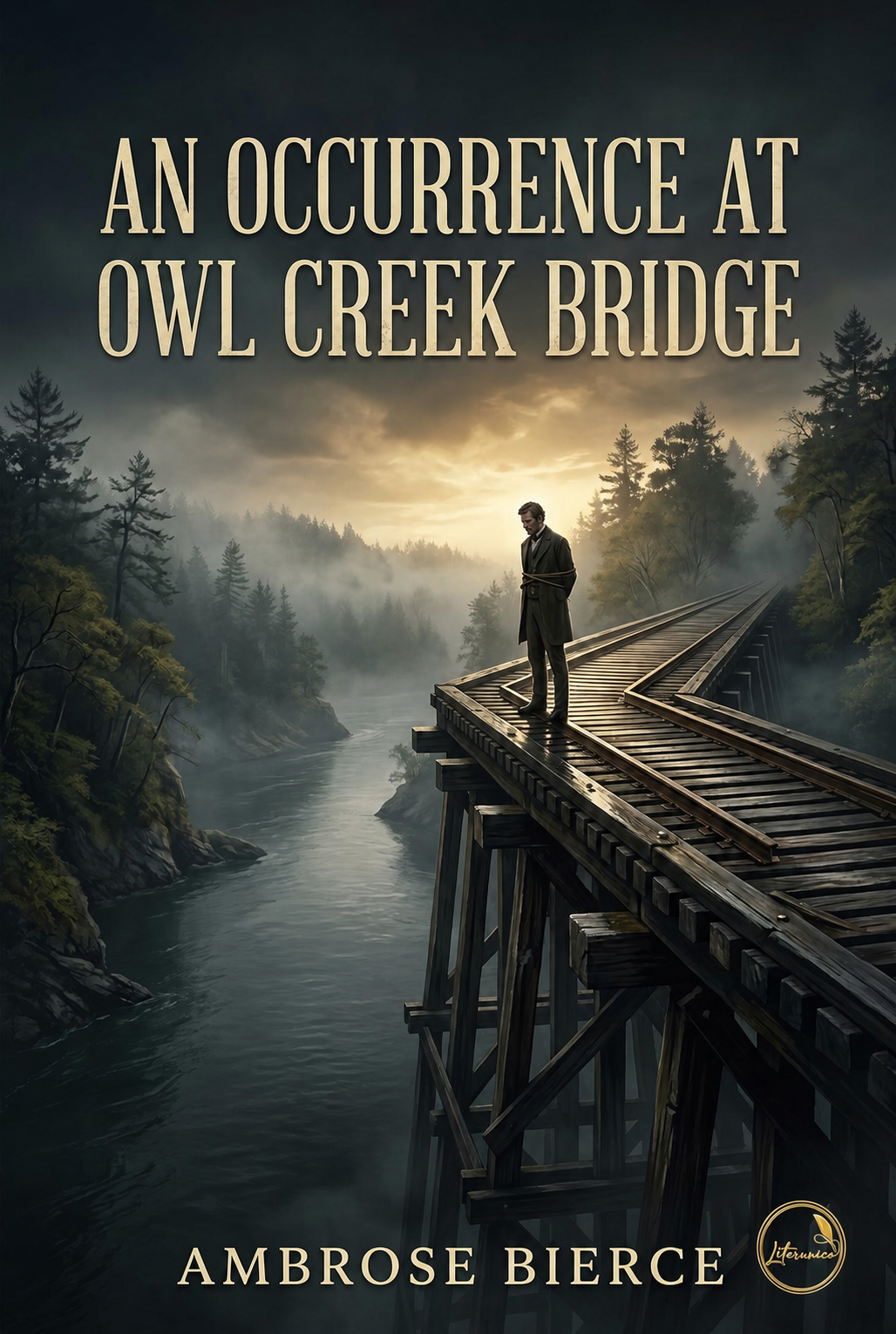
A man stood upon a railroad bridge in northern Alabama, looking down
into the swift water twenty feet below. The man’s hands were behind his
back, the wrists bound with a cord. A rope closely encircled his neck.
It was attached to a stout cross-timber above his head and the slack
fell to the level of his knees. Some loose boards laid upon the ties
supporting the rails of the railway supplied a footing for him and his
executioners—two private soldiers of the Federal army, directed by a
sergeant who in civil life may have been a deputy sheriff. At a short
remove upon the same temporary platform was an officer in the uniform
of his rank, armed. He was a captain. A sentinel at each end of the
bridge stood with his rifle in the position known as “support,” that is
to say, vertical in front of the left shoulder, the hammer resting on
the forearm thrown straight across the chest—a formal and unnatural
position, enforcing an erect carriage of the body. It did not appear to
be the duty of these two men to know what was occurring at the center
of the bridge; they merely blockaded the two ends of the foot planking
that traversed it.
Beyond one of the sentinels nobody was in sight; the railroad ran
straight away into a forest for a hundred yards, then, curving, was
lost to view. Doubtless there was an outpost farther along. The other
bank of the stream was open ground—a gentle slope topped with a
stockade of vertical tree trunks, loopholed for rifles, with a single
embrasure through which protruded the muzzle of a brass cannon
commanding the bridge. Midway up the slope between the bridge and fort
were the spectators—a single company of infantry in line, at “parade
rest,” the butts of their rifles on the ground, the barrels inclining
slightly backward against the right shoulder, the hands crossed upon
the stock. A lieutenant stood at the right of the line, the point of
his sword upon the ground, his left hand resting upon his right.
Excepting the group of four at the center of the bridge, not a man
moved. The company faced the bridge, staring stonily, motionless. The
sentinels, facing the banks of the stream, might have been statues to
adorn the bridge. The captain stood with folded arms, silent, observing
the work of his subordinates, but making no sign. Death is a dignitary
who when he comes announced is to be received with formal
manifestations of respect, even by those most familiar with him. In the
code of military etiquette silence and fixity are forms of deference.
The man who was engaged in being hanged was apparently about
thirty-five years of age. He was a civilian, if one might judge from
his habit, which was that of a planter. His features were good—a
straight nose, firm mouth, broad forehead, from which his long, dark
hair was combed straight back, falling behind his ears to the collar of
his well fitting frock coat. He wore a moustache and pointed beard, but
no whiskers; his eyes were large and dark gray, and had a kindly
expression which one would hardly have expected in one whose neck was
in the hemp. Evidently this was no vulgar assassin. The liberal
military code makes provision for hanging many kinds of persons, and
gentlemen are not excluded.
The preparations being complete, the two private soldiers stepped aside
and each drew away the plank upon which he had been standing. The
sergeant turned to the captain, saluted and placed himself immediately
behind that officer, who in turn moved apart one pace. These movements
left the condemned man and the sergeant standing on the two ends of the
same plank, which spanned three of the cross-ties of the bridge. The
end upon which the civilian stood almost, but not quite, reached a
fourth. This plank had been held in place by the weight of the captain;
it was now held by that of the sergeant. At a signal from the former
the latter would step aside, the plank would tilt and the condemned man
go down between two ties. The arrangement commended itself to his
judgement as simple and effective. His face had not been covered nor
his eyes bandaged. He looked a moment at his “unsteadfast footing,”
then let his gaze wander to the swirling water of the stream racing
madly beneath his feet. A piece of dancing driftwood caught his
attention and his eyes followed it down the current. How slowly it
appeared to move! What a sluggish stream!
He closed his eyes in order to fix his last thoughts upon his wife and
children. The water, touched to gold by the early sun, the brooding
mists under the banks at some distance down the stream, the fort, the
soldiers, the piece of drift—all had distracted him. And now he became
conscious of a new disturbance. Striking through the thought of his
dear ones was sound which he could neither ignore nor understand, a
sharp, distinct, metallic percussion like the stroke of a blacksmith’s
hammer upon the anvil; it had the same ringing quality. He wondered
what it was, and whether immeasurably distant or near by— it seemed
both. Its recurrence was regular, but as slow as the tolling of a death
knell. He awaited each new stroke with impatience and—he knew not
why—apprehension. The intervals of silence grew progressively longer;
the delays became maddening. With their greater infrequency the sounds
increased in strength and sharpness. They hurt his ear like the thrust
of a knife; he feared he would shriek. What he heard was the ticking of
his watch.
He unclosed his eyes and saw again the water below him. “If I could
free my hands,” he thought, “I might throw off the noose and spring
into the stream. By diving I could evade the bullets and, swimming
vigorously, reach the bank, take to the woods and get away home. My
home, thank God, is as yet outside their lines; my wife and little ones
are still beyond the invader’s farthest advance.”
As these thoughts, which have here to be set down in words, were
flashed into the doomed man’s brain rather than evolved from it the
captain nodded to the sergeant. The sergeant stepped aside.
An Occurrence at Owl Creek Bridge, de Ambrose Bierce. Short story. 3 capítulos disponíveis gratuitamente no Literunico.
A classic 1890 short story by Ambrose Bierce. At the edge of execution, Peyton Farquhar enters the space where reality and imagination become indistinguishable.
Ainda não há resenhas para esta obra. A primeira leitura comentada pode começar aqui.
Escolha a arte, confira a disponibilidade e adicione o produto ao carrinho sem sair da experiência.
Adquira Relíquias da Obra e deixe sua marca registrada, criando valor ao item!

Capa frontal, contracapa, Capa Aberta e Marca-Páginas pertencem à obra e acompanham este Universes.
Escolha uma Relíquia no painel principal para enviar uma proposta ao autor.
Capítulos disponíveis para continuar a leitura.
Nenhuma Relíquia desta obra foi adquirida ainda. Seja o primeiro a eternizar seu nome no acervo oficial!
Conhecer as 100 RelíquiasAinda não há resenhas para esta obra. A primeira leitura comentada pode começar aqui.
Nenhuma posse foi registrada publicamente para esta edição.
Durante a leitura, abra Menu para ajustar a experiência sem sair do capítulo. As preferências de aparência ficam salvas neste aparelho.
Recursos identificados como “em preparo” aparecem para antecipar a evolução do leitor, mas ainda não executam uma ação.
Posso mostrar leituras em destaque, clássicos e Relíquias disponíveis agora no Literúnico.
Escolha um caminho
Dúvidas desta página
As explicações do Aurélio são respostas cadastradas pelo Literúnico.