
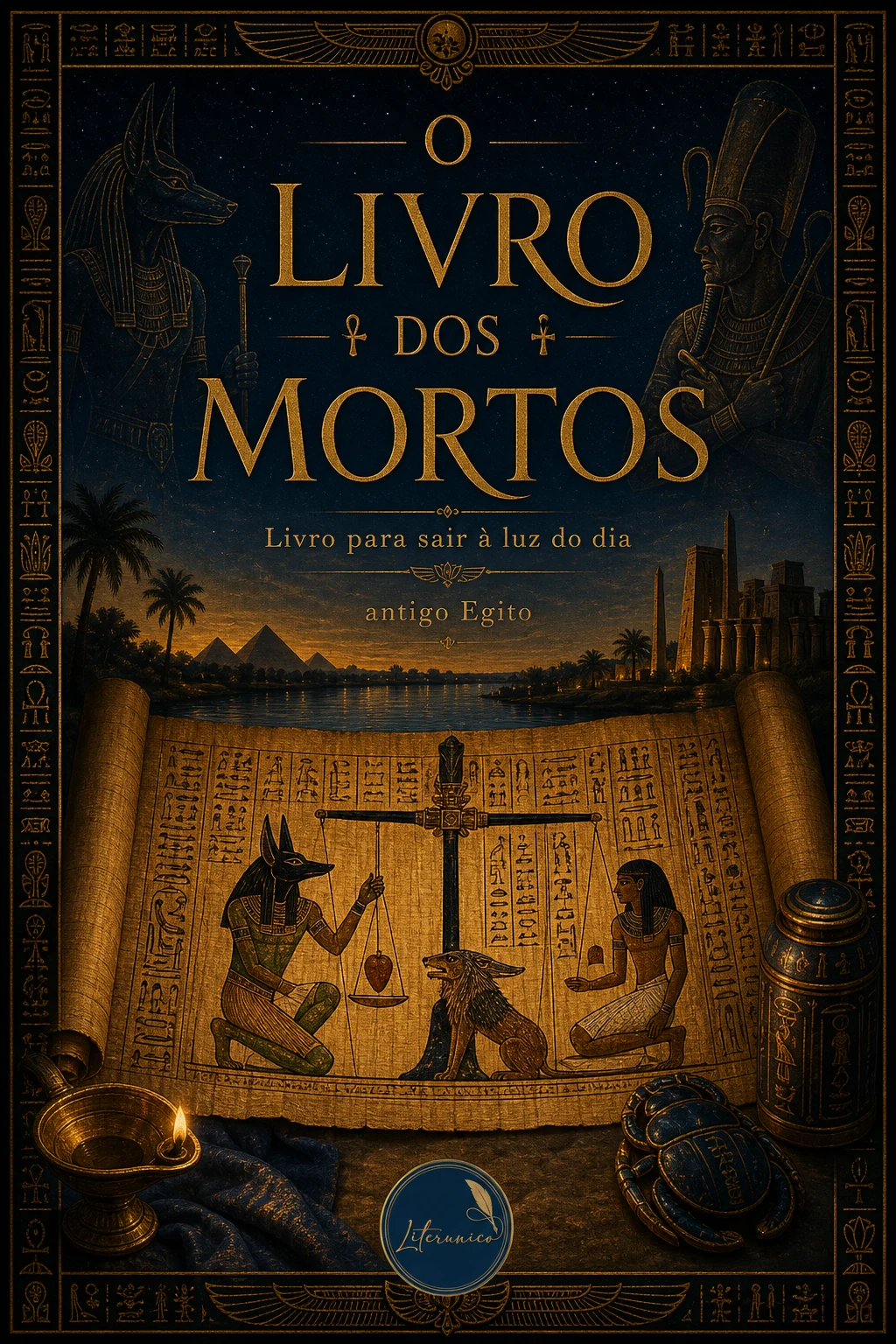
Universo da obra
Universo da obra
The Judgment of Osiris.
The oldest religious texts suggest that the Egyptians always associated
the Last Judgment with the weighing of the heart in a pair of scales,
and in the illustrated papyri of the Book of the Dead great prominence
is always given to the vignettes in which this weighing is being
carried out. The heart, ab, was taken as the symbol of all the
emotions, desires, and passions, both good and evil, and out of it
proceeded the issues of life. It was intimately connected with the ka,
i.e., the double or personality of a man, and several short spells
in the Book PER-T EM HRU were composed to ensure its preservation
(Chapters XXVI-XXXB*). The great Chapter of the Judgment of Osiris,
the CXXVth, is divided into three parts, which are sometimes (as
in the Papyrus of Ani) prefaced by a Hymn to Osiris. The first part
contains the following, which was said by the deceased when he entered
the Hall of Maati, in which Osiris sat in judgment:
"Homage to thee, O Great God, Lord of Maati, I have come to thee,
O my Lord, that I may behold thy beneficence. I know thee, and I know
thy name, and the names of the Forty-Two who live with thee in the
Hall of Maati, who keep ward over sinners, and feed upon their blood
on the day of estimating characters before Un-Nefer ... Behold,
I have come to thee, and I have brought maat (i.e., truth, integrity)
to thee. I have destroyed sin for thee. I have not sinned against
men. I have not oppressed [my] kinsfolk. I have done no wrong in the
place of truth. I have not known worthless folk. I have not wrought
evil. I have not defrauded the oppressed one of his goods. I have
not done the things that the gods abominate. I have not vilified a
servant to his master. I have not caused pain. I have not let any man
hunger. I have made no one to weep. I have not committed murder. I have
not commanded any to commit murder for me. I have inflicted pain on
no man. I have not defrauded the temples of their oblations. I have
not purloined the cakes of the gods. I have not stolen the offerings
to the spirits (i.e., the dead). I have not committed fornication. I
have not polluted myself in the holy places of the god of my city. I
have not diminished from the bushel. I did not take from or add to the
acre-measure. I did not encroach on the fields [of others]. I have not
added to the weights of the scales. I have not misread the pointer of
the scales. I have not taken milk from the mouths of children. I have
not driven cattle from their pastures. I have not snared the birds
of the gods. I have not caught fish with fish of their kind. I have
not stopped water [when it should flow]. I have not cut the dam of
a canal. I have not extinguished a fire when it should burn. I have
not altered the times of the chosen meat offerings. I have not turned
away the cattle [intended for] offerings. I have not repulsed the
god at his appearances. I am pure. I am pure. I am pure. I am pure...."
In the second part of Chapter CXXV Osiris is seen seated at one
end of the Hall of Maati accompanied by the two goddesses of Law
and Truth, and the Forty-Two gods who are there to assist him. Each
of the Forty-Two gods represents one of the nomes of Egypt and has a
symbolic name. When the deceased had repeated the magical names of the
doors of the Hall, he entered it and saw these gods arranged in two
rows, twenty-one on each side of the Hall. At the end, near Osiris,
were the Great Scales, under the charge of Anpu (Anubis), and the
monster Amemit, the Eater of the Dead, i.e., of the hearts of the
wicked who were condemned in the Judgment of Osiris. The deceased
advanced along the Hall and, addressing each of the Forty-Two gods
by his name, declared that he had not committed a certain sin, thus:
"O Usekh-nemmit, comer forth from Anu, I have not committed sin.
"O Fenti, comer forth from Khemenu, I have not robbed.
"O Neha-hau, comer forth from Re-stau, I have not killed men.
"O Neba, comer forth in retreating, I have not plundered the property
of God.
"O Set-qesu, comer forth from Hensu, I have not lied.
"O Uammti, comer forth from Khebt, I have not defiled any man's wife.
"O Maa-anuf, comer forth from Per-Menu, I have not defiled myself.
"O Tem-Sep, comer forth from Tetu, I have not cursed the king.
"O Nefer-Tem, comer forth from Het-ka-Ptah, I have not acted
deceitfully; I have not committed wickedness.
"O Nekhen, comer forth from Heqat, I have not turned a deaf ear to
the words of the Law (or Truth)."
The names of most of the Forty-Two gods are not ancient, but
were invented by the priests probably about the same time as the
names in the Book of Him that is in the Tuat and the Book of Gates,
i.e., between the XIIth and the XVIIIth dynasties. Their artificial
character is shown by their meanings. Thus Usekh-nemmit means "He
of the long strides"; Fenti means "He of the Nose"; Neha-hau means
"Stinking-members"; Set-qesu means "Breaker of bones," etc. The
early Egyptologists called the second part of the CXXVth Chapter the
"Negative Confession," and it is generally known by this somewhat
inexact title to this day.
In the third part of the CXXVth Chapter comes the address which the
deceased made to the gods after he had declared his innocence of the
sins enumerated before the Forty-Two gods. He says: "Homage to you,
O ye gods who dwell in your Hall of Maati. I know you and I know your
names. Let me not fall under your slaughtering knives. Bring not my
wickedness to the notice of the god whose followers ye are. Let not
the affair [of my judgment] come under your jurisdiction. Speak ye the
Law (or truth) concerning me before Neb-er-tcher, for I performed
the Law (or, truth) in Ta-mera (i.e., Egypt). I have not blasphemed
the God. No affair of mine came under the notice of the king in his
day. Homage to you, O ye who are in your Hall of Maati, who have no
lies in your bodies, who live on truth, who eat truth before Horus,
the dweller in his disk, deliver ye me from Babai who liveth upon
the entrails of the mighty ones on the day of the Great Reckoning (APT
AAT). Behold me! I have come to you without sin, without deceit (?),
without evil, without false testimony (?) I have not done an [evil]
thing. I live upon truth and I feed upon truth. I have performed
the behests of men, and the things that satisfy the gods. I
have propitiated the God [by doing] His will. I have given bread to
the hungry, water to the thirsty, raiment to the naked, and a boat
to him that needed one. I have made holy offerings to the gods, and
sepulchral offerings to the beautified dead. Be ye then my saviours,
be ye my protectors, and make no accusation against me before the
Great God. I am pure of mouth, and clean of hands; therefore it hath
been said by those who saw me, 'Come in peace, come in peace.'"
The deceased then addresses Osiris, and says, "Hail, thou who art
exalted upon thy standard, thou Lord of the Atefu Crown, whose name
is 'Lord of Winds,' save me from thy Messengers (or Assessors) with
uncovered faces, who bring charges of evil and make shortcomings plain,
because I have performed the Law (or Truth) for the Lord of the Law
(or Truth). I have purified myself with washings in water, my back
hath been cleansed with salt, and my inner parts are in the Pool of
Truth. There is not a member of mine that lacketh truth." From the
lines that follow the above in the Papyrus of Nu it seems as though
the judgment of the deceased by the Forty-Two gods was preliminary
to the final judgment of Osiris. At all events, after questioning
him about the performance of certain ceremonies, they invited him to
enter the Hall of Maati, but when he was about to do so the porter,
and the door-bolts, and the various parts of the door and its frame,
and the floor, refused to permit him to enter until he had repeated
their magical names. When he had pronounced these correctly the
porter took him in and presented him to Maau (?)-Taui, who was Thoth
himself. When asked by him why he had come the deceased answered,
"I have come that report may be made of me." Then Thoth said, "What
is thy condition?" And the deceased replied, "I am purified from evil
things, I am free from the wickedness of those who lived in my days; I
am not one of them." On this Thoth said, "Thou shalt be reported. [Tell
me:] Who is he whose roof is fire, whose walls are living serpents,
and whose floor is a stream of water? Who is he?" The deceased having
replied "Osiris," Thoth then led him forward to the god Osiris, who
received him, and promised that subsistence should be provided for
him from the Eye of Ra.
In great papyri of the Book of the Dead such as those of Nebseni,
Nu, Ani, Hunefer, etc., the Last Judgment, or the "Great Reckoning,"
is made the most prominent scene in the whole work, and the vignette
in which it is depicted is several feet long. The most complete form
of it is given in the Papyrus of Ani, and may be thus described:
At one end of the Hall of Maati Osiris is seated on a throne within
a shrine made in the form of a funerary coffer; behind him stand
Isis and Nephthys. Along one side of the Hall are seated the gods
Harmachis, Tem, Shu, Tefnut, Geb, Nut, Isis and Nephthys, Horus,
Hathor, Hu and Saa, who are to serve as the divine jury; these formed
the "Great Company of the Gods" of Anu (Heliopolis). By these stands
the Great Balance, and on its pillar sits the dog-headed ape Astes,
or Astenu, the associate of Thoth. The pointer of the Balance is in
the charge of Anpu. Behind Anpu are Thoth the scribe of the gods,
and the monster Amemit, with the head of a crocodile, the forepaws
and shoulders of a lion, and the hindquarters of a hippopotamus; the
duty of the last-named was to eat up the hearts that were light in
the balance. On the other side of the Balance Ani, accompanied by his
wife, is seen standing with head bent low in adoration, and between him
and the Balance stand the two goddesses who nurse and rear children,
Meskhenet and Rennet, Ani's soul, in the form of a man-headed hawk, a
portion of his body, and his luck Shai. Since the heart was considered
to be the seat of all will, emotion, feeling, reason and intelligence,
Ani's heart, is seen in one pan of the Balance, and in the other is
the feather, symbolic of truth and righteousness. Whilst his heart
was in the Balance Ani, repeating the words of Chapter XXXB* of the
Book of the Dead, addressed it, saying, "My heart of my mother! My
heart of my mother! My heart of my being! Make no stand against me
when testifying, thrust me not back before the Tchatchaut (i.e., the
overseers of Osiris), and make no failure in respect of me before
the Master of the Balance. Thou art my Ka, the dweller in my body,
uniting (?) and strengthening my members. Thou shalt come forth to
the happiness to which we advance. Make not my name to stink with
the officers [of Osiris] who made men, utter no lie against me before
the Great God, the Lord of Amentt."
Then Thoth, the Judge of Truth, of the Great Company of the Gods
who are in the presence of Osiris, saith to the gods, "Hearken ye to
this word: In very truth the heart of Osiris hath been weighed, and
his soul hath borne testimony concerning him; according to the Great
Balance his case is truth (i.e., just). No wickedness hath been found
in him. He did not filch offerings from the temples. He did not act
crookedly, and he did not vilify folk when he was on earth."
And the Great Company of the Gods say to Thoth, who dwelleth in
Khemenu (Hermopolis): "This that cometh forth from thy mouth of
truth is confirmed (?) The Osiris, the scribe Ani, true of voice,
hath testified. He hath not sinned and [his name] doth not stink
before us; Amemit (i.e., the Eater of the Dead) shall not have the
mastery over him. Let there be given unto him offerings of food and
an appearance before Osiris, and an abiding homestead in the Field
of Offerings as unto the Followers of Horus."
Thus the gods have declared that Ani is "true of voice," as was Osiris,
and they have called Ani "Osiris," because in his purity of word and
deed he resembled that god. In all the copies of the Book of the Dead
the deceased is always called "Osiris," and as it was always assumed
that those for whom they were written would be found innocent when
weighed in the Great Balance, the words "true of voice," which were
equivalent in meaning to "innocent and acquitted," were always written
after their names. It may be noted in passing that when Ani's heart
was weighed against Truth, the beam of the Great Balance remained
perfectly horizontal. This suggests that the gods did not expect the
heart of the deceased to "kick the beam," but were quite satisfied
if it exactly counterbalanced Truth. They demanded the fulfilment of
the Law and nothing more, and were content to bestow immortality upon
the man on whom Thoth's verdict was "he hath done no evil."
In accordance with the command of the gods Ani passes from the Great
Balance to the end of the Hall of Maati where Osiris is seated, and as
he approaches the god Horus, the son of Isis, takes him by the hand and
leads him forward, and standing before his father Osiris says, "I have
come to thee, Un-Nefer, I have brought to thee the Osiris Ani. His
heart is righteous [and] hath come forth from the Balance. It hath no
sin before any god or any goddess. Thoth hath set down his judgment in
writing, and the Company of the Gods have declared on his behalf that
[his] evidence is very true. Let there be given unto him of the bread
and beer which appear before Osiris. Let him be like the Followers of
Horus for ever!" Next we see Ani kneeling in adoration before Osiris,
and he says, "Behold, I am in thy presence, O Lord of Amentt. There
is no sin in my body. I have not uttered a lie knowingly. [I have] no
duplicity (?) Grant that I may be like the favoured (or rewarded) ones
who are in thy train." Under favour of Osiris Ani then became a sahu,
or "spirit-body," and in this form passed into the Kingdom of Osiris.
Public domain English edition of The Book of the Dead by Sir E. A. Wallis Budge, preserved by Project Gutenberg.
Ainda não há resenhas para esta obra. A primeira leitura comentada pode começar aqui.
Escolha a arte, confira a disponibilidade e adicione o produto ao carrinho sem sair da experiência.
Adquira Relíquias da Obra e deixe sua marca registrada, criando valor ao item!

Capa frontal, contracapa, Capa Aberta e Marca-Páginas pertencem à obra e acompanham este Universes.
Escolha uma Relíquia no painel principal para enviar uma proposta ao autor.
Capítulos disponíveis para continuar a leitura.
Nenhuma Relíquia desta obra foi adquirida ainda. Seja o primeiro a eternizar seu nome no acervo oficial!
Conhecer as 100 RelíquiasAinda não há resenhas para esta obra. A primeira leitura comentada pode começar aqui.
Nenhuma posse foi registrada publicamente para esta edição.
Durante a leitura, abra Menu para ajustar a experiência sem sair do capítulo. As preferências de aparência ficam salvas neste aparelho.
Recursos identificados como “em preparo” aparecem para antecipar a evolução do leitor, mas ainda não executam uma ação.
Posso mostrar leituras em destaque, clássicos e Relíquias disponíveis agora no Literúnico.
Escolha um caminho
Dúvidas desta página
As explicações do Aurélio são respostas cadastradas pelo Literúnico.