
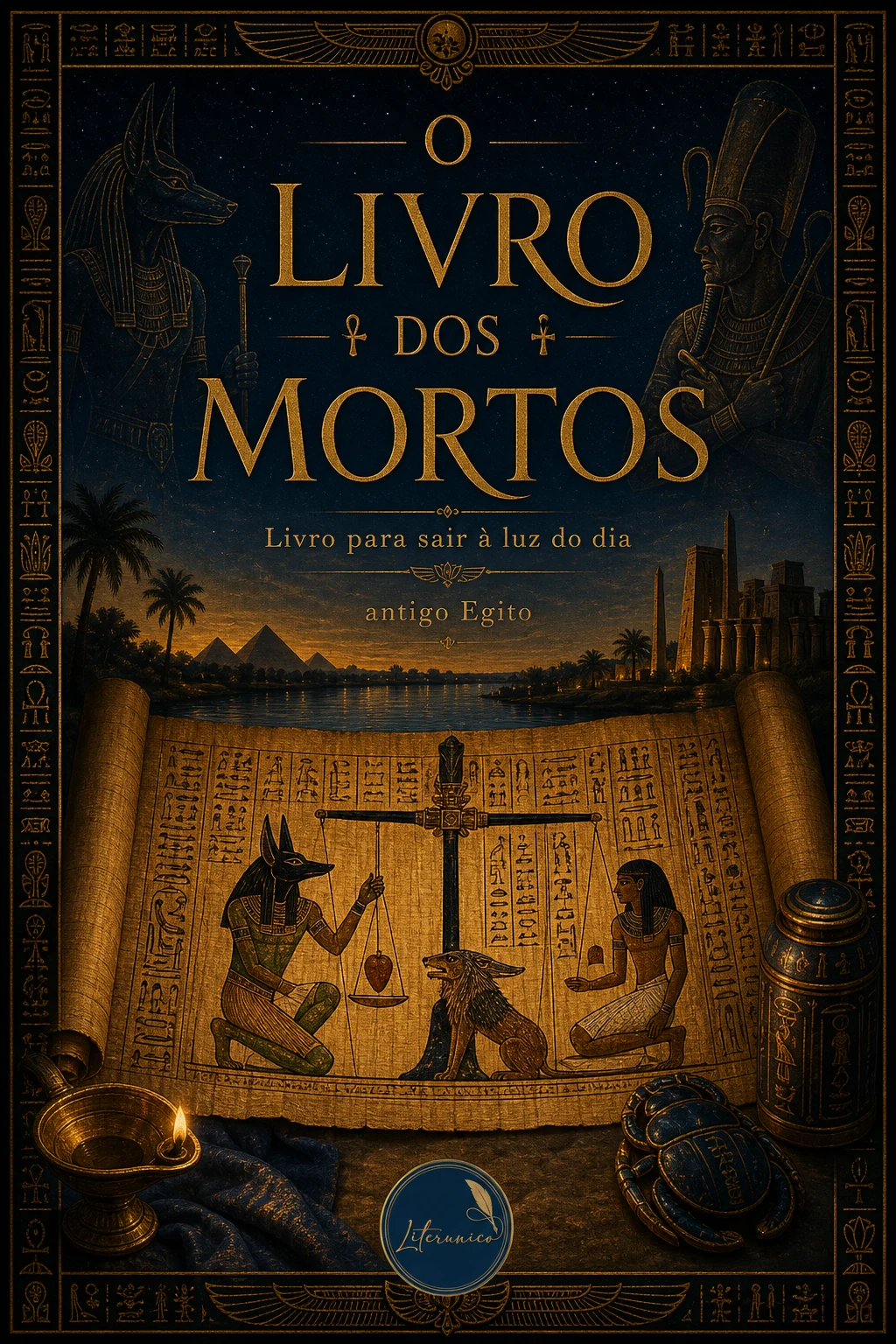
Universo da obra
Universo da obra
Thoth and Osiris.
The Egyptians were not satisfied with the mere possession of the
texts of Thoth, when their souls were being weighed in the Great
Scales in the Judgment Hall of Osiris, but they also wished Thoth
to act as their Advocate on this dread occasion and to prove their
innocence as he had proved that of Osiris before the great gods in
prehistoric times. According to a very ancient Egyptian tradition,
the god Osiris, who was originally the god of the principle of the
fertility of the Nile, became incarnate on earth as the son of Geb,
the Earth-god, and Nut, the Sky-goddess. He had two sisters, Isis
and Nephthys, and one brother, Set; he married Isis and Set married
Nephthys. Geb set Osiris on the throne of Egypt, and his rule was
beneficent and the nation was happy and prosperous. Set marked this
and became very jealous of his brother, and wished to slay him so
that he might seize his throne and take possession of Isis, whose
reputation as a devoted and loving wife and able manager filled the
country. By some means or other Set did contrive to kill Osiris:
according to one story he killed him by the side of a canal at
Netat, near Abydos, and according to another he caused him to be
drowned. Isis, accompanied by her sister Nephthys, went to Netat and
rescued the body of her lord, and the two sisters, with the help of
Anpu, a son of Ra the Sun-god, embalmed it. They then laid the body
in a tomb, and a sycamore tree grew round it and flourished over the
grave. A tradition which is found in the Pyramid Texts states that
before Osiris was laid in his tomb, his wife Isis, by means of her
magical powers, succeeded in restoring him to life temporarily, and
made him beget of her an heir, who was called Horus. After the burial
of Osiris, Isis retreated to the marshes in the Delta, and there she
brought forth Horus. In order to avoid the persecution of Set, who on
one occasion succeeded in killing Horus by the sting of a scorpion,
she fled from place to place in the Delta, and lived a very unhappy
life for some years. But Thoth helped her in all her difficulties and
provided her with the words of power which restored Horus to life,
and enabled her to pass unharmed among the crocodiles and other evil
beasts that infested the waters of the Delta at that time.
When Horus arrived at years of maturity, he set out to find Set
and to wage war against his father's murderer. At length they met
and a fierce fight ensued, and though Set was defeated before he
was finally hurled to the ground, he succeeded in tearing out the
right eye of Horus and keeping it. Even after this fight Set was
able to persecute Isis, and Horus was powerless to prevent it until
Thoth made Set give him the right eye of Horus which he had carried
off. Thoth then brought the eye to Horus, and replaced it in his face,
and restored sight to it by spitting upon it. Horus then sought out the
body of Osiris in order to raise it up to life, and when he found it
he untied the bandages so that Osiris might move his limbs, and rise
up. Under the direction of Thoth Horus recited a series of formulas
as he presented offerings to Osiris, and he and his sons and Anubis
performed the ceremonies which opened the mouth, and nostrils, and the
eyes and the ears of Osiris. He embraced Osiris and so transferred to
him his ka, i.e., his own living personality and virility, and gave
him his eye which Thoth had rescued from Set and had replaced in his
face. As soon as Osiris had eaten the eye of Horus he became endowed
with a soul and vital power, and recovered thereby the complete use
of all his mental faculties, which death had suspended. Straightway
he rose up from his bier and became the Lord of the Dead and King of
the Under World. Osiris became the type and symbol of resurrection
among the Egyptians of all periods, because he was a god who had been
originally a mortal and had risen from the dead.
But before Osiris became King of the Under World he suffered further
persecution from Set. Piecing together a number of disconnected hints
and brief statements in the texts, it seems pretty clear either
that Osiris appealed to the "Great Gods" to take notice that Set
had murdered him, or that Set brought a series of charges against
Osiris. At all events the "Great Gods" determined to investigate the
matter. The Greater and the Lesser Companies of the Gods assembled in
the celestial Anu, or Heliopolis, and ordered Osiris to stand up and
defend himself against the charges brought against him by Set. Isis and
Nephthys brought him before the gods, and Horus, "the avenger of his
father," came to watch the case on behalf of his father, Osiris. Thoth
appeared in the Hall of Judgment in his official capacity as "scribe,"
i.e., secretary to the gods, and the hearing of the evidence began. Set
seems to have pleaded his own cause, and to have repeated the charges
which he had made against Osiris. The defence of Osiris was undertaken
by Thoth, who proved to the gods that the charges brought against
Osiris by Set were unfounded, that the statements of Set were lies,
and that therefore Set was a liar. The gods accepted Thoth's proof
of the innocence of Osiris and the guilt of Set, and ordered that
Osiris was to be considered a Great God and to have rule over the
Kingdom of the Under World, and that Set was to be punished. Thoth
convinced them that Osiris was "MAA KHERU," "true of word," i.e.,
that he had spoken the truth when he gave his evidence, and in texts
of all periods Thoth is frequently described as S-MAA KHERU ASAR,
i.e., he who proved Osiris to be "true of word." As for Set the Liar,
he was seized by the ministers of the Great Gods, who threw him down
on his hands and face and made Osiris mount upon his back as a mark of
his victory and superiority. After this Set was bound with cords like a
beast for sacrifice, and in the presence of Thoth was hacked in pieces.
Public domain English edition of The Book of the Dead by Sir E. A. Wallis Budge, preserved by Project Gutenberg.
Ainda não há resenhas para esta obra. A primeira leitura comentada pode começar aqui.
Escolha a arte, confira a disponibilidade e adicione o produto ao carrinho sem sair da experiência.
Adquira Relíquias da Obra e deixe sua marca registrada, criando valor ao item!

Capa frontal, contracapa, Capa Aberta e Marca-Páginas pertencem à obra e acompanham este Universes.
Escolha uma Relíquia no painel principal para enviar uma proposta ao autor.
Capítulos disponíveis para continuar a leitura.
Nenhuma Relíquia desta obra foi adquirida ainda. Seja o primeiro a eternizar seu nome no acervo oficial!
Conhecer as 100 RelíquiasAinda não há resenhas para esta obra. A primeira leitura comentada pode começar aqui.
Nenhuma posse foi registrada publicamente para esta edição.
Durante a leitura, abra Menu para ajustar a experiência sem sair do capítulo. As preferências de aparência ficam salvas neste aparelho.
Recursos identificados como “em preparo” aparecem para antecipar a evolução do leitor, mas ainda não executam uma ação.
Posso mostrar leituras em destaque, clássicos e Relíquias disponíveis agora no Literúnico.
Escolha um caminho
Dúvidas desta página
As explicações do Aurélio são respostas cadastradas pelo Literúnico.