
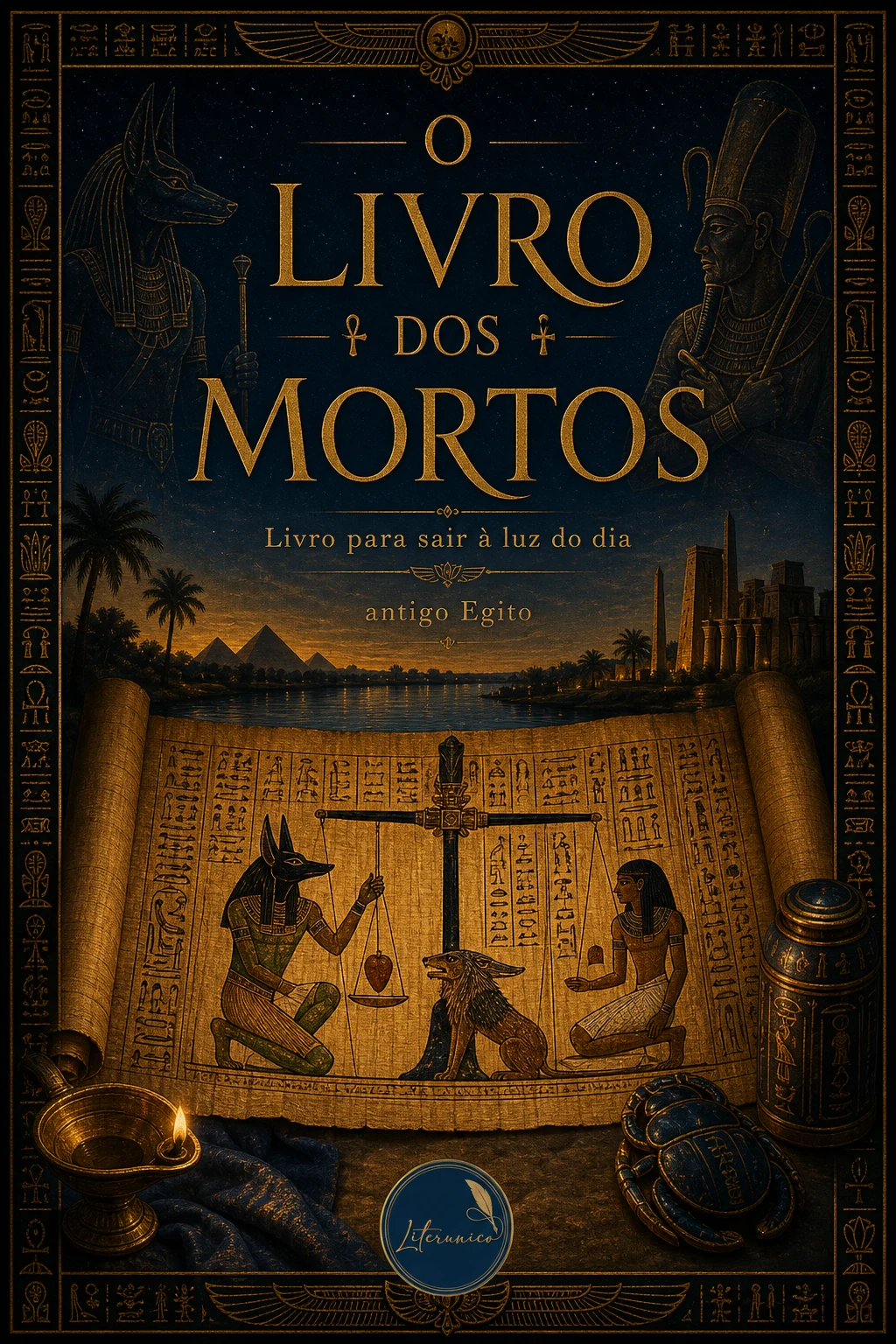
Universo da obra
Universo da obra
The Book Per-t em hru, or [The Chapters of] Coming forth by (or,
into) the Day, commonly called the "Book of the Dead."
The spells and other texts which were written by Thoth for the
benefit of the dead, and are directly connected with him, were called,
according to documents written under the XIth and XVIIIth dynasties,
"Chapters of the Coming Forth by (or, into) the Day." One rubric in
the Papyrus of Nu (Brit. Mus. No. 10477) states that the text of the
work called "PER-T EM HRU," i.e., "Coming Forth (or, into) the Day,"
was discovered by a high official in the foundations of a shrine of
the god Hennu during the reign of Semti, or Hesepti, a king of the Ist
dynasty. Another rubric in the same papyrus says that the text was
cut upon the alabaster plinth of a statue of Menkaura (Mycerinus),
a king of the IVth dynasty, and that the letters were inlaid with
lapis lazuli. The plinth was found by Prince Herutataf, a son of
King Khufu (Cheops), who carried it off to his king and exhibited it
as a "most wonderful" thing. This composition was greatly reverenced,
for it "would make a man victorious upon earth and in the Other World;
it would ensure him a safe and free passage through the Tuat (Under
World); it would allow him to go in and to go out, and to take at
any time any form he pleased; it would make his soul to flourish, and
would prevent him from dying the [second] death." For the deceased to
receive the full benefit of this text it had to be recited by a man
"who was ceremonially pure, and who had not eaten fish or meat, and
had not consorted with women." On coffins of the XIth dynasty and on
papyri of the XVIIIth dynasty we find two versions of the PER-T EM HRU,
one long and one short. As the title of the shorter version states
that it is the "Chapters of the PER-T EM HRU in a single chapter,"
it is clear that this work, even under the IVth dynasty, contained
many "Chapters," and that a much abbreviated form of the work was also
current at the same period. The rubric that attributes the "finding" of
the Chapter to Herutataf associates it with Khemenu, i.e., Hermopolis,
and indicates that Thoth, the god of this city, was its author.
The work PER-T EM HRU received many additions in the course of
centuries, and at length, under the XVIIIth dynasty, it contained about
190 distinct compositions, or "Chapters." The original forms of many
of these are to be found in the "Pyramid Texts" (i.e., the funerary
compositions cut on the walls of the chambers and corridors of the
pyramids of Kings Unas, Teta, Pepi I Meri-Ra, Merenra and Pepi II at
Sakkârah), which were written under the Vth and VIth dynasties. The
forms which many other chapters had under the XIth and XIIth dynasties
are well represented by the texts painted on the coffins of Amamu,
Sen, and Guatep in the British Museum (Nos. 6654, 30839, 30841),
but it is possible that both these and the so-called "Pyramid Texts"
all belonged to the work PER-T EM HRU, and are extracts from it. The
"Pyramid Texts" have no illustrations, but a few of the texts on the
coffins of the XIth and XIIth dynasties have coloured vignettes, e.g.,
those which refer to the region to be traversed by the deceased on his
way to the Other World, and the Islands of the Blessed or the Elysian
Fields. On the upper margins of the insides of such coffins there
are frequently given two or more rows of coloured drawings of the
offerings which under the Vth dynasty were presented to the deceased
or his statue during the celebration of the service of "Opening
the Mouth" and the performance of the ceremonies of "The Liturgy
of Funerary Offerings." Under the XVIIIth dynasty, when the use of
large rectangular coffins and sarcophagi fell somewhat into disuse,
the scribes began to write collections of Chapters from the PER-T EM
HRU on rolls of papyri instead of on coffins. At first the texts were
written in hieroglyphs, the greater number of them being in black ink,
and an attempt was made to illustrate each text by a vignette drawn
in black outline. The finest known example of such a codex is the
Papyrus of Nebseni (Brit. Mus. No. 9900), which is 77 feet 7 1/2
inches in length and I foot I1/2 inches in breadth. Early in the
XVIIIth dynasty scribes began to write the titles of the Chapters,
the rubrics, and the catchwords in red ink and the text in black,
and it became customary to decorate the vignettes with colours, and to
increase their size and number. The oldest codex of this class is the
Papyrus of Nu (Brit. Mus. No. 10477) which is 65 feet 3 1/2 inches in
length, and 1 foot 1 1/2 inches in breadth. This and many other rolls
were written by their owners for their own tombs, and in each roll both
text and vignettes were usually, the work of the same hand. Later,
however, the scribe wrote the text only, and a skilled artist was
employed to add the coloured vignettes, for which spaces were marked
out and left blank by the scribe. The finest example of this class of
roll is the Papyrus of Ani (Brit. Mus., No. 10470). which is 78 feet
in length and 1 foot 3 inches in breadth. In all papyri of this class
the text is written in hieroglyphs, but under the XIXth and following
dynasties many papyri are written throughout in the hieratic character;
these usually lack vignettes, but have coloured frontispieces.
Under the rule of the High Priests of Amen many changes were introduced
into the contents of the papyri, and the arrangement cf the texts and
vignettes of the PER-T EM HRU was altered. The great confraternity
of Amen-Ra, the "King of the Gods," felt it to be necessary to
emphasize the supremacy of their god, even in the Kingdom of Osiris,
and they added many prayers, litanies and hymns to the Sun-god to
every selection of the texts from the PER-T EM HRU that was copied
on a roll of papyrus for funerary purposes. The greater number of the
rolls of this period are short and contain only a few Chapters, e.g.,
the Papyrus of the Royal Mother Netchemet (Brit. Mus. No. 10541) and
the Papyrus of Queen Netchemet (Brit. Mus. No. 10478). In some the text
is very defective and carelessly written, but the coloured vignettes
are remarkable for their size and beauty; of this class of roll the
finest example is the Papyrus of Anhai (Brit. Mus. No. 10472). The
most interesting of all the rolls that were written during the rule
of the Priest-Kings over Upper Egypt is the Papyrus of Princess
Nesitanebtashru (Brit. Mus. No. 10554), now commonly known as the
"Greenfield Papyrus." It is the longest and widest funerary papyrus
known, for it measures 123 feet by 1 foot 6 1/2 inches, and it
contains more Chapters, Hymns, Litanies, Adorations and Homages to
the gods than any other roll. The 87 Chapters from the PER-T EM HRU
which it contains prove the princess's devotion to the cult of Osiris,
and the Hymns to Amen-Ra show that she was able to regard this god
and Osiris not as rivals but as two aspects of the same god. She
believed that the "hidden" creative power which was materialized in
Amen was only another form of the power of procreation, renewed birth
and resurrection which was typified by Osiris. The oldest copies of the
PER-T EM HRU which we have on papyrus contain a few extracts from other
ancient funerary works, such as the "Book of Opening the Mouth," the
"Liturgy of Funerary Offerings," and the "Book of the Two Ways." But
under the rule of the Priest-Kings the scribes incorporated with the
Chapters of the PER-T EM HRU extracts from the "Book of Ami-Tuat"
and the "Book of Gates," and several of the vignettes and texts that
are found on the walls of the royal tombs of Thebes.
One of the most remarkable texts written at this period is found in
the Papyrus of Nesi-Khensu, which is now in the Egyptian Museum in
Cairo. This is really the copy of a contract which is declared to have
been made between Nesi-Khensu and Amen-Ra, "the holy god, the lord of
all the gods." As a reward for the great piety of the queen, and her
devotion to the interests of Amen-Ra upon earth, the god undertakes to
make her a goddess in his kingdom, to provide her with an estate there
in perpetuity and a never-failing supply of offerings, and happiness
of heart, soul and body, and the [daily] recital upon earth of the
"Seventy Songs of Ra" for the benefit of her soul in the Khert-Neter,
or Under World. The contract was drawn up in a series of paragraphs
in legal phraseology by the priests of Amen, who believed they had
the power of making their god do as they pleased when they pleased.
Little is known of the history of the PER-T EM HRU after the downfall
of the priests of Amen, and during the period of the rule of the
Nubians, but under the kings of the XXVIth dynasty the Book enjoyed a
great vogue. Many funerary rolls were written both in hieroglyphs and
hieratic, and were decorated with vignettes drawn in black outline;
and about this time the scribes began to write funerary texts in
the demotic character. But men no longer copied long selections
from the PER-T EM HRU as they had done under the XVIIIth, XIXth and
XXth dynasties, partly because the religious views of the Egyptians
had undergone a great change, and partly because a number of Books
of the Dead of a more popular character had appeared. The cult of
Osiris was triumphant everywhere, and men preferred the hymns and
litanies which dealt with his sufferings, death and resurrection to
the compositions in which the absolute supremacy of Ra and his solar
cycle of gods and goddesses was assumed or proclaimed. Thus, in the
"Lamentations of Isis" and the "Festival Songs of Isis and Nephthys,"
and the "Litanies of Seker," and the "Book of Honouring Osiris," etc.,
the central figure is Osiris, and he alone is regarded as the giver
of everlasting life. The dead were no longer buried with large rolls
of papyrus filled with Chapters of the PER-T EM HRU laid in their
coffins, but with small sheets or strips of papyrus, on which were
inscribed the above compositions, or the shorter texts of the "Book
of Breathings," or the "Book of Traversing Eternity," or the "Book of
May my name flourish," or a part of the "Chapter of the Last Judgment."
Ancient Egyptian tradition asserts that the Book PER-T EM HRU was
used early in the Ist dynasty, and the papyri and coffins of the
Roman Period afford evidence that the native Egyptians still accepted
all the essential beliefs and doctrines contained in it. During the
four thousand years of its existence many additions were made to it,
but nothing of importance seems to have been taken away from it. In
the space here available it is impossible to describe in detail the
various Recensions of this work, viz., (1) the Heliopolitan, (2) the
Theban and its various forms, and (3) the Saïte; but it is proposed
to sketch briefly the main facts of the Egyptian Religion which
may be deduced from them generally, and especially from the Theban
Recension, and to indicate the contents of the principal Chapters. No
one papyrus can be cited as a final authority, for no payprus contains
all the Chapters, 190 in number, of the Theban Recension, and in no
two papyri are the selection and sequence of the Chapters identical,
or is the treatment of the vignettes the same.
Public domain English edition of The Book of the Dead by Sir E. A. Wallis Budge, preserved by Project Gutenberg.
Ainda não há resenhas para esta obra. A primeira leitura comentada pode começar aqui.
Escolha a arte, confira a disponibilidade e adicione o produto ao carrinho sem sair da experiência.
Adquira Relíquias da Obra e deixe sua marca registrada, criando valor ao item!

Capa frontal, contracapa, Capa Aberta e Marca-Páginas pertencem à obra e acompanham este Universes.
Escolha uma Relíquia no painel principal para enviar uma proposta ao autor.
Capítulos disponíveis para continuar a leitura.
Nenhuma Relíquia desta obra foi adquirida ainda. Seja o primeiro a eternizar seu nome no acervo oficial!
Conhecer as 100 RelíquiasAinda não há resenhas para esta obra. A primeira leitura comentada pode começar aqui.
Nenhuma posse foi registrada publicamente para esta edição.
Durante a leitura, abra Menu para ajustar a experiência sem sair do capítulo. As preferências de aparência ficam salvas neste aparelho.
Recursos identificados como “em preparo” aparecem para antecipar a evolução do leitor, mas ainda não executam uma ação.
Posso mostrar leituras em destaque, clássicos e Relíquias disponíveis agora no Literúnico.
Escolha um caminho
Dúvidas desta página
As explicações do Aurélio são respostas cadastradas pelo Literúnico.