
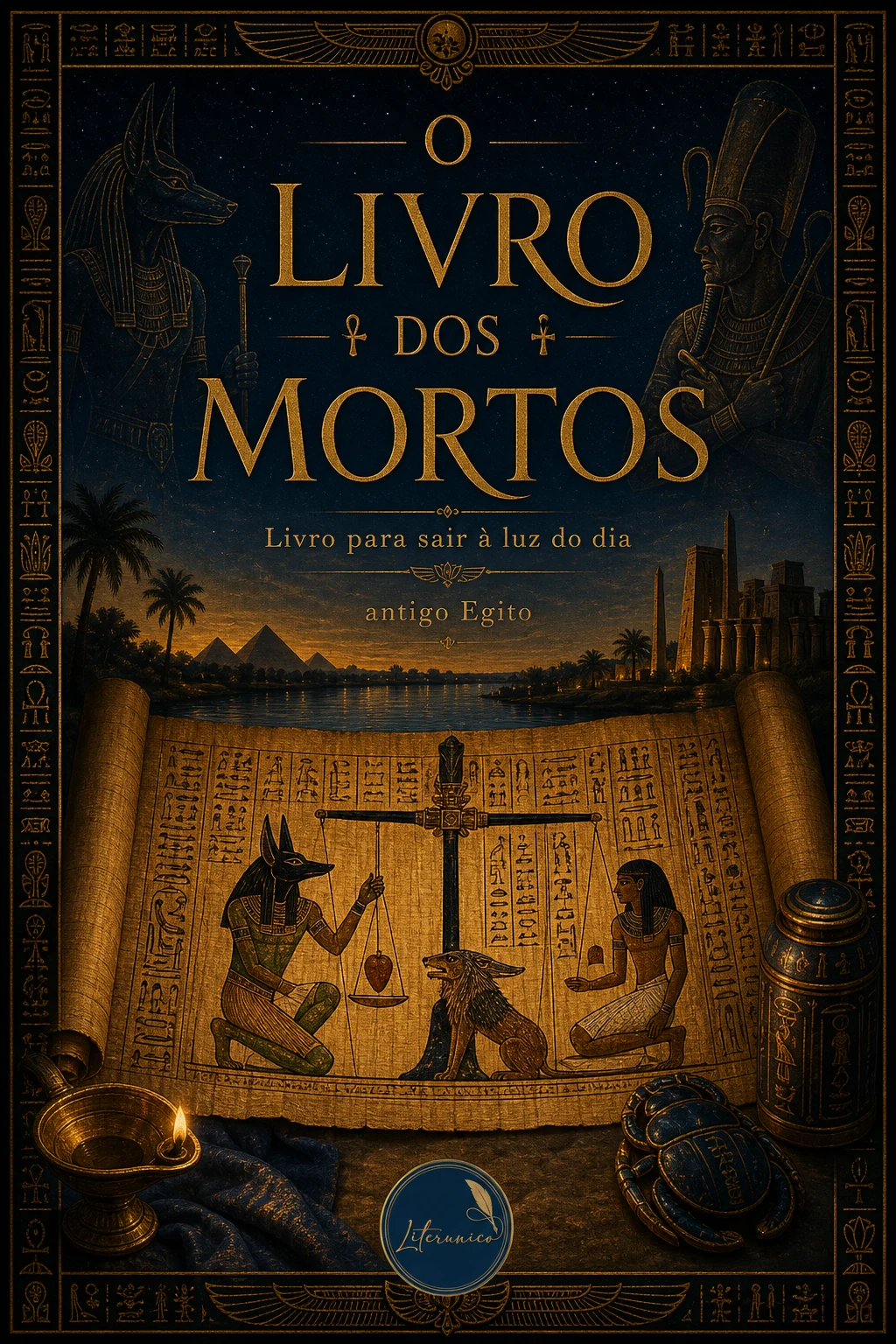
Universo da obra
Universo da obra
Osiris as Judge of the Dead and King of the Under World.
When Set was destroyed Osiris departed from this world to the kingdom
which the gods had given him and began to reign over the dead. He was
absolute king of this realm, just as Ra the Sun-god was absolute king
of the sky. This region of the dead, or Dead-land, is called "Tat,"
or "Tuat," but where the Egyptians thought it was situated is not
quite clear. The original home of the cult of Osiris was in the Delta,
in a city which in historic times was called Tetu by the Egyptians and
Busiris by the Greeks, and it is reasonable to assume that the Tuat,
over which Osiris ruled, was situated near this place. Wherever it
was it was not underground, and it was not originally in the sky
or even on its confines; but it was located on the borders of the
visible world, in the Outer Darkness. The Tuat was not a place of
happiness, judging from the description of it in the PER-T EM HRU,
or Book of the Dead. When Ani the scribe arrived there he said,
"What is this to which I have come? There is neither water nor air
here, its depth is unfathomable, it is as dark as the darkest night,
and men wander about here helplessly. A man cannot live here and be
satisfied, and he cannot gratify the cravings of affection" (Chapter
CLXXV). In the Tuat there was neither tree nor plant, for it was the
"land where nothing grew"; and in primitive times it was a region
of destruction and death, a place where the dead rotted and decayed,
a place of abomination, and horror and terror, and annihilation. But
in very early times, certainly in the Neolithic Period, the Egyptians
believed in some kind of a future life, and they dimly conceived that
the attainment of that life might possibly depend upon the manner of
life which those who hoped to enjoy it led here. The Egyptians "hated
death and loved life," and when the belief gained ground among them
that Osiris, the God of the Dead, had himself risen from the dead,
and had been acquitted by the gods of heaven after a searching trial,
and had the power to "make men and women to be born again," and
"to renew life" because of his truth and righteousness, they came
to regard him as the Judge as well as the God of the Dead. As time
went on, and moral and religious ideas developed among the Egyptians,
it became certain to them that only those who had satisfied Osiris
as to their truth-speaking and honest dealing upon earth could hope
for admission into his kingdom.
When the power of Osiris became predominant in the Under World, and
his fame as a just and righteous judge became well established among
the natives of Lower and Upper Egypt, it was universally believed
that after death all men would appear before him in his dread Hall of
Judgment to receive their reward or their sentence of doom. The writers
of the Pyramid Texts, more than fifty-five centuries ago, dreamed of
a time when heaven and earth and men did not exist, when the gods had
not yet been born, when death had not been created, and when anger,
speech (?), cursing and rebellion were unknown. But that time was
very remote, and long before the great fight took place between Horus
and Set, when the former lost his eye and the latter was wounded in
a vital part of his body. Meanwhile death had come into the world,
and since the religion of Osiris gave man a hope of escape from death,
and the promise of everlasting life of the peculiar kind that appealed
to the great mass of the Egyptian people, the spread of the cult of
Osiris and its ultimate triumph over all forms of religion in Egypt
were assured. Under the early dynasties the priesthood of Anu (the On
of the Bible) strove to make their Sun-god Ra pre-eminent in Egypt,
but the cult of this god never appealed to the people as a whole. It
was embraced by the Pharaohs, and their high officials, and some of
the nobles, and the official priesthood, but the reward which its
doctrine offered was not popular with the materialistic Egyptians. A
life passed in the Boat of Ra with the gods, being arrayed in light
and fed upon light, made no appeal to the ordinary folk since Osiris
offered them as a reward a life in the Field of Reeds, and the Field of
Offerings of Food, and the Field of the Grasshoppers, and everlasting
existence in a transmuted and beautified body among the resurrected
bodies of father and mother, wife and children, kinsfolk and friends.
But, as according to the cult of Ra, the wicked, the rebels, and the
blasphemers of the Sun-god suffered swift and final punishment, so
also all those who had sinned against the stern moral Law of Osiris,
and who had failed to satisfy its demands, paid the penalty without
delay. The Judgment of Ra was held at sunrise, and the wicked were
thrown into deep pits filled with fire, and their bodies, souls,
shadows and hearts were consumed forthwith. The Judgment of Osiris
took place near Abydos, probably at midnight, and a decree of swift
annihilation was passed by him on the damned. Their heads were cut
off by the headsman of Osiris, who was called Shesmu, and their
bodies dismembered and destroyed in pits of fire. There was no
eternal punishment for men, for the wicked were annihilated quickly
and completely; but inasmuch as Osiris sat in judgment and doomed the
wicked to destruction daily, the infliction of punishment never ceased.
Public domain English edition of The Book of the Dead by Sir E. A. Wallis Budge, preserved by Project Gutenberg.
Ainda não há resenhas para esta obra. A primeira leitura comentada pode começar aqui.
Escolha a arte, confira a disponibilidade e adicione o produto ao carrinho sem sair da experiência.
Adquira Relíquias da Obra e deixe sua marca registrada, criando valor ao item!

Capa frontal, contracapa, Capa Aberta e Marca-Páginas pertencem à obra e acompanham este Universes.
Escolha uma Relíquia no painel principal para enviar uma proposta ao autor.
Capítulos disponíveis para continuar a leitura.
Nenhuma Relíquia desta obra foi adquirida ainda. Seja o primeiro a eternizar seu nome no acervo oficial!
Conhecer as 100 RelíquiasAinda não há resenhas para esta obra. A primeira leitura comentada pode começar aqui.
Nenhuma posse foi registrada publicamente para esta edição.
Durante a leitura, abra Menu para ajustar a experiência sem sair do capítulo. As preferências de aparência ficam salvas neste aparelho.
Recursos identificados como “em preparo” aparecem para antecipar a evolução do leitor, mas ainda não executam uma ação.
Posso mostrar leituras em destaque, clássicos e Relíquias disponíveis agora no Literúnico.
Escolha um caminho
Dúvidas desta página
As explicações do Aurélio são respostas cadastradas pelo Literúnico.