
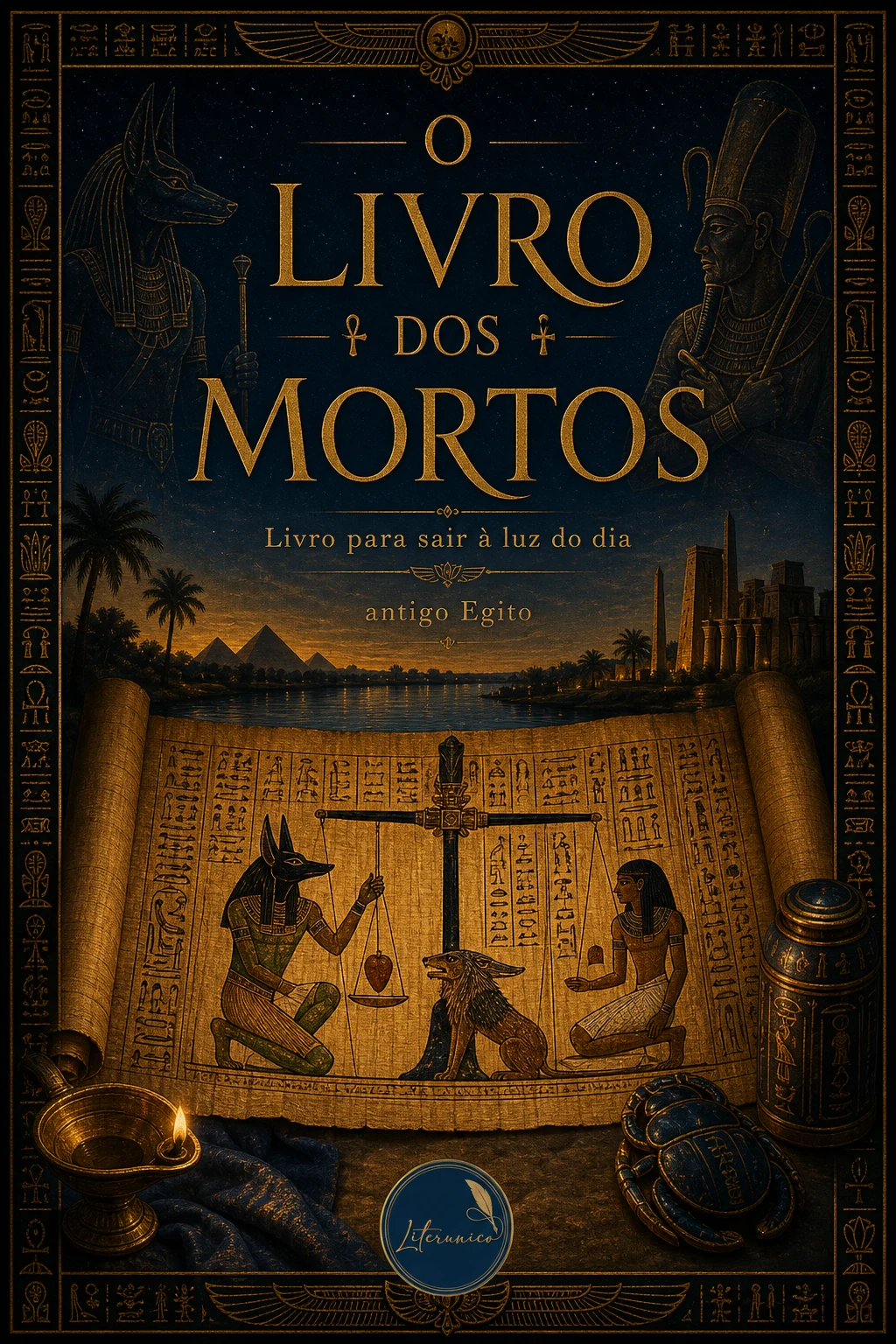
Universo da obra
Universo da obra
The Kingdom of Osiris.
According to the Book of Gates and the other "Guides" to the Egyptian
Under World, the Kingdom of Osiris formed the Sixth Division of the
Tuat; in very early times it was situated in the Western Delta,
but after the XIIth dynasty theologians placed it near Abydos in
Upper Egypt, and before the close of the Dynastic Period the Tuat of
Osiris had absorbed the Under World of every nome of Egypt. When the
soul in its beautified or spirit body arrived there, the ministers
of Osiris took it to the homestead or place of abode which had been
allotted to it by the command of Osiris, and there it began its new
existence. The large vignette to the CXth Chapter shows us exactly
what manner of place the abode of the blessed was. The country was
flat and the fields were intersected by canals of running water in
which there were "no fish and no worms" (i.e., water snakes). In one
part of it were several small islands, and on one of them Osiris was
supposed to dwell with his saints. It was called the "Island of Truth,"
and the ferry-man of Osiris would not convey to it any soul that
had not been declared "true of word" by Thoth, Osiris and the Great
Gods at the "Great Reckoning." The portion of the Kingdom of Osiris
depicted in the large Books of the Dead represents in many respects a
typical Egyptian farm, and we see the deceased engaged in ploughing
and reaping and driving the oxen that are treading out the corn. He
was introduced into the Sekhet Heteput (a section of the Sekhet Aaru,
i.e., "Field of Reeds," or the "Elysian Fields") by Thoth, and there
he found the souls of his ancestors, who were joined to the Company
of the Gods. One corner of this region was specially set apart for the
dwelling place of the aakhu, i.e., beautified souls, or spirit-souls,
who were said to be seven cubits in height, and to reap wheat or
barley which grew to a height of three cubits. Near this spot were
moored two boats that were always ready for the use of the denizens
of that region; they appear to have been "spirit boats," i.e., boats
which moved of themselves and carried the beautified wheresoever they
wanted to go without any trouble or fatigue on their part.
How the beautified passed their time in the Kingdom of Osiris
may be seen from the pictures cut on the alabaster sarcophagus of
Seti I, now preserved in Sir John Soane's Museum in Lincoln's Inn
Fields. Here we see them occupied in producing the celestial food on
which they and the god lived. Some are tending the wheat plants as
they grow, and others are reaping the ripe grain. In the texts that
accompany these scenes the ears of wheat are said to be the "members
of Osiris," and the wheat plant is called the maat plant. Osiris was
the Wheat-god and also the personification of Maat (i.e., Truth), and
the beautified lived upon the body of their god and ate him daily,
and the substance of him was the "Bread of Everlastingness," which
is mentioned in the Pyramid Texts. The beautified are described as
"Those who have offered up incense to the gods, and whose kau (i.e.,
doubles, or persons) have been washed clean. They have been reckoned
up and they are maat (i.e., Truth) in the presence of the Great God
who destroyeth sin." Osiris says to them, "Ye are truth of truth;
rest in peace." And of them he says, "They were doers of truth whilst
they were upon earth, they did battle for their god, and they shall
be called to the enjoyment of the Land of the House of Life with
Truth. Their truth shall be reckoned to them in the presence of the
Great God who destroyeth sin." Then addressing them again Osiris says,
"Ye are beings of Truth, O ye Truths. Take ye your rest because of
what ye have done, becoming even as those who are in my following,
and who direct the House of Him whose Soul is holy. Ye shall live
there even as they live, and ye shall have dominion over the cool
waters of your land. I command that ye have your being to the limit [of
that land] with Truth and without sin." In these passages we have the
two conceptions of Osiris well illustrated. As the Wheat-god he would
satisfy those who wished for a purely material, agricultural heaven,
where hunger would be unknown and where the blessed would be able to
satisfy every physical desire and want daily; and as the God of Truth,
of whom the spiritually minded hoped to become the counterpart, he
would be their hope, and consolation, and the image of the Eternal God.
Public domain English edition of The Book of the Dead by Sir E. A. Wallis Budge, preserved by Project Gutenberg.
Ainda não há resenhas para esta obra. A primeira leitura comentada pode começar aqui.
Escolha a arte, confira a disponibilidade e adicione o produto ao carrinho sem sair da experiência.
Adquira Relíquias da Obra e deixe sua marca registrada, criando valor ao item!

Capa frontal, contracapa, Capa Aberta e Marca-Páginas pertencem à obra e acompanham este Universes.
Escolha uma Relíquia no painel principal para enviar uma proposta ao autor.
Capítulos disponíveis para continuar a leitura.
Nenhuma Relíquia desta obra foi adquirida ainda. Seja o primeiro a eternizar seu nome no acervo oficial!
Conhecer as 100 RelíquiasAinda não há resenhas para esta obra. A primeira leitura comentada pode começar aqui.
Nenhuma posse foi registrada publicamente para esta edição.
Durante a leitura, abra Menu para ajustar a experiência sem sair do capítulo. As preferências de aparência ficam salvas neste aparelho.
Recursos identificados como “em preparo” aparecem para antecipar a evolução do leitor, mas ainda não executam uma ação.
Posso mostrar leituras em destaque, clássicos e Relíquias disponíveis agora no Literúnico.
Escolha um caminho
Dúvidas desta página
As explicações do Aurélio são respostas cadastradas pelo Literúnico.