
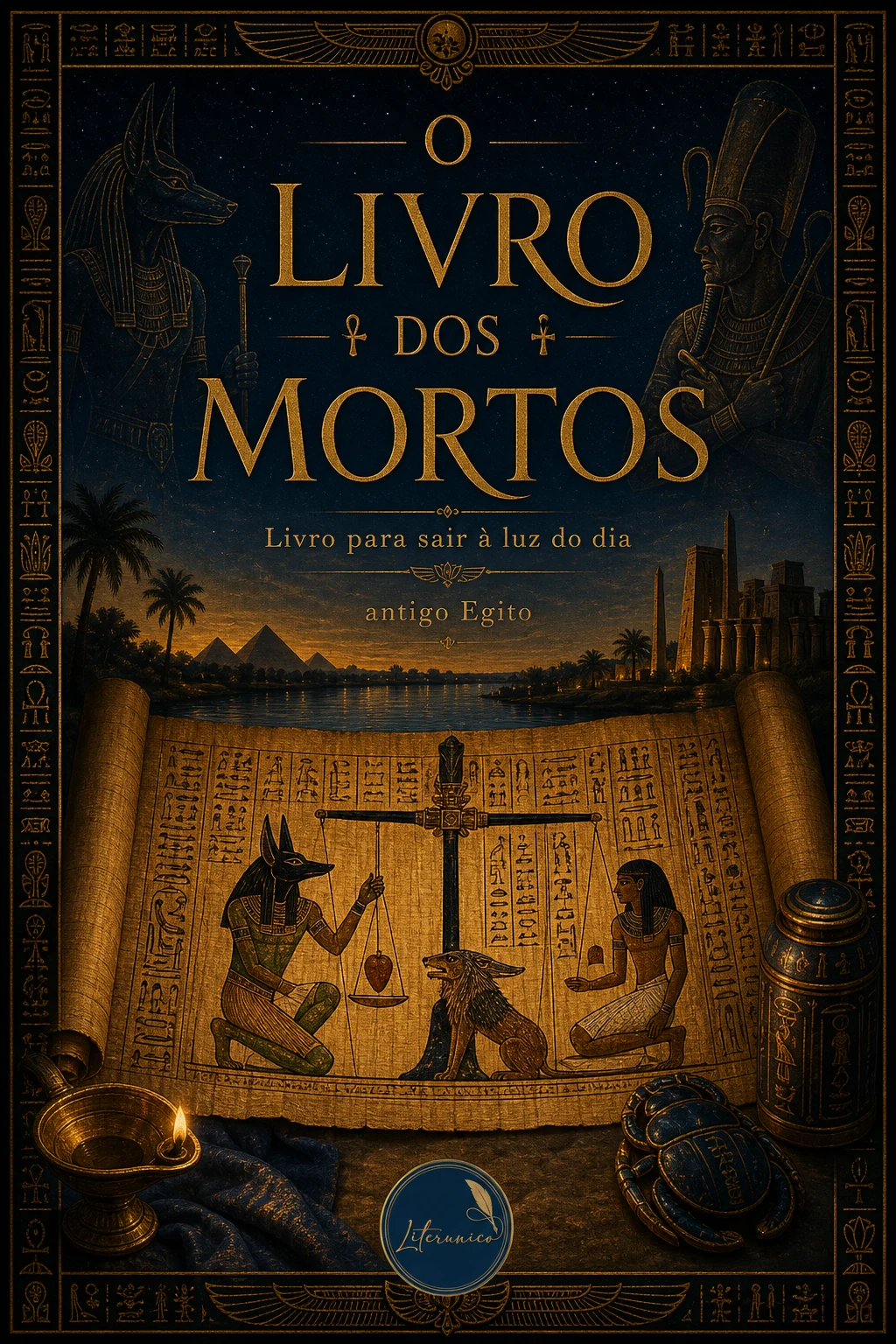
Universo da obra
Universo da obra
A Short Description of the "Doors" or Chapters of the Book of the Dead.
All the great papyri of the Book of the Dead begin with a HYMN TO RA,
who from the period of the IVth dynasty was the "King of the Gods"
of Egypt. His cult was finally "established" under the Vth dynasty
when the king of Egypt began to call himself in official documents
and monuments "Son of the Sun," Sa Ra. This Hymn is supposed to be
sung by the deceased, who says:--
"Homage to thee, O Ra, at thy beauteous rising. Thou risest, thou
risest; thou shinest, thou shinest at the dawn. Thou art King of
the Gods, and the Maati goddesses embrace thee. The Company of the
Gods praise thee at sunrise and at sunset. Thou sailest over the
heights of heaven and thy heart is glad. Thy Morning Boat meeteth
thy Evening Boat with fair winds. Thy father is the Sky-god and
thy mother is the Sky-goddess, and thou art Horus of the Eastern
and Western skies. ... O thou Only One, O thou Perfect One, O thou
who art eternal, who art never weak, whom no mighty one can abase;
none hath dominion over the things which appertain to thee. Homage to
thee in thy characters of Horus, Tem, and Khepera, thou Great Hawk,
who makest man to rejoice by thy beautiful face. When thou risest men
and women live. Thou renewest thy youth, and dost set thyself in the
place where thou wast yesterday. O Divine Youth, who art self-created,
I cannot comprehend thee. Thou art the lord of heaven and earth,
and didst create beings celestial and beings terrestrial. Thou art
the God One, who camest into being in the beginning of time. Thou
didst create the earth, and man, thou didst make the sky and the
celestial river Hep; thou didst make the waters and didst give life
unto all that therein is. Thou hast knit together the mountains, thou
hast made mankind and the beasts of the field to come into being, and
hast made the heavens and the earth. The fiend Nak is overthrown, his
arms are cut off. O thou Divine Youth, thou heir of everlastingness,
self-begotten and self-born, One, Might, of myriad forms and aspects,
Prince of An (i.e., On), Lord of Eternity, Everlasting Ruler, the
Company of the Gods rejoice in thee. As thou risest thou growest
greater: thy rays are upon all faces. Thou art unknowable, and no
tongue can describe thy similitude; thou existest alone. Millions
of years have passed over the world, I cannot tell the number of
those through which thou hast passed. Thou journeyest through spaces
[requiring] millions of years [to pass over] in one little moment of
time, and then thou settest and dost make an end of the hours."
The subject matter of the above extract is treated at greater length
in Chapter XV, which contains a long Hymn to Ra at his rising, or
Amen-Ra, or Ra united to other solar gods, e.g., Horus and Khepera,
and a short Hymn to Ra at his setting. In the latter the welcome
which Ra receives from the dwellers in Amentt (i.e., the Hidden Place,
like the Greek "Hades") is emphasized thus:--
"All the beautified dead (Aakhu) in the Tuat receive him in the horizon
of Amentt. They shout praises of him in his form of Tem (i.e., the
setting sun). Thou didst rise and put on strength, and thou settest,
a living being, and thy glories are in Amentt. The gods of Amentt
rejoice in thy beauties (or beneficence). The hidden ones worship
thee, the aged ones bring thee offerings and protect thee. The Souls
of Amentt cry out, and when they meet thy Majesty (Life, Strength,
Health be to thee!) they shout 'Hail! Hail!' The lords of the mansions
of the Tuat stretch out their hands to thee from their abodes,
and they cry to thee, and they follow in thy bright train, and the
hearts of the lords of the Tuat rejoice when thou sendest thy light
into Amentt. Their eyes follow thee, they press forward to see thee,
and their hearts rejoice at the sight of thy face. Thou hearkenest to
the petitions of those who are in their tombs, thou dispellest their
helplessness and drivest away evil from them. Thou givest breath to
their nostrils. Thou art greatly feared, thy form is majestic, and
very greatly art thou beloved by those who dwell in the Other World."
The Introductory HYMN TO RA is followed by a HYMN TO OSIRIS, in which
the deceased says:--
"Glory be to thee, O Osiris Un-Nefer, thou great god in Abtu
(Abydos), King of Eternity, Lord of Everlastingness, God whose
existence is millions of years, eldest son of Nut, begotten by Geb,
the Ancestor-Chief, Lord of the Crowns of the South and the North,
Lord of the High White Crown. Thou art the Governor of gods and of
men and hast received the sceptre, the whip, and the rank of thy
Divine Fathers. Let thy heart in Amentt be content, for thy son
Horus is seated upon thy throne. Thou art Lord of Tetu (Busiris)
and Governor of Abtu (Abydos). Thou makest fertile the Two Lands
(i.e., all Egypt) by [thy] true word before the Lord to the Uttermost
Limit.... Thy power is widespread, and great is the terror of thy name
'Osiris.' Thou endurest for all eternity in thy name of 'Un-Nefer'
(i.e., Beneficent Being). Homage to thee, King of kings, Lord of
lords, Governor of governors, who from the womb of the Sky-goddess
hast ruled the World and the Under World. Thy limbs are as silver-gold,
thy hand is blue like lapis-lazuli, and the space on either side
of thee is of the colour of turquoise (or emerald). Thou god An
of millions of years, thy body is all-pervading, O dweller in the
Land of Holiness, thy face is beautiful ... The gods come before
thee bowing low. They hold thee in fear. They withdraw and retreat
when they see the awfulness of Ra upon thee; the [thought] of the
conquests of thy Majesty is in their hearts. Life is with thee.
"Let me follow thy Majesty as when I was on earth, let my soul be
summoned, and let it be found near the Lords of Truth. I have come
to the City of God, the region that is eternally old, with my soul
(ba), double (ka) and spirit-soul (aakhu), to be a dweller in this
land. Its God is the Lord of Truth ... he giveth old age to him that
worketh Truth, and honour to his followers, and at the last abundant
equipment for the tomb, and burial in the Land of Holiness. I have
come unto thee, my hands hold Truth, and there is no falsehood in
my heart ... Thou hast set Truth before thee: I know on what thou
livest. I have committed no sin in this land, and I have defrauded
no man of his possessions." (Chapter CLXXXIII.)
Chapter I was recited by the priest who accompanied the mummy to
the tomb and performed the burial ceremonies there. In it the priest
(kher heb) assumed the character of Thoth and promised the deceased to
do for him all that he had done for Osiris in days of old. Chapter IB
gave the sahu, or "spirit-body," power to enter the Tuat immediately
after the burial of the material body, and delivered it from the
Nine Worms that lived on the dead. Chapters II-IV are short spells
written to give the deceased power to revisit the earth, to join the
gods, and to travel about the sky. Chapters V and VI provided for the
performance of agricultural labours in the Other World. The text of
Chapter VI was cut on figures made of stone, wood, etc. (ushabtiu),
which were placed in the tomb, and when the deceased recited it these
figures became alive and did everything he wished. The shabti figure,
took the place of the human funerary sacrifice which was common all
over Egypt before the general adoption of the cult of Osiris under
the XIIth dynasty. About 700 ushabtiu figures were found in the tomb
of Seti I, and many of them are in the British Museum. Chapter VII
is a spell to destroy the Great Serpent Aapep, the Arch-enemy of
Horus the Elder, Ra, Osiris, Horus son of Isis, and of every follower
of Osiris. Chapters VIII and IX secured a passage for the deceased
through the Tuat, and Chapters X and XI gave him power over the
enemies he met there. Chapters XII and XIII gave him great freedom of
movement in the Kingdom of Osiris. Chapter XIV is a prayer in which
Osiris is entreated to put away any feeling of dissatisfaction that
he may have for the deceased, who says, "Wash away my sins, Lord of
Truth; destroy my transgressions, wickedness and iniquity, O God of
Truth. May this god be at peace with me. Destroy the things that are
obstacles between us. Give me peace, and remove all dissatisfaction
from thy heart in respect of me."
Chapter XV has several forms, and each of them contains Hymns to Ra,
which were sung daily in the morning and evening; specimen paragraphs
are given above (pp. 33, 34). Chapter XVI is only a vignette that
illustrates Chapter XV, Chapter XVII is a very important chapter,
for it contains statements of divine doctrine as understood by the
priests of Heliopolis. The opening words are, "I am Tem in rising. I
am the Only One. I came into being in Nu (the Sky). I am Ra, who rose
in primeval time, ruler of what he had made." Following this comes the
question, "Who is this?" and the answer is, "It is Ra who rose in the
city of Hensu, in primeval time, crowned as king. He existed on the
height of the Dweller in Khemenu (i.e., Thoth of Hermopolis) before
the pillars that support the sky were made." Chapter XVIII contains
the Addresses to Thoth, who is entreated to make the deceased to be
declared innocent before the gods of Heliopolis, Busiris, Latopolis,
Mendes, Abydos, etc. These addresses formed a very powerful spell which
was used by Horus, and when he recited it four times all his enemies
were overthrown and cut to pieces. Chapters XIX and XX are variant
forms of Chapter XVIII. Chapters XXI-XXIII secured the help of Thoth
in "opening the mouth" of the deceased, whereby he obtained the power
to breathe and think and drink and eat. Thoth recited spells over the
gods whilst Ptah untied the bandages and Shu forced open their mouths
with an iron (?) knife. Chapter XXIV gave to the deceased a knowledge
of the "words of power" (hekau) which were used by the great god
Tem-Khepera, and Chapter XXV restored to him his memory. Five chapters,
XXVI-XXX, contain prayers and spells whereby the deceased obtained
power over his heart and gained absolute possession of it. The most
popular prayer is that of Chapter XXXB (see above, p. 4) which,
according to its rubric, was "found," i.e., edited, by Herutataf,
the son of the great Cheops, about 3600 B.C. This prayer was still
in use in the early years of the Christian Era. In the Papyrus of
Nu it is associated with Chapter LXIV, and the earliest form of it
was probably in existence under the Ist dynasty.
Chapters XXXI-XLII were written to deliver the deceased from the
Great Crocodile Sui, and the Serpents Rerek and Seksek, and the Lynx
with its deadly claws, and the Beetle Apshait, and the terrible Merti
snake-goddesses, and a group of three particularly venomous serpents,
and Aapep a personification of Set the god of evil, and the Eater
of the Ass, and a series of beings who lived by slaughtering the
souls of the dead. In Chapter XLII every member of the deceased is
put under the protection of, or identified with, a god or goddess,
e.g., the hair with Nu, the face with Aten (i.e., the solar disk),
the eyes with Hathor, and the deceased exclaims triumphantly, "There
is no member of my body which is not the member of a god." Chapter
XLIII. A spell to prevent the decapitation of the deceased, who
assumes in it the character of Osiris the Lord of Eternity. Chapter
XLIV. An ancient and mighty spell, the recital of which prevented the
deceased from dying a second time. Chapters XLV and XLVI preserved
the mummy of the deceased from decay, and Chapter XLVII prevented
the removal of his seat or throne. Chapter L enabled the deceased
to avoid the block of execution of the god Shesmu. Chapters LI-LIII
provided the deceased with pure food and clean water from the table
of the gods; he lived upon what they lived upon, and so became one
with them. Chapters LIV-LXII gave the deceased power to obtain cool
water from the Celestial Nile and the springs of waters of heaven, and
being identified with Shu, the god of light and air, he was enabled
to pass over all the earth at will. His life was that of the Egg of
the "Great Cackler," and the goddess Sesheta built a house for him
in the Celestial Anu, or Heliopolis.
The recital of Chapter LXIII enabled the deceased to avoid drinking
boiling water in the Tuat. The water in some of its pools was cool
and refreshing to those who were speakers of the truth, but it turned
into boiling water and scalded the wicked when they tried to drink
of it. Chapter LXIV is an epitome of the whole Book of the Dead,
and it formed a "great and divine protection" for the deceased. The
text is of a mystical character and suggests that the deceased could,
through its recital, either absorb the gods into his being, or become
himself absorbed by them. Its rubric orders abstention from meats,
fish and women on the part of those who were to recite it. Chapter LXV
gave the deceased victory over all his enemies, and Chapters LXVI and
LXVII gave him access to the Boat of Ra. Chapters LXVIII-LXX procured
him complete freedom of motion in heaven and on earth. Chapter LXXI
is a series of addresses to the Seven Spirits who punished the wicked
in the Kingdom of Osiris, and Chapter LXXII aided the deceased to
be reborn in the Mesqet Chamber. The Mesqet was originally a bull's
skin in which the deceased was wrapped. Chapter LXXIII is the same as
Chapter IX. Chapters LXXIV and LXXV secured a passage for the deceased
in the Henu Boat of Seker the Death-god, and Chapter LXXVI brought
to his help the praying mantis which guided him through the "bush"
to the House of Osiris. By the recital of Chapters LXXVII-LXXXVIII,
i.e., the "Chapters of Transformations," the deceased was enabled
to assume at will the forms of (1) the Golden Hawk, (2) the Divine
Hawk, (3) the Great Self-created God, (4) the Light-god or the Robe
of Nu, (5) the Pure Lily, (6) the Son of Ptah, (7) the Benu Bird,
(8) the Heron, (9) the Soul of Ra, (10) the Swallow, (11) the Sata
or Earth-serpent, (12) the Crocodile. Chapter LXXXIX brought the soul
(ba) of the deceased to his body in the Tuat, and Chapter XC preserved
him from mutilation and attacks of the god who "cut off heads and slit
foreheads." Chapters XCI and XCII prevented the soul of the deceased
from being shut in the tomb. Chapter XCIII is a spell very difficult
to understand. Chapters XCIV and XCV provided the deceased with the
books of Thoth and the power of this god, and enabled him to take his
place as the scribe of Osiris. Chapters XCVI and XCVII also placed him
under the protection of Thoth. The recital of Chapter XCVIII provided
the deceased with a boat in which to sail over the northern heavens,
and a ladder by which to ascend to heaven. Chapters XCIX-CIII gave him
the use of the magical boat, the mystic name of each part of which
he was obliged to know, and helped him to enter the Boat of Ra and
to be with Hathor. The Bebait, or mantis, led him to the great gods
(Chapter CIV), and the Uatch amulet from the neck of Ra provided
his double (ka) and his heart-soul (ba) with offerings (Chapters CV,
CVI). Chapters CVII-CIX made him favourably known to the spirits of
the East and West, and the gods of the Mountain of Sunrise. In this
region lived the terrible Serpent-god Ami-hem-f; he was 30 cubits
(50 feet) long. In the East the deceased saw the Morning Star, and
the Two Sycamores, from between which the Sun-god appeared daily,
and found the entrance to the Sekhet Aaru or Elysian Fields. Chapter
CX and its vignette of the Elysian Fields have already been described
(see p. 31). Chapters CXI and CXII describe how Horus lost the sight
of his eye temporarily through looking at Set under the form of a
black pig, and Chapter CXIII refers to the legend of the drowning of
Horus and the recovery of his body by Sebek the Crocodile-god. Chapter
CXIV enabled the deceased to absorb the wisdom of Thoth and his Eight
gods. Chapters CXV-CXXII made him lord of the Tuats of Memphis and
Heliopolis, and supplied him with food, and Chapter CXXIII enabled
him to identify himself with Thoth. Chapters CXXIV and CXXV, which
treat of the Judgment, have already been described. Chapter CXXVI
contains a prayer to the Four Holy Apes, Chapter CXXVII a hymn to
the gods of the "Circles" in the Tuat, and Chapter CXXVIII a hymn to
Osiris. Chapters CXXX and CXXXI secured for the deceased the use of
the Boats of Sunrise and Sunset, and Chapter CXXXII enabled him to
return to earth and visit the house he had lived in. Chapters CXXXIII
(or CXXXIX)-CXXXVI resemble in contents Chapter CXXXI. Chapter
CXXXVII describes a series of magical ceremonies that were to be
performed for the deceased daily in order to make him to become a
"living soul for ever." The formulae are said to have been composed
under the IVth dynasty. Chapter CXXXVIII refers to the ceremony of
reconstituting Osiris, and Chapters CXL-CXLII deal with the setting
up of twelve altars, and the making of offerings to all the gods and
to the various forms of Osiris. Chapter CXLIII consists of a series
of vignettes, in three of which solar boats are represented.
Chapters CXLIV and CXLVII deal with the Seven Great Halls (Arit) of
the Kingdom of Osiris. The gate of each Hall was guarded by a porter,
a watchman, and a messenger; the first kept the door, the second looked
out for the arrival of visitors, and the third took their names to
Osiris. No one could enter a Hall without repeating the name of it,
of the porter, of the watchman, and of the messenger. According to a
late tradition the Gates of the Kingdom of Osiris were twenty-one in
number (Chapters CXLV and CXLVI), and each had a magical name, and
each was guarded by one or two gods, whose names had to be repeated
by the deceased before he could pass. Chapter CXLVIII supplied the
deceased with the names of the Seven Cows and their Bull on which the
"gods" were supposed to feed. Chapters CXLIX and CL give the names
of the Fourteen Aats, or districts, of the Kingdom of Osiris. Chapter
*CLI-A and *CLI-B give a picture of the mummy chamber and the magical
texts that were necessary for the protection of both the chamber and
the mummy in it. Chapter CLII provided a house for the deceased in
the Celestial Anu, and Chapter *CLIII-A and *CLIII-B enabled his soul
to avoid capture in the net of the snarer of souls. Chapter CLIV is
an address to Osiris in which the deceased says, "I shall not decay,
nor rot, nor putrefy, nor become worms, nor see corruption. I shall
have my being, I shall live, I shall flourish, I shall rise up
in peace." Chapters CLV-CLXVII are spells which were engraved on
the amulets, giving the deceased the protection of Ra, Osiris, Isis,
Horus, and other gods. The remaining Chapters (CLXVIII-CXC) are of a
miscellaneous character, and few of them are found in more than one
or two papyri of the Book of the Dead. A few contain hymns that are
not older than the XVIIIth dynasty, and one is an extract from the
text on the Pyramid of Unas (lines 379-399). The most interesting is,
perhaps, Chapter CLXXV, which describes the Tuat as airless,
waterless, and lightless. In this chapter the deceased is assured
of immortality in the words, "Thou shalt live for millions of millions
of years, a life of millions of years."
E. A. Wallis Budge.
Department of Egyptian and Assyrian Antiquities, British Museum.
April 15, 1920.
Note.
The Trustees of the British Museum have published:--
1. Coloured facsimile of the Papyrus of Hunefer, XIXth dynasty,
with hieroglyphic transcript and translation. 11 plates, large folio.
2. Coloured facsimile of the Papyrus of Anhai, XXIst dynasty, with
hieroglyphic transcript and translation. 8 plates, large folio.
3. Collotype reproduction of the Papyrus of Queen Netchemet, XXIst
dynasty, with hieroglyphic transcript and translation. 12 plates,
large folio.
4. Coloured reproduction of the hieratic text of the Book of
Breathings, with hieroglyphic transcript and translation. With 2
collotypes of the vignettes, large folio.
5. Hieroglyphic transcript of the Papyrus of Nu, with one collotype
plate.
Nos. 1-5 are bound in one volume, price £2 10s.
6. Collotype reproduction of the Papyrus of Queen Nesi-ta-nebt-ashru,
with full descriptions of the vignettes, translations, and
introduction, containing several illustrations, and 116 plates of
hieratic text. Large 4to. Price £2 10s.
Public domain English edition of The Book of the Dead by Sir E. A. Wallis Budge, preserved by Project Gutenberg.
Ainda não há resenhas para esta obra. A primeira leitura comentada pode começar aqui.
Escolha a arte, confira a disponibilidade e adicione o produto ao carrinho sem sair da experiência.
Adquira Relíquias da Obra e deixe sua marca registrada, criando valor ao item!

Capa frontal, contracapa, Capa Aberta e Marca-Páginas pertencem à obra e acompanham este Universes.
Escolha uma Relíquia no painel principal para enviar uma proposta ao autor.
Capítulos disponíveis para continuar a leitura.
Nenhuma Relíquia desta obra foi adquirida ainda. Seja o primeiro a eternizar seu nome no acervo oficial!
Conhecer as 100 RelíquiasAinda não há resenhas para esta obra. A primeira leitura comentada pode começar aqui.
Nenhuma posse foi registrada publicamente para esta edição.
Durante a leitura, abra Menu para ajustar a experiência sem sair do capítulo. As preferências de aparência ficam salvas neste aparelho.
Recursos identificados como “em preparo” aparecem para antecipar a evolução do leitor, mas ainda não executam uma ação.
Posso mostrar leituras em destaque, clássicos e Relíquias disponíveis agora no Literúnico.
Escolha um caminho
Dúvidas desta página
As explicações do Aurélio são respostas cadastradas pelo Literúnico.