
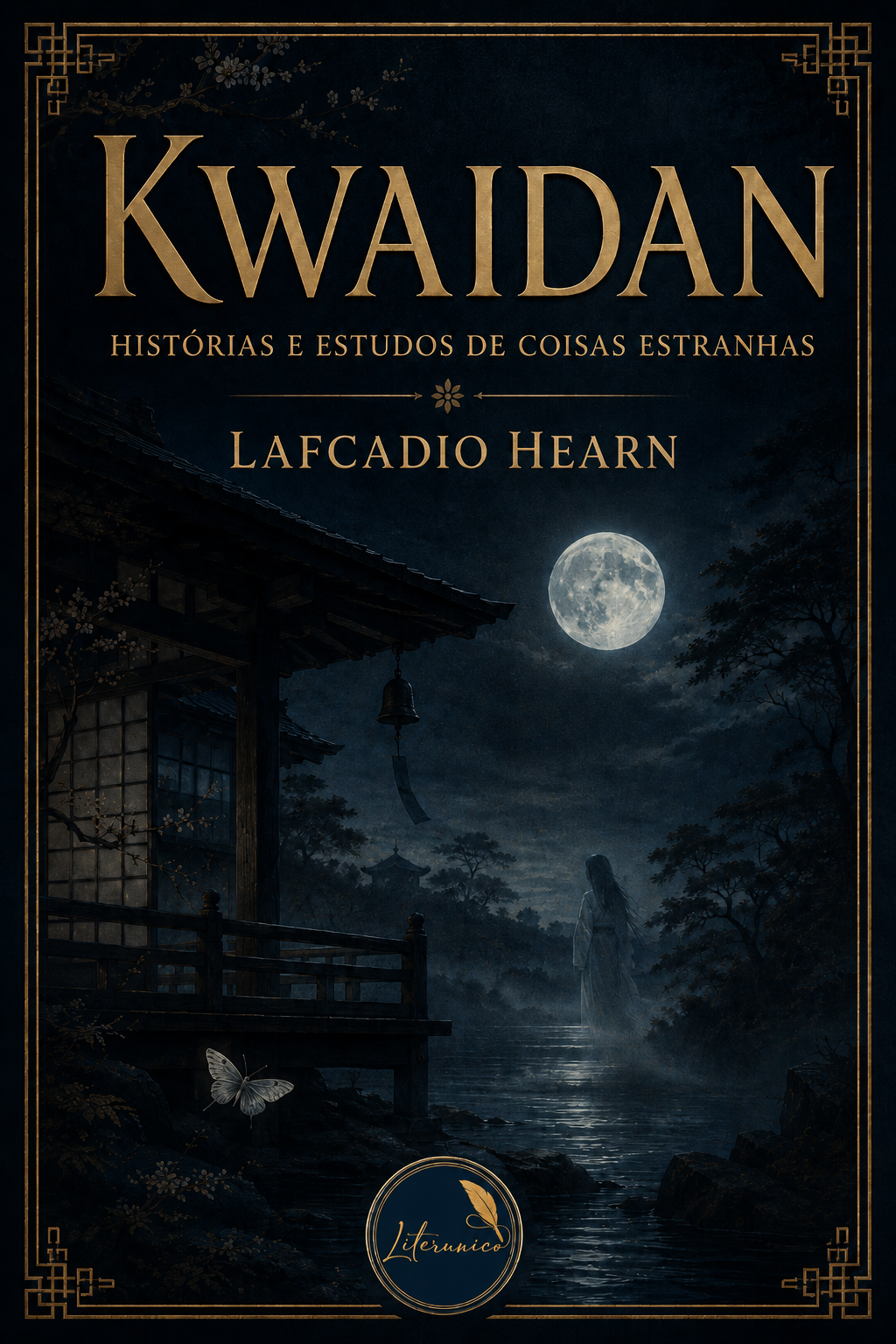
Universo da obra
Universo da obra
Once, when Musō Kokushi, a priest of the Zen sect, was journeying alone
through the province of Mino (1), he lost his way in a
mountain-district where there was nobody to direct him. For a long time
he wandered about helplessly; and he was beginning to despair of
finding shelter for the night, when he perceived, on the top of a hill
lighted by the last rays of the sun, one of those little hermitages,
called _anjitsu_, which are built for solitary priests. It seemed to be
in ruinous condition; but he hastened to it eagerly, and found that it
was inhabited by an aged priest, from whom he begged the favor of a
night’s lodging. This the old man harshly refused; but he directed Musō
to a certain hamlet, in the valley adjoining where lodging and food
could be obtained.
Musō found his way to the hamlet, which consisted of less than a dozen
farm-cottages; and he was kindly received at the dwelling of the
headman. Forty or fifty persons were assembled in the principal
apartment, at the moment of Musō’s arrival; but he was shown into a
small separate room, where he was promptly supplied with food and
bedding. Being very tired, he lay down to rest at an early hour; but a
little before midnight he was roused from sleep by a sound of loud
weeping in the next apartment. Presently the sliding-screens were
gently pushed apart; and a young man, carrying a lighted lantern,
entered the room, respectfully saluted him, and said:—
“Reverend Sir, it is my painful duty to tell you that I am now the
responsible head of this house. Yesterday I was only the eldest son.
But when you came here, tired as you were, we did not wish that you
should feel embarrassed in any way: therefore we did not tell you that
father had died only a few hours before. The people whom you saw in the
next room are the inhabitants of this village: they all assembled here
to pay their last respects to the dead; and now they are going to
another village, about three miles off,—for by our custom, no one of us
may remain in this village during the night after a death has taken
place. We make the proper offerings and prayers;—then we go away,
leaving the corpse alone. Strange things always happen in the house
where a corpse has thus been left: so we think that it will be better
for you to come away with us. We can find you good lodging in the other
village. But perhaps, as you are a priest, you have no fear of demons
or evil spirits; and, if you are not afraid of being left alone with
the body, you will be very welcome to the use of this poor house.
However, I must tell you that nobody, except a priest, would dare to
remain here tonight.”
Musō made answer:—
“For your kind intention and your generous hospitality, I am deeply
grateful. But I am sorry that you did not tell me of your father’s
death when I came;—for, though I was a little tired, I certainly was
not so tired that I should have found difficulty in doing my duty as a
priest. Had you told me, I could have performed the service before your
departure. As it is, I shall perform the service after you have gone
away; and I shall stay by the body until morning. I do not know what
you mean by your words about the danger of staying here alone; but I am
not afraid of ghosts or demons: therefore please to feel no anxiety on
my account.”
The young man appeared to be rejoiced by these assurances, and
expressed his gratitude in fitting words. Then the other members of the
family, and the folk assembled in the adjoining room, having been told
of the priest’s kind promises, came to thank him,—after which the
master of the house said:—
“Now, reverend Sir, much as we regret to leave you alone, we must bid
you farewell. By the rule of our village, none of us can stay here
after midnight. We beg, kind Sir, that you will take every care of your
honorable body, while we are unable to attend upon you. And if you
happen to hear or see anything strange during our absence, please tell
us of the matter when we return in the morning.”
All then left the house, except the priest, who went to the room where
the dead body was lying. The usual offerings had been set before the
corpse; and a small Buddhist lamp—_tōmyō_—was burning. The priest
recited the service, and performed the funeral ceremonies,—after which
he entered into meditation. So meditating he remained through several
silent hours; and there was no sound in the deserted village. But, when
the hush of the night was at its deepest, there noiselessly entered a
Shape, vague and vast; and in the same moment Musō found himself
without power to move or speak. He saw that Shape lift the corpse, as
with hands, devour it, more quickly than a cat devours a rat,—beginning
at the head, and eating everything: the hair and the bones and even the
shroud. And the monstrous Thing, having thus consumed the body, turned
to the offerings, and ate them also. Then it went away, as mysteriously
as it had come.
When the villagers returned next morning, they found the priest
awaiting them at the door of the headman’s dwelling. All in turn
saluted him; and when they had entered, and looked about the room, no
one expressed any surprise at the disappearance of the dead body and
the offerings. But the master of the house said to Musō:—
“Reverent Sir, you have probably seen unpleasant things during the
night: all of us were anxious about you. But now we are very happy to
find you alive and unharmed. Gladly we would have stayed with you, if
it had been possible. But the law of our village, as I told you last
evening, obliges us to quit our houses after a death has taken place,
and to leave the corpse alone. Whenever this law has been broken,
heretofore, some great misfortune has followed. Whenever it is obeyed,
we find that the corpse and the offerings disappear during our absence.
Perhaps you have seen the cause.”
Then Musō told of the dim and awful Shape that had entered the
death-chamber to devour the body and the offerings. No person seemed to
be surprised by his narration; and the master of the house observed:—
“What you have told us, reverend Sir, agrees with what has been said
about this matter from ancient time.”
Musō then inquired:—
“Does not the priest on the hill sometimes perform the funeral service
for your dead?”
“What priest?” the young man asked.
“The priest who yesterday evening directed me to this village,”
answered Musō. “I called at his _anjitsu_ on the hill yonder. He
refused me lodging, but told me the way here.”
The listeners looked at each other, as in astonishment; and, after a
moment of silence, the master of the house said:—
“Reverend Sir, there is no priest and there is no _anjitsu_ on the
hill. For the time of many generations there has not been any
resident-priest in this neighborhood.”
Musō said nothing more on the subject; for it was evident that his kind
hosts supposed him to have been deluded by some goblin. But after
having bidden them farewell, and obtained all necessary information as
to his road, he determined to look again for the hermitage on the hill,
and so to ascertain whether he had really been deceived. He found the
_anjitsu_ without any difficulty; and, this time, its aged occupant
invited him to enter. When he had done so, the hermit humbly bowed down
before him, exclaiming:—“Ah! I am ashamed!—I am very much ashamed!—I am
exceedingly ashamed!”
“You need not be ashamed for having refused me shelter,” said Musō.
“You directed me to the village yonder, where I was very kindly
treated; and I thank you for that favor.”
“I can give no man shelter,” the recluse made answer;—“and it is not
for the refusal that I am ashamed. I am ashamed only that you should
have seen me in my real shape,—for it was I who devoured the corpse and
the offerings last night before your eyes... Know, reverend Sir, that I
am a _jikininki_,[1]—an eater of human flesh. Have pity upon me, and
suffer me to confess the secret fault by which I became reduced to this
condition.
“A long, long time ago, I was a priest in this desolate region. There
was no other priest for many leagues around. So, in that time, the
bodies of the mountain-folk who died used to be brought here,—sometimes
from great distances,—in order that I might repeat over them the holy
service. But I repeated the service and performed the rites only as a
matter of business;—I thought only of the food and the clothes that my
sacred profession enabled me to gain. And because of this selfish
impiety I was reborn, immediately after my death, into the state of a
_jikininki_. Since then I have been obliged to feed upon the corpses of
the people who die in this district: every one of them I must devour in
the way that you saw last night... Now, reverend Sir, let me beseech
you to perform a Ségaki-service[2] for me: help me by your prayers, I
entreat you, so that I may be soon able to escape from this horrible
state of existence”...
No sooner had the hermit uttered this petition than he disappeared; and
the hermitage also disappeared at the same instant. And Musō Kokushi
found himself kneeling alone in the high grass, beside an ancient and
moss-grown tomb of the form called _go-rin-ishi_,[3] which seemed to be
the tomb of a priest.
Texto original em EN preservado no Literunico para leitura comparada com a edição/tradução da Copa Literunico. Fonte-base: https://www.gutenberg.org/cache/epub/1210/pg1210.txt
Ainda não há resenhas para esta obra. A primeira leitura comentada pode começar aqui.
Escolha a arte, confira a disponibilidade e adicione o produto ao carrinho sem sair da experiência.
Adquira Relíquias da Obra e deixe sua marca registrada, criando valor ao item!

Capa frontal, contracapa, Capa Aberta e Marca-Páginas pertencem à obra e acompanham este Universes.
Escolha uma Relíquia no painel principal para enviar uma proposta ao autor.
Capítulos disponíveis para continuar a leitura.
Nenhuma Relíquia desta obra foi adquirida ainda. Seja o primeiro a eternizar seu nome no acervo oficial!
Conhecer as 100 RelíquiasAinda não há resenhas para esta obra. A primeira leitura comentada pode começar aqui.
Nenhuma posse foi registrada publicamente para esta edição.
Durante a leitura, abra Menu para ajustar a experiência sem sair do capítulo. As preferências de aparência ficam salvas neste aparelho.
Recursos identificados como “em preparo” aparecem para antecipar a evolução do leitor, mas ainda não executam uma ação.
Posso mostrar leituras em destaque, clássicos e Relíquias disponíveis agora no Literúnico.
Escolha um caminho
Dúvidas desta página
As explicações do Aurélio são respostas cadastradas pelo Literúnico.