
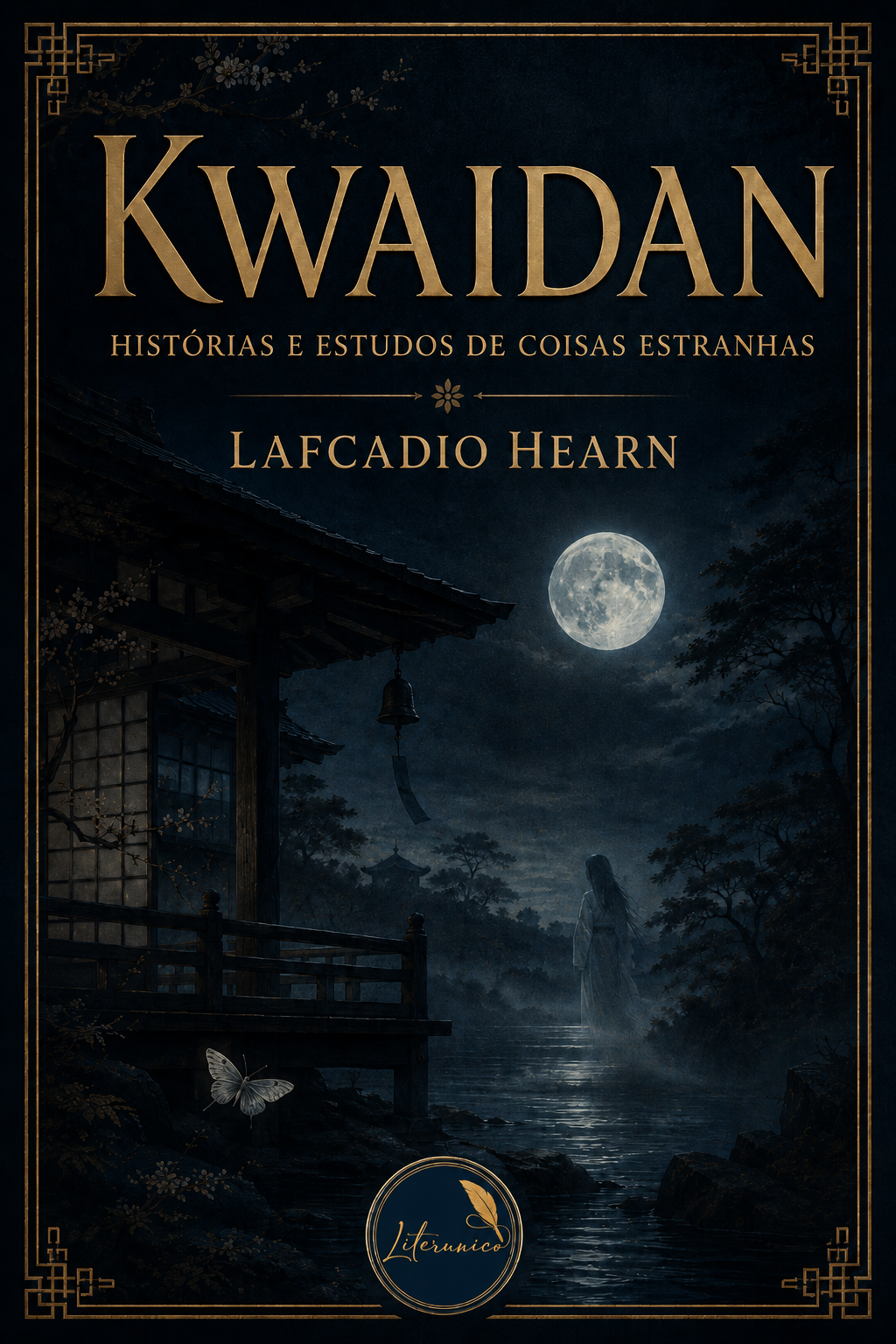
Universo da obra
Universo da obra
(1) Kana: the Japanese phonetic alphabet.
(2) “So-and-so”: appellation used by Hearn in place of the real name.
(3) A section of Tōkyō.
[1] A square piece of cotton-goods, or other woven material, used as a
wrapper in which to carry small packages.
(4) Ten yen is nothing now, but was a formidable sum then.
(1) Haiku.
[1] “The modest nymph beheld her God, and blushed.” (Or, in a more
familiar rendering: “The modest water saw its God, and blushed.”) In
this line the double value of the word _nympha_—used by classical
poets both in the meaning of fountain and in that of the divinity of a
fountain, or spring—reminds one of that graceful playing with words
which Japanese poets practice.
[2] More usually written _nugi-kakéru_, which means either “to take
off and hang up,” or “to begin to take off,”—as in the above poem.
More loosely, but more effectively, the verses might thus be rendered:
“Like a woman slipping off her haori—that is the appearance of a
butterfly.” One must have seen the Japanese garment described, to
appreciate the comparison. The haori is a silk upper-dress,—a kind of
sleeved cloak,—worn by both sexes; but the poem suggests a woman’s
_haori_, which is usually of richer color or material. The sleeves are
wide; and the lining is usually of brightly-colored silk, often
beautifully variegated. In taking off the haori, the brilliant lining
is displayed,—and at such an instant the fluttering splendor might
well be likened to the appearance of a butterfly in motion.
[3] The bird-catcher’s pole is smeared with bird-lime; and the verses
suggest that the insect is preventing the man from using his pole, by
persistently getting in the way of it,—as the birds might take warning
from seeing the butterfly limed. _Jama suru_ means “to hinder” or
“prevent.”
[4] Even while it is resting, the wings of the butterfly may be seen
to quiver at moments,—as if the creature were dreaming of flight.
[5] A little poem by Bashō, greatest of all Japanese composers of
_hokku_. The verses are intended to suggest the joyous feeling of
spring-time.
[6] Literally, “a windless day;” but two negatives in Japanese poetry
do not necessarily imply an affirmative, as in English. The meaning
is, that although there is no wind, the fluttering motion of the
butterflies suggests, to the eyes at least, that a strong breeze is
playing.
[7] Alluding to the Buddhist proverb: _Rakkwa éda ni kaërazu; ha-kyō
futatabi terasazu_ (“The fallen flower returns not to the branch; the
broken mirror never again reflects.”) So says the proverb—yet it
seemed to me that I saw a fallen flower return to the branch... No: it
was only a butterfly.
[8] Alluding probably to the light fluttering motion of falling
cherry-petals.
[9] That is to say, the grace of their motion makes one think of the
grace of young girls, daintily costumed, in robes with long fluttering
sleeves... And old Japanese proverb declares that even a devil is
pretty at eighteen: _Oni mo jiu-hachi azami no hana:_ “Even a devil at
eighteen, flower-of-the-thistle.”
[10] Or perhaps the verses might be more effectively rendered thus:
“Happy together, do you say? Yes—if we should be reborn as
field-butterflies in some future life: then we might accord!” This
poem was composed by the celebrated poet Issa, on the occasion of
divorcing his wife.
[11] Or, _Taré no tama?_
[12] Literally, “Butterfly-pursuing heart I wish to have
always;”—_i.e._, I would that I might always be able to find pleasure
in simple things, like a happy child.
[13] An old popular error,—probably imported from China.
[14] A name suggested by the resemblance of the larva’s artificial
covering to the _mino_, or straw-raincoat, worn by Japanese peasants.
I am not sure whether the dictionary rendering, “basket-worm,” is
quite correct;—but the larva commonly called _minomushi_ does really
construct for itself something much like the covering of the
basket-worm.
(2) A very large, white radish. “Daikon” literally means “big root.”
[15] _Pyrus spectabilis_.
[16] An evil spirit.
(3) A common female name.
(1) Meiji: The period in which Hearn wrote this book. It lasted from
1868 to 1912, and was a time when Japan plunged head-first into
Western-style modernization. By the “fashions and the changes and the
disintegrations of Meiji” Hearn is lamenting that this process of
modernization was destroying some of the good things in traditional
Japanese culture.
(1) Cicadas.
[1] An interesting fact in this connection is that the Japanese word
for ant, _ari_, is represented by an ideograph formed of the character
for “insect” combined with the character signifying “moral rectitude,”
“propriety” (_giri_). So the Chinese character actually means “The
Propriety-Insect.”
Texto original em EN preservado no Literunico para leitura comparada com a edição/tradução da Copa Literunico. Fonte-base: https://www.gutenberg.org/cache/epub/1210/pg1210.txt
Ainda não há resenhas para esta obra. A primeira leitura comentada pode começar aqui.
Escolha a arte, confira a disponibilidade e adicione o produto ao carrinho sem sair da experiência.
Adquira Relíquias da Obra e deixe sua marca registrada, criando valor ao item!

Capa frontal, contracapa, Capa Aberta e Marca-Páginas pertencem à obra e acompanham este Universes.
Escolha uma Relíquia no painel principal para enviar uma proposta ao autor.
Capítulos disponíveis para continuar a leitura.
Nenhuma Relíquia desta obra foi adquirida ainda. Seja o primeiro a eternizar seu nome no acervo oficial!
Conhecer as 100 RelíquiasAinda não há resenhas para esta obra. A primeira leitura comentada pode começar aqui.
Nenhuma posse foi registrada publicamente para esta edição.
Durante a leitura, abra Menu para ajustar a experiência sem sair do capítulo. As preferências de aparência ficam salvas neste aparelho.
Recursos identificados como “em preparo” aparecem para antecipar a evolução do leitor, mas ainda não executam uma ação.
Posso mostrar leituras em destaque, clássicos e Relíquias disponíveis agora no Literúnico.
Escolha um caminho
Dúvidas desta página
As explicações do Aurélio são respostas cadastradas pelo Literúnico.