
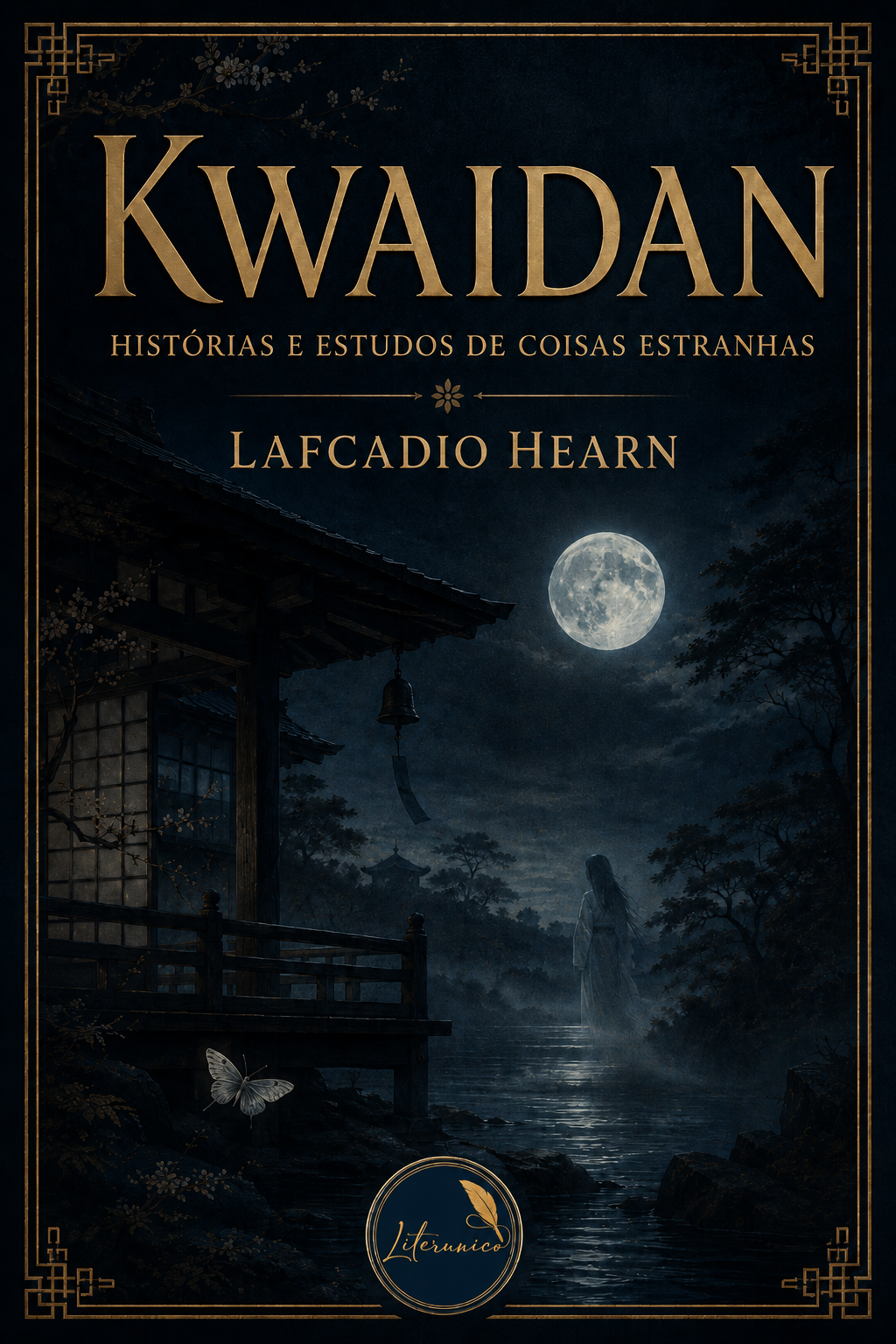
Universo da obra
Universo da obra
In the district called Toïchi of Yamato Province, (1) there used to
live a gōshi named Miyata Akinosuké... [Here I must tell you that in
Japanese feudal times there was a privileged class of
soldier-farmers,—free-holders,—corresponding to the class of yeomen in
England; and these were called gōshi.]
In Akinosuké’s garden there was a great and ancient cedar-tree, under
which he was wont to rest on sultry days. One very warm afternoon he
was sitting under this tree with two of his friends, fellow-gōshi,
chatting and drinking wine, when he felt all of a sudden very
drowsy,—so drowsy that he begged his friends to excuse him for taking a
nap in their presence. Then he lay down at the foot of the tree, and
dreamed this dream:—
He thought that as he was lying there in his garden, he saw a
procession, like the train of some great daimyō descending a hill near
by, and that he got up to look at it. A very grand procession it proved
to be,—more imposing than anything of the kind which he had ever seen
before; and it was advancing toward his dwelling. He observed in the
van of it a number of young men richly appareled, who were drawing a
great lacquered palace-carriage, or _gosho-guruma_, hung with bright
blue silk. When the procession arrived within a short distance of the
house it halted; and a richly dressed man—evidently a person of
rank—advanced from it, approached Akinosuké, bowed to him profoundly,
and then said:—
“Honored Sir, you see before you a _kérai_ [vassal] of the Kokuō of
Tokoyo.[1] My master, the King, commands me to greet you in his august
name, and to place myself wholly at your disposal. He also bids me
inform you that he augustly desires your presence at the palace. Be
therefore pleased immediately to enter this honorable carriage, which
he has sent for your conveyance.”
Upon hearing these words Akinosuké wanted to make some fitting reply;
but he was too much astonished and embarrassed for speech;—and in the
same moment his will seemed to melt away from him, so that he could
only do as the _kérai_ bade him. He entered the carriage; the _kérai_
took a place beside him, and made a signal; the drawers, seizing the
silken ropes, turned the great vehicle southward;—and the journey
began.
In a very short time, to Akinosuké’s amazement, the carriage stopped in
front of a huge two-storied gateway (_rōmon_), of a Chinese style,
which he had never before seen. Here the _kérai_ dismounted, saying, “I
go to announce the honorable arrival,”—and he disappeared. After some
little waiting, Akinosuké saw two noble-looking men, wearing robes of
purple silk and high caps of the form indicating lofty rank, come from
the gateway. These, after having respectfully saluted him, helped him
to descend from the carriage, and led him through the great gate and
across a vast garden, to the entrance of a palace whose front appeared
to extend, west and east, to a distance of miles. Akinosuké was then
shown into a reception-room of wonderful size and splendor. His guides
conducted him to the place of honor, and respectfully seated themselves
apart; while serving-maids, in costume of ceremony, brought
refreshments. When Akinosuké had partaken of the refreshments, the two
purple-robed attendants bowed low before him, and addressed him in the
following words,—each speaking alternately, according to the etiquette
of courts:—
“It is now our honorable duty to inform you... as to the reason of your
having been summoned hither... Our master, the King, augustly desires
that you become his son-in-law;... and it is his wish and command that
you shall wed this very day... the August Princess, his
maiden-daughter... We shall soon conduct you to the presence-chamber...
where His Augustness even now is waiting to receive you... But it will
be necessary that we first invest you... with the appropriate garments
of ceremony.”[2]
Having thus spoken, the attendants rose together, and proceeded to an
alcove containing a great chest of gold lacquer. They opened the chest,
and took from it various robes and girdles of rich material, and a
_kamuri_, or regal headdress. With these they attired Akinosuké as
befitted a princely bridegroom; and he was then conducted to the
presence-room, where he saw the Kokuō of Tokoyo seated upon the
_daiza_,[3] wearing a high black cap of state, and robed in robes of
yellow silk. Before the _daiza_, to left and right, a multitude of
dignitaries sat in rank, motionless and splendid as images in a temple;
and Akinosuké, advancing into their midst, saluted the king with the
triple prostration of usage. The king greeted him with gracious words,
and then said:—
“You have already been informed as to the reason of your having been
summoned to Our presence. We have decided that you shall become the
adopted husband of Our only daughter;—and the wedding ceremony shall
now be performed.”
As the king finished speaking, a sound of joyful music was heard; and a
long train of beautiful court ladies advanced from behind a curtain to
conduct Akinosuké to the room in which his bride awaited him.
The room was immense; but it could scarcely contain the multitude of
guests assembled to witness the wedding ceremony. All bowed down before
Akinosuké as he took his place, facing the King’s daughter, on the
kneeling-cushion prepared for him. As a maiden of heaven the bride
appeared to be; and her robes were beautiful as a summer sky. And the
marriage was performed amid great rejoicing.
Afterwards the pair were conducted to a suite of apartments that had
been prepared for them in another portion of the palace; and there they
received the congratulations of many noble persons, and wedding gifts
beyond counting.
Some days later Akinosuké was again summoned to the throne-room. On
this occasion he was received even more graciously than before; and the
King said to him:—
“In the southwestern part of Our dominion there is an island called
Raishū. We have now appointed you Governor of that island. You will
find the people loyal and docile; but their laws have not yet been
brought into proper accord with the laws of Tokoyo; and their customs
have not been properly regulated. We entrust you with the duty of
improving their social condition as far as may be possible; and We
desire that you shall rule them with kindness and wisdom. All
preparations necessary for your journey to Raishū have already been
made.”
So Akinosuké and his bride departed from the palace of Tokoyo,
accompanied to the shore by a great escort of nobles and officials; and
they embarked upon a ship of state provided by the king. And with
favoring winds they safety sailed to Raishū, and found the good people
of that island assembled upon the beach to welcome them.
Akinosuké entered at once upon his new duties; and they did not prove
to be hard. During the first three years of his governorship he was
occupied chiefly with the framing and the enactment of laws; but he had
wise counselors to help him, and he never found the work unpleasant.
When it was all finished, he had no active duties to perform, beyond
attending the rites and ceremonies ordained by ancient custom. The
country was so healthy and so fertile that sickness and want were
unknown; and the people were so good that no laws were ever broken. And
Akinosuké dwelt and ruled in Raishū for twenty years more,—making in
all twenty-three years of sojourn, during which no shadow of sorrow
traversed his life.
But in the twenty-fourth year of his governorship, a great misfortune
came upon him; for his wife, who had borne him seven children,—five
boys and two girls,—fell sick and died. She was buried, with high pomp,
on the summit of a beautiful hill in the district of Hanryōkō; and a
monument, exceedingly splendid, was placed upon her grave. But
Akinosuké felt such grief at her death that he no longer cared to live.
Now when the legal period of mourning was over, there came to Raishū,
from the Tokoyo palace, a _shisha_, or royal messenger. The _shisha_
delivered to Akinosuké a message of condolence, and then said to him:—
“These are the words which our august master, the King of Tokoyo,
commands that I repeat to you: ‘We will now send you back to your own
people and country. As for the seven children, they are the grandsons
and granddaughters of the King, and shall be fitly cared for. Do not,
therefore, allow your mind to be troubled concerning them.’”
On receiving this mandate, Akinosuké submissively prepared for his
departure. When all his affairs had been settled, and the ceremony of
bidding farewell to his counselors and trusted officials had been
concluded, he was escorted with much honor to the port. There he
embarked upon the ship sent for him; and the ship sailed out into the
blue sea, under the blue sky; and the shape of the island of Raishū
itself turned blue, and then turned grey, and then vanished forever...
And Akinosuké suddenly awoke—under the cedar-tree in his own garden!
For a moment he was stupefied and dazed. But he perceived his two
friends still seated near him,—drinking and chatting merrily. He stared
at them in a bewildered way, and cried aloud,—
“How strange!”
“Akinosuké must have been dreaming,” one of them exclaimed, with a
laugh. “What did you see, Akinosuké, that was strange?”
Then Akinosuké told his dream,—that dream of three-and-twenty years’
sojourn in the realm of Tokoyo, in the island of Raishū;—and they were
astonished, because he had really slept for no more than a few minutes.
One gōshi said:—
“Indeed, you saw strange things. We also saw something strange while
you were napping. A little yellow butterfly was fluttering over your
face for a moment or two; and we watched it. Then it alighted on the
ground beside you, close to the tree; and almost as soon as it alighted
there, a big, big ant came out of a hole and seized it and pulled it
down into the hole. Just before you woke up, we saw that very butterfly
come out of the hole again, and flutter over your face as before. And
then it suddenly disappeared: we do not know where it went.”
“Perhaps it was Akinosuké’s soul,” the other gōshi said;—“certainly I
thought I saw it fly into his mouth... But, even if that butterfly
_was_ Akinosuké’s soul, the fact would not explain his dream.”
“The ants might explain it,” returned the first speaker. “Ants are
queer beings—possibly goblins... Anyhow, there is a big ant’s nest
under that cedar-tree.”...
“Let us look!” cried Akinosuké, greatly moved by this suggestion. And
he went for a spade.
The ground about and beneath the cedar-tree proved to have been
excavated, in a most surprising way, by a prodigious colony of ants.
The ants had furthermore built inside their excavations; and their tiny
constructions of straw, clay, and stems bore an odd resemblance to
miniature towns. In the middle of a structure considerably larger than
the rest there was a marvelous swarming of small ants around the body
of one very big ant, which had yellowish wings and a long black head.
“Why, there is the King of my dream!” cried Akinosuké; “and there is
the palace of Tokoyo!... How extraordinary!... Raishū ought to lie
somewhere southwest of it—to the left of that big root... Yes!—here it
is!... How very strange! Now I am sure that I can find the mountain of
Hanryōkō, and the grave of the princess.”...
In the wreck of the nest he searched and searched, and at last
discovered a tiny mound, on the top of which was fixed a water-worn
pebble, in shape resembling a Buddhist monument. Underneath it he
found—embedded in clay—the dead body of a female ant.
Texto original em EN preservado no Literunico para leitura comparada com a edição/tradução da Copa Literunico. Fonte-base: https://www.gutenberg.org/cache/epub/1210/pg1210.txt
Ainda não há resenhas para esta obra. A primeira leitura comentada pode começar aqui.
Escolha a arte, confira a disponibilidade e adicione o produto ao carrinho sem sair da experiência.
Adquira Relíquias da Obra e deixe sua marca registrada, criando valor ao item!

Capa frontal, contracapa, Capa Aberta e Marca-Páginas pertencem à obra e acompanham este Universes.
Escolha uma Relíquia no painel principal para enviar uma proposta ao autor.
Capítulos disponíveis para continuar a leitura.
Nenhuma Relíquia desta obra foi adquirida ainda. Seja o primeiro a eternizar seu nome no acervo oficial!
Conhecer as 100 RelíquiasAinda não há resenhas para esta obra. A primeira leitura comentada pode começar aqui.
Nenhuma posse foi registrada publicamente para esta edição.
Durante a leitura, abra Menu para ajustar a experiência sem sair do capítulo. As preferências de aparência ficam salvas neste aparelho.
Recursos identificados como “em preparo” aparecem para antecipar a evolução do leitor, mas ainda não executam uma ação.
Posso mostrar leituras em destaque, clássicos e Relíquias disponíveis agora no Literúnico.
Escolha um caminho
Dúvidas desta página
As explicações do Aurélio são respostas cadastradas pelo Literúnico.