
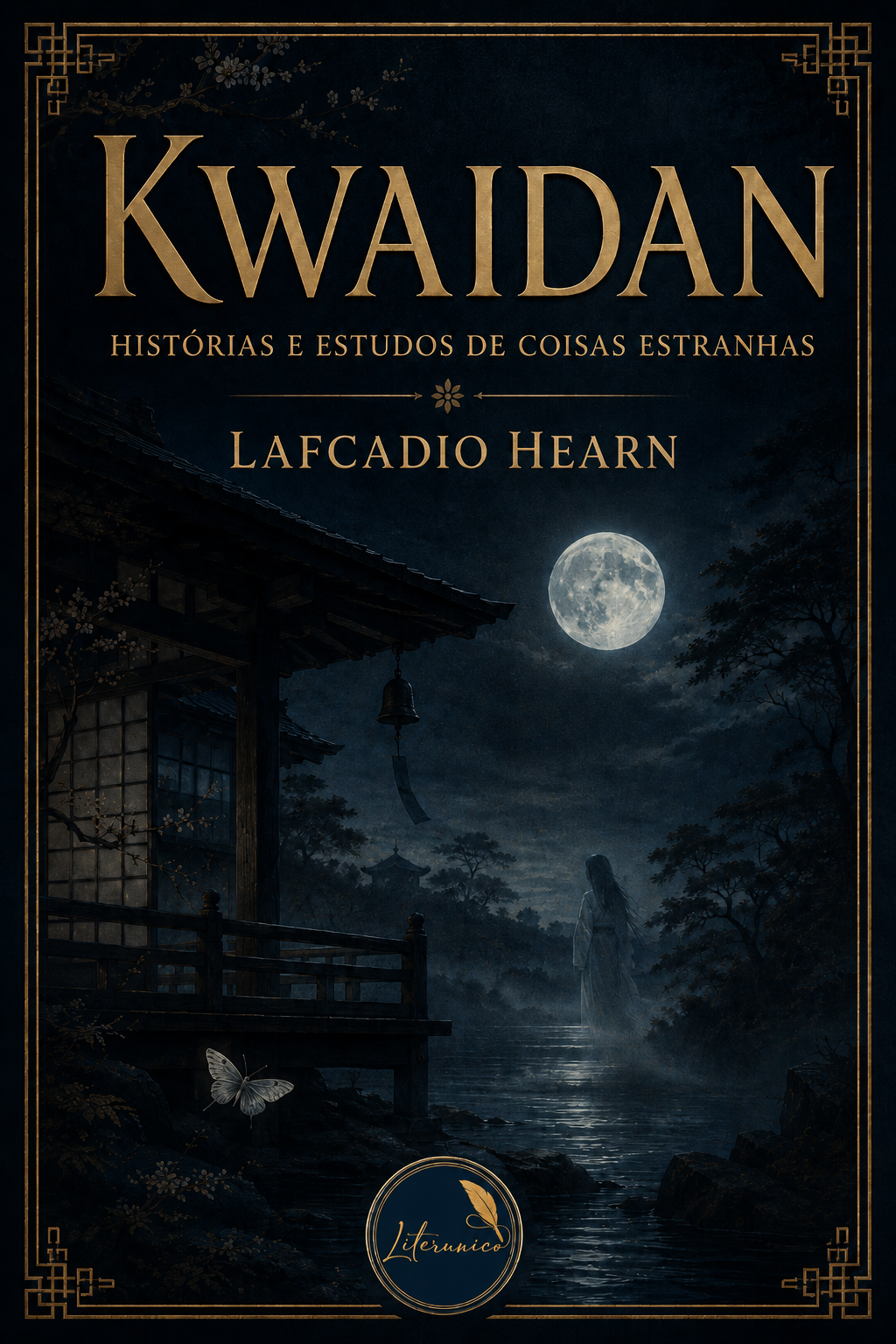
Universo da obra
Universo da obra
Blue vision of depth lost in height,—sea and sky interblending through
luminous haze. The day is of spring, and the hour morning.
Only sky and sea,—one azure enormity... In the fore, ripples are
catching a silvery light, and threads of foam are swirling. But a
little further off no motion is visible, nor anything save color: dim
warm blue of water widening away to melt into blue of air. Horizon
there is none: only distance soaring into space,—infinite concavity
hollowing before you, and hugely arching above you,—the color deepening
with the height. But far in the midway-blue there hangs a faint, faint
vision of palace towers, with high roofs horned and curved like
moons,—some shadowing of splendor strange and old, illumined by a
sunshine soft as memory.
...What I have thus been trying to describe is a kakémono,—that is to
say, a Japanese painting on silk, suspended to the wall of my
alcove;—and the name of it is SHINKIRŌ, which signifies “Mirage.” But
the shapes of the mirage are unmistakable. Those are the glimmering
portals of Hōrai the blest; and those are the moony roofs of the Palace
of the Dragon-King;—and the fashion of them (though limned by a
Japanese brush of to-day) is the fashion of things Chinese, twenty-one
hundred years ago...
Thus much is told of the place in the Chinese books of that time:—
In Hōrai there is neither death nor pain; and there is no winter. The
flowers in that place never fade, and the fruits never fail; and if a
man taste of those fruits even but once, he can never again feel thirst
or hunger. In Hōrai grow the enchanted plants _So-rin-shi_, and
_Riku-gō-aoi_, and _Ban-kon-tō_, which heal all manner of sickness;—and
there grows also the magical grass _Yō-shin-shi_, that quickens the
dead; and the magical grass is watered by a fairy water of which a
single drink confers perpetual youth. The people of Hōrai eat their
rice out of very, very small bowls; but the rice never diminishes
within those bowls,—however much of it be eaten,—until the eater
desires no more. And the people of Hōrai drink their wine out of very,
very small cups; but no man can empty one of those cups,—however
stoutly he may drink,—until there comes upon him the pleasant
drowsiness of intoxication.
All this and more is told in the legends of the time of the Shin
dynasty. But that the people who wrote down those legends ever saw
Hōrai, even in a mirage, is not believable. For really there are no
enchanted fruits which leave the eater forever satisfied,—nor any
magical grass which revives the dead,—nor any fountain of fairy
water,—nor any bowls which never lack rice,—nor any cups which never
lack wine. It is not true that sorrow and death never enter
Hōrai;—neither is it true that there is not any winter. The winter in
Hōrai is cold;—and winds then bite to the bone; and the heaping of snow
is monstrous on the roofs of the Dragon-King.
Nevertheless there are wonderful things in Hōrai; and the most
wonderful of all has not been mentioned by any Chinese writer. I mean
the atmosphere of Hōrai. It is an atmosphere peculiar to the place;
and, because of it, the sunshine in Hōrai is _whiter_ than any other
sunshine,—a milky light that never dazzles,—astonishingly clear, but
very soft. This atmosphere is not of our human period: it is enormously
old,—so old that I feel afraid when I try to think how old it is;—and
it is not a mixture of nitrogen and oxygen. It is not made of air at
all, but of ghost,—the substance of quintillions of quintillions of
generations of souls blended into one immense translucency,—souls of
people who thought in ways never resembling our ways. Whatever mortal
man inhales that atmosphere, he takes into his blood the thrilling of
these spirits; and they change the sense within him,—reshaping his
notions of Space and Time,—so that he can see only as they used to see,
and feel only as they used to feel, and think only as they used to
think. Soft as sleep are these changes of sense; and Hōrai, discerned
across them, might thus be described:—
_—Because in Hōrai there is no knowledge of great evil, the hearts of
the people never grow old. And, by reason of being always young in
heart, the people of Hōrai smile from birth until death—except when the
Gods send sorrow among them; and faces then are veiled until the sorrow
goes away. All folk in Hōrai love and trust each other, as if all were
members of a single household;—and the speech of the women is like
birdsong, because the hearts of them are light as the souls of
birds;—and the swaying of the sleeves of the maidens at play seems a
flutter of wide, soft wings. In Hōrai nothing is hidden but grief,
because there is no reason for shame;—and nothing is locked away,
because there could not be any theft;—and by night as well as by day
all doors remain unbarred, because there is no reason for fear. And
because the people are fairies—though mortal—all things in Hōrai,
except the Palace of the Dragon-King, are small and quaint and
queer;—and these fairy-folk do really eat their rice out of very, very
small bowls, and drink their wine out of very, very small cups...._
—Much of this seeming would be due to the inhalation of that ghostly
atmosphere—but not all. For the spell wrought by the dead is only the
charm of an Ideal, the glamour of an ancient hope;—and something of
that hope has found fulfillment in many hearts,—in the simple beauty of
unselfish lives,—in the sweetness of Woman...
—Evil winds from the West are blowing over Hōrai; and the magical
atmosphere, alas! is shrinking away before them. It lingers now in
patches only, and bands,—like those long bright bands of cloud that
train across the landscapes of Japanese painters. Under these shreds of
the elfish vapor you still can find Hōrai—but not everywhere...
Remember that Hōrai is also called Shinkirō, which signifies
Mirage,—the Vision of the Intangible. And the Vision is fading,—never
again to appear save in pictures and poems and dreams...
Would that I could hope for the luck of that Chinese scholar known to
Japanese literature as “Rōsan”! For he was beloved by two
spirit-maidens, celestial sisters, who every ten days came to visit him
and to tell him stories about butterflies. Now there are marvelous
Chinese stories about butterflies—ghostly stories; and I want to know
them. But never shall I be able to read Chinese, nor even Japanese; and
the little Japanese poetry that I manage, with exceeding difficulty, to
translate, contains so many allusions to Chinese stories of butterflies
that I am tormented with the torment of Tantalus... And, of course, no
spirit-maidens will even deign to visit so skeptical a person as
myself.
I want to know, for example, the whole story of that Chinese maiden
whom the butterflies took to be a flower, and followed in multitude,—so
fragrant and so fair was she. Also I should like to know something more
concerning the butterflies of the Emperor Gensō, or Ming Hwang, who
made them choose his loves for him... He used to hold wine-parties in
his amazing garden; and ladies of exceeding beauty were in attendance;
and caged butterflies, set free among them, would fly to the fairest;
and then, upon that fairest the Imperial favor was bestowed. But after
Gensō Kōtei had seen Yōkihi (whom the Chinese call Yang-Kwei-Fei), he
would not suffer the butterflies to choose for him,—which was unlucky,
as Yokihi got him into serious trouble... Again, I should like to know
more about the experience of that Chinese scholar, celebrated in Japan
under the name Sōshū, who dreamed that he was a butterfly, and had all
the sensations of a butterfly in that dream. For his spirit had really
been wandering about in the shape of a butterfly; and, when he awoke,
the memories and the feelings of butterfly existence remained so vivid
in his mind that he could not act like a human being... Finally I
should like to know the text of a certain Chinese official recognition
of sundry butterflies as the spirits of an Emperor and of his
attendants...
Most of the Japanese literature about butterflies, excepting some
poetry, appears to be of Chinese origin; and even that old national
aæsthetic feeling on the subject, which found such delightful
expression in Japanese art and song and custom, may have been first
developed under Chinese teaching. Chinese precedent doubtless explains
why Japanese poets and painters chose so often for their _geimyō_, or
professional appellations, such names as _Chōmu_ (“Butterfly-Dream),”
_Ichō_ (“Solitary Butterfly),” etc. And even to this day such _geimyō_
as _Chōhana_ (“Butterfly-Blossom”), _Chōkichi_ (“Butterfly-Luck”), or
_Chōnosuké_ (“Butterfly-Help”), are affected by dancing-girls. Besides
artistic names having reference to butterflies, there are still in use
real personal names (_yobina_) of this kind,—such as Kochō, or Chō,
meaning “Butterfly.” They are borne by women only, as a rule,—though
there are some strange exceptions... And here I may mention that, in
the province of Mutsu, there still exists the curious old custom of
calling the youngest daughter in a family _Tekona_,—which quaint word,
obsolete elsewhere, signifies in Mutsu dialect a butterfly. In classic
time this word signified also a beautiful woman...
It is possible also that some weird Japanese beliefs about butterflies
are of Chinese derivation; but these beliefs might be older than China
herself. The most interesting one, I think, is that the soul of a
_living_ person may wander about in the form of a butterfly. Some
pretty fancies have been evolved out of this belief,—such as the notion
that if a butterfly enters your guest-room and perches behind the
bamboo screen, the person whom you most love is coming to see you. That
a butterfly may be the spirit of somebody is not a reason for being
afraid of it. Nevertheless there are times when even butterflies can
inspire fear by appearing in prodigious numbers; and Japanese history
records such an event. When Taïra-no-Masakado was secretly preparing
for his famous revolt, there appeared in Kyōto so vast a swarm of
butterflies that the people were frightened,—thinking the apparition to
be a portent of coming evil... Perhaps those butterflies were supposed
to be the spirits of the thousands doomed to perish in battle, and
agitated on the eve of war by some mysterious premonition of death.
However, in Japanese belief, a butterfly may be the soul of a dead
person as well as of a living person. Indeed it is a custom of souls to
take butterfly-shape in order to announce the fact of their final
departure from the body; and for this reason any butterfly which enters
a house ought to be kindly treated.
To this belief, and to queer fancies connected with it, there are many
allusions in popular drama. For example, there is a well-known play
called _Tondé-déru-Kochō-no-Kanzashi;_ or, “The Flying Hairpin of
Kochō.” Kochō is a beautiful person who kills herself because of false
accusations and cruel treatment. Her would-be avenger long seeks in
vain for the author of the wrong. But at last the dead woman’s hairpin
turns into a butterfly, and serves as a guide to vengeance by hovering
above the place where the villain is hiding.
—Of course those big paper butterflies (_o-chō_ and _mé-chō_) which
figure at weddings must not be thought of as having any ghostly
signification. As emblems they only express the joy of living union,
and the hope that the newly married couple may pass through life
together as a pair of butterflies flit lightly through some pleasant
garden,—now hovering upward, now downward, but never widely separating.
A small selection of _hokku_ (1) on butterflies will help to illustrate
Japanese interest in the aæsthetic side of the subject. Some are
pictures only,—tiny color-sketches made with seventeen syllables; some
are nothing more than pretty fancies, or graceful suggestions;—but the
reader will find variety. Probably he will not care much for the verses
in themselves. The taste for Japanese poetry of the epigrammatic sort
is a taste that must be slowly acquired; and it is only by degrees,
after patient study, that the possibilities of such composition can be
fairly estimated. Hasty criticism has declared that to put forward any
serious claim on behalf of seventeen-syllable poems “would be absurd.”
But what, then, of Crashaw’s famous line upon the miracle at the
marriage feast in Cana?—
Nympha pudica Deum vidit, et erubuit.[1]
Only fourteen syllables—and immortality. Now with seventeen Japanese
syllables things quite as wonderful—indeed, much more wonderful—have
been done, not once or twice, but probably a thousand times... However,
there is nothing wonderful in the following _hokku_, which have been
selected for more than literary reasons:—
Nugi-kakuru[2]
Haori sugata no
Kochō kana!
[_Like a_ haori _being taken off—that is the shape of a butterfly!_]
Torisashi no
Sao no jama suru
Kochō kana!
[_Ah, the butterfly keeps getting in the way of the bird-catcher’s
pole!_[3]]
Tsurigané ni
Tomarité nemuru
Kochō kana!
[_Perched upon the temple-bell, the butterfly sleeps:_]
Néru-uchi mo
Asobu-yumé wo ya—
Kusa no chō!
[_Even while sleeping, its dream is of play—ah, the butterfly of the
grass!_[4]
Oki, oki yo!
Waga tomo ni sen,
Néru-kochō!
[_Wake up! wake up!—I will make thee my comrade, thou sleeping
butterfly._[5]]
Kago no tori
Chō wo urayamu
Metsuki kana!
[_Ah, the sad expression in the eyes of that caged bird!—envying the
butterfly!_]
Chō tondé—
Kazé naki hi to mo
Miëzari ki!
[_Even though it did not appear to be a windy day_,[6] _the fluttering
of the butterflies—!_]
Rakkwa éda ni
Kaëru to miréba—
Kochō kana!
[_When I saw the fallen flower return to the branch—lo! it was only a
butterfly!_[7]]
Chiru-hana ni—
Karusa arasoü
Kochō kana!
[_How the butterfly strives to compete in lightness with the falling
flowers!_[8]]
Chōchō ya!
Onna no michi no
Ato ya saki!
[_See that butterfly on the woman’s path,—now fluttering behind her,
now before!_]
Chōchō ya!
Hana-nusubito wo
Tsukété-yuku!
[_Ha! the butterfly!—it is following the person who stole the
flowers!_]
Aki no chō
Tomo nakéréba ya;
Hito ni tsuku
[_Poor autumn butterfly!—when left without a comrade_ (of its own
race), _it follows after man_ (or “a person”)!]
Owarété mo,
Isoganu furi no
Chōcho kana!
[_Ah, the butterfly! Even when chased, it never has the air of being in
a hurry._]
Chō wa mina
Jiu-shichi-hachi no
Sugata kana!
[_As for butterflies, they all have the appearance of being about
seventeen or eighteen years old._[9]]
Chō tobu ya—
Kono yo no urami
Naki yō ni!
[_How the butterfly sports,—just as if there were no enmity_ (or
“envy”) _in this world!_]
Chō tobu ya,
Kono yo ni nozomi
Nai yō ni!
[_Ah, the butterfly!—it sports about as if it had nothing more to
desire in this present state of existence._]
Nami no hana ni
Tomari kanétaru,
Kochō kana!
[_Having found it difficult indeed to perch upon the_ (_foam_-)
_blossoms of the waves,—alas for the butterfly!_]
Mutsumashi ya!—
Umaré-kawareba
Nobé no chō.[10]
[_If_ (in our next existence) _we be born into the state of butterflies
upon the moor, then perchance we may be happy together!_]
Nadéshiko ni
Chōchō shiroshi—
Taré no kon?[11]
[_On the pink-flower there is a white butterfly: whose spirit, I
wonder?_]
Ichi-nichi no
Tsuma to miëkéri—
Chō futatsu.
[_The one-day wife has at last appeared—a pair of butterflies!_]
Kité wa maü,
Futari shidzuka no
Kochō kana!
[_Approaching they dance; but when the two meet at last they are very
quiet, the butterflies!_]
Chō wo oü
Kokoro-mochitashi
Itsumadémo!
[_Would that I might always have the heart_ (desire) _of chasing
butterflies!_[12]]
Besides these specimens of poetry about butterflies, I have one queer
example to offer of Japanese prose literature on the same topic. The
original, of which I have attempted only a free translation, can be
found in the curious old book _Mushi-Isamé_ (“Insect-Admonitions”); and
it assumes the form of a discourse to a butterfly. But it is really a
didactic allegory,—suggesting the moral significance of a social rise
and fall:—
“Now, under the sun of spring, the winds are gentle, and flowers pinkly
bloom, and grasses are soft, and the hearts of people are glad.
Butterflies everywhere flutter joyously: so many persons now compose
Chinese verses and Japanese verses about butterflies.
“And this season, O Butterfly, is indeed the season of your bright
prosperity: so comely you now are that in the whole world there is
nothing more comely. For that reason all other insects admire and envy
you;—there is not among them even one that does not envy you. Nor do
insects alone regard you with envy: men also both envy and admire you.
Sōshū of China, in a dream, assumed your shape;—Sakoku of Japan, after
dying, took your form, and therein made ghostly apparition. Nor is the
envy that you inspire shared only by insects and mankind: even things
without soul change their form into yours;—witness the barley-grass,
which turns into a butterfly.[13]
“And therefore you are lifted up with pride, and think to yourself: ‘In
all this world there is nothing superior to me!’ Ah! I can very well
guess what is in your heart: you are too much satisfied with your own
person. That is why you let yourself be blown thus lightly about by
every wind;—that is why you never remain still,—always, always
thinking, ‘In the whole world there is no one so fortunate as I.’
“But now try to think a little about your own personal history. It is
worth recalling; for there is a vulgar side to it. How a vulgar side?
Well, for a considerable time after you were born, you had no such
reason for rejoicing in your form. You were then a mere cabbage-insect,
a hairy worm; and you were so poor that you could not afford even one
robe to cover your nakedness; and your appearance was altogether
disgusting. Everybody in those days hated the sight of you. Indeed you
had good reason to be ashamed of yourself; and so ashamed you were that
you collected old twigs and rubbish to hide in, and you made a
hiding-nest, and hung it to a branch,—and then everybody cried out to
you, ‘Raincoat Insect!’ (_Mino-mushi_.)[14] And during that period of
your life, your sins were grievous. Among the tender green leaves of
beautiful cherry-trees you and your fellows assembled, and there made
ugliness extraordinary; and the expectant eyes of the people, who came
from far away to admire the beauty of those cherry-trees, were hurt by
the sight of you. And of things even more hateful than this you were
guilty. You knew that poor, poor men and women had been cultivating
_daikon_ (2) in their fields,—toiling under the hot sun till their
hearts were filled with bitterness by reason of having to care for that
_daikon;_ and you persuaded your companions to go with you, and to
gather upon the leaves of that _daikon_, and on the leaves of other
vegetables planted by those poor people. Out of your greediness you
ravaged those leaves, and gnawed them into all shapes of
ugliness,—caring nothing for the trouble of those poor folk... Yes,
such a creature you were, and such were your doings.
“And now that you have a comely form, you despise your old comrades,
the insects; and, whenever you happen to meet any of them, you pretend
not to know them [literally, ‘You make an I-don’t-know face’]. Now you
want to have none but wealthy and exalted people for friends... Ah! You
have forgotten the old times, have you?
“It is true that many people have forgotten your past, and are charmed
by the sight of your present graceful shape and white wings, and write
Chinese verses and Japanese verses about you. The high-born damsel, who
could not bear even to look at you in your former shape, now gazes at
you with delight, and wants you to perch upon her hairpin, and holds
out her dainty fan in the hope that you will light upon it. But this
reminds me that there is an ancient Chinese story about you, which is
not pretty.
“In the time of the Emperor Gensō, the Imperial Palace contained
hundreds and thousands of beautiful ladies,—so many, indeed, that it
would have been difficult for any man to decide which among them was
the loveliest. So all of those beautiful persons were assembled
together in one place; and you were set free to fly among them; and it
was decreed that the damsel upon whose hairpin you perched should be
augustly summoned to the Imperial Chamber. In that time there could not
be more than one Empress—which was a good law; but, because of you, the
Emperor Gensō did great mischief in the land. For your mind is light
and frivolous; and although among so many beautiful women there must
have been some persons of pure heart, you would look for nothing but
beauty, and so betook yourself to the person most beautiful in outward
appearance. Therefore many of the female attendants ceased altogether
to think about the right way of women, and began to study how to make
themselves appear splendid in the eyes of men. And the end of it was
that the Emperor Gensō died a pitiful and painful death—all because of
your light and trifling mind. Indeed, your real character can easily be
seen from your conduct in other matters. There are trees, for
example,—such as the evergreen-oak and the pine,—whose leaves do not
fade and fall, but remain always green;—these are trees of firm heart,
trees of solid character. But you say that they are stiff and formal;
and you hate the sight of them, and never pay them a visit. Only to the
cherry-tree, and the _kaido_[15], and the peony, and the yellow rose
you go: those you like because they have showy flowers, and you try
only to please them. Such conduct, let me assure you, is very
unbecoming. Those trees certainly have handsome flowers; but
hunger-satisfying fruits they have not; and they are grateful to those
only who are fond of luxury and show. And that is just the reason why
they are pleased by your fluttering wings and delicate shape;—that is
why they are kind to you.
“Now, in this spring season, while you sportively dance through the
gardens of the wealthy, or hover among the beautiful alleys of
cherry-trees in blossom, you say to yourself: ‘Nobody in the world has
such pleasure as I, or such excellent friends. And, in spite of all
that people may say, I most love the peony,—and the golden yellow rose
is my own darling, and I will obey her every least behest; for that is
my pride and my delight.’... So you say. But the opulent and elegant
season of flowers is very short: soon they will fade and fall. Then, in
the time of summer heat, there will be green leaves only; and presently
the winds of autumn will blow, when even the leaves themselves will
shower down like rain, _parari-parari_. And your fate will then be as
the fate of the unlucky in the proverb, _Tanomi ki no shita ni amé
furu_ [Even through the tree upon which I relied for shelter the rain
leaks down]. For you will seek out your old friend, the root-cutting
insect, the grub, and beg him to let you return into your old-time
hole;—but now having wings, you will not be able to enter the hole
because of them, and you will not be able to shelter your body anywhere
between heaven and earth, and all the moor-grass will then have
withered, and you will not have even one drop of dew with which to
moisten your tongue,—and there will be nothing left for you to do but
to lie down and die. All because of your light and frivolous heart—but,
ah! how lamentable an end!”...
Most of the Japanese stories about butterflies appear, as I have said,
to be of Chinese origin. But I have one which is probably indigenous;
and it seems to me worth telling for the benefit of persons who believe
there is no “romantic love” in the Far East.
Behind the cemetery of the temple of Sōzanji, in the suburbs of the
capital, there long stood a solitary cottage, occupied by an old man
named Takahama. He was liked in the neighborhood, by reason of his
amiable ways; but almost everybody supposed him to be a little mad.
Unless a man take the Buddhist vows, he is expected to marry, and to
bring up a family. But Takahama did not belong to the religious life;
and he could not be persuaded to marry. Neither had he ever been known
to enter into a love-relation with any woman. For more than fifty years
he had lived entirely alone.
One summer he fell sick, and knew that he had not long to live. He then
sent for his sister-in-law, a widow, and for her only son,—a lad of
about twenty years old, to whom he was much attached. Both promptly
came, and did whatever they could to soothe the old man’s last hours.
One sultry afternoon, while the widow and her son were watching at his
bedside, Takahama fell asleep. At the same moment a very large white
butterfly entered the room, and perched upon the sick man’s pillow. The
nephew drove it away with a fan; but it returned immediately to the
pillow, and was again driven away, only to come back a third time. Then
the nephew chased it into the garden, and across the garden, through an
open gate, into the cemetery of the neighboring temple. But it
continued to flutter before him as if unwilling to be driven further,
and acted so queerly that he began to wonder whether it was really a
butterfly, or a _ma_[16]. He again chased it, and followed it far into
the cemetery, until he saw it fly against a tomb,—a woman’s tomb. There
it unaccountably disappeared; and he searched for it in vain. He then
examined the monument. It bore the personal name “Akiko,” (3) together
with an unfamiliar family name, and an inscription stating that Akiko
had died at the age of eighteen. Apparently the tomb had been erected
about fifty years previously: moss had begun to gather upon it. But it
had been well cared for: there were fresh flowers before it; and the
water-tank had recently been filled.
On returning to the sick room, the young man was shocked by the
announcement that his uncle had ceased to breathe. Death had come to
the sleeper painlessly; and the dead face smiled.
The young man told his mother of what he had seen in the cemetery.
“Ah!” exclaimed the widow, “then it must have been Akiko!”...
“But who was Akiko, mother?” the nephew asked.
The widow answered:—
“When your good uncle was young he was betrothed to a charming girl
called Akiko, the daughter of a neighbor. Akiko died of consumption,
only a little before the day appointed for the wedding; and her
promised husband sorrowed greatly. After Akiko had been buried, he made
a vow never to marry; and he built this little house beside the
cemetery, so that he might be always near her grave. All this happened
more than fifty years ago. And every day of those fifty years—winter
and summer alike—your uncle went to the cemetery, and prayed at the
grave, and swept the tomb, and set offerings before it. But he did not
like to have any mention made of the matter; and he never spoke of
it... So, at last, Akiko came for him: the white butterfly was her
soul.”
I had almost forgotten to mention an ancient Japanese dance, called the
Butterfly Dance (_Kochō-Mai_), which used to be performed in the
Imperial Palace, by dancers costumed as butterflies. Whether it is
danced occasionally nowadays I do not know. It is said to be very
difficult to learn. Six dancers are required for the proper performance
of it; and they must move in particular figures,—obeying traditional
rules for every step, pose, or gesture,—and circling about each other
very slowly to the sound of hand-drums and great drums, small flutes
and great flutes, and pandean pipes of a form unknown to Western Pan.
[Illustration] BUTTERFLY DANCE
With a view to self-protection I have been reading Dr. Howard’s book,
“Mosquitoes.” I am persecuted by mosquitoes. There are several species
in my neighborhood; but only one of them is a serious torment,—a tiny
needly thing, all silver-speckled and silver-streaked. The puncture of
it is sharp as an electric burn; and the mere hum of it has a
lancinating quality of tone which foretells the quality of the pain
about to come,—much in the same way that a particular smell suggests a
particular taste. I find that this mosquito much resembles the creature
which Dr. Howard calls _Stegomyia fasciata_, or _Culex fasciatus:_ and
that its habits are the same as those of the _Stegomyia_. For example,
it is diurnal rather than nocturnal and becomes most troublesome in the
afternoon. And I have discovered that it comes from the Buddhist
cemetery,—a very old cemetery,—in the rear of my garden.
Dr. Howard’s book declares that, in order to rid a neighborhood of
mosquitoes, it is only necessary to pour a little petroleum, or
kerosene oil, into the stagnant water where they breed. Once a week the
oil should be used, “at the rate of once ounce for every fifteen square
feet of water-surface, and a proportionate quantity for any less
surface.” ...But please to consider the conditions in _my_
neighborhood!
I have said that my tormentors come from the Buddhist cemetery. Before
nearly every tomb in that old cemetery there is a water-receptacle, or
cistern, called _mizutamé_. In the majority of cases this _mizutamé_ is
simply an oblong cavity chiseled in the broad pedestal supporting the
monument; but before tombs of a costly kind, having no pedestal-tank, a
larger separate tank is placed, cut out of a single block of stone, and
decorated with a family crest, or with symbolic carvings. In front of a
tomb of the humblest class, having no _mizutamé_, water is placed in
cups or other vessels,—for the dead must have water. Flowers also must
be offered to them; and before every tomb you will find a pair of
bamboo cups, or other flower-vessels; and these, of course, contain
water. There is a well in the cemetery to supply water for the graves.
Whenever the tombs are visited by relatives and friends of the dead,
fresh water is poured into the tanks and cups. But as an old cemetery
of this kind contains thousands of _mizutamé_, and tens of thousands of
flower-vessels the water in all of these cannot be renewed every day.
It becomes stagnant and populous. The deeper tanks seldom get dry;—the
rainfall at Tōkyō being heavy enough to keep them partly filled during
nine months out of the twelve.
Well, it is in these tanks and flower-vessels that mine enemies are
born: they rise by millions from the water of the dead;—and, according
to Buddhist doctrine, some of them may be reincarnations of those very
dead, condemned by the error of former lives to the condition of
_Jiki-ketsu-gaki_, or blood-drinking pretas.... Anyhow the malevolence
of the _Culex fasciatus_ would justify the suspicion that some wicked
human soul had been compressed into that wailing speck of a body....
Now, to return to the subject of kerosene-oil, you can exterminate the
mosquitoes of any locality by covering with a film of kerosene all
stagnant water surfaces therein. The larvae die on rising to breathe;
and the adult females perish when they approach the water to launch
their rafts of eggs. And I read, in Dr. Howard’s book, that the actual
cost of freeing from mosquitoes one American town of fifty thousand
inhabitants, does not exceed three hundred dollars!...
I wonder what would be said if the city-government of Tōkyō—which is
aggressively scientific and progressive—were suddenly to command that
all water-surfaces in the Buddhist cemeteries should be covered, at
regular intervals, with a film of kerosene oil! How could the religion
which prohibits the taking of any life—even of invisible life—yield to
such a mandate? Would filial piety even dream of consenting to obey
such an order? And then to think of the cost, in labor and time, of
putting kerosene oil, every seven days, into the millions of
_mizutamé_, and the tens of millions of bamboo flower-cups, in the
Tōkyō graveyards!... Impossible! To free the city from mosquitoes it
would be necessary to demolish the ancient graveyards;—and that would
signify the ruin of the Buddhist temples attached to them;—and that
would mean the disparition of so many charming gardens, with their
lotus-ponds and Sanscrit-lettered monuments and humpy bridges and holy
groves and weirdly-smiling Buddhas! So the extermination of the _Culex
fasciatus_ would involve the destruction of the poetry of the ancestral
cult,—surely too great a price to pay!...
Besides, I should like, when my time comes, to be laid away in some
Buddhist graveyard of the ancient kind,—so that my ghostly company
should be ancient, caring nothing for the fashions and the changes and
the disintegrations of Meiji (1). That old cemetery behind my garden
would be a suitable place. Everything there is beautiful with a beauty
of exceeding and startling queerness; each tree and stone has been
shaped by some old, old ideal which no longer exists in any living
brain; even the shadows are not of this time and sun, but of a world
forgotten, that never knew steam or electricity or magnetism
or—kerosene oil! Also in the boom of the big bell there is a quaintness
of tone which wakens feelings, so strangely far-away from all the
nineteenth-century part of me, that the faint blind stirrings of them
make me afraid,—deliciously afraid. Never do I hear that billowing peal
but I become aware of a striving and a fluttering in the abyssal part
of my ghost,—a sensation as of memories struggling to reach the light
beyond the obscurations of a million million deaths and births. I hope
to remain within hearing of that bell... And, considering the
possibility of being doomed to the state of a _Jiki-ketsu-gaki_, I want
to have my chance of being reborn in some bamboo flower-cup, or
_mizutamé_, whence I might issue softly, singing my thin and pungent
song, to bite some people that I know.
This morning sky, after the night’s tempest, is a pure and dazzling
blue. The air—the delicious air!—is full of sweet resinous odors, shed
from the countless pine-boughs broken and strewn by the gale. In the
neighboring bamboo-grove I hear the flute-call of the bird that praises
the Sûtra of the Lotos; and the land is very still by reason of the
south wind. Now the summer, long delayed, is truly with us: butterflies
of queer Japanese colors are flickering about; semi (1) are wheezing;
wasps are humming; gnats are dancing in the sun; and the ants are busy
repairing their damaged habitations... I bethink me of a Japanese
poem:—
Yuku é naki:
Ari no sumai ya!
Go-getsu amé.
[_Now the poor creature has nowhere to go!... Alas for the dwellings of
the ants in this rain of the fifth month!_]
But those big black ants in my garden do not seem to need any sympathy.
They have weathered the storm in some unimaginable way, while great
trees were being uprooted, and houses blown to fragments, and roads
washed out of existence. Yet, before the typhoon, they took no other
visible precaution than to block up the gates of their subterranean
town. And the spectacle of their triumphant toil to-day impels me to
attempt an essay on Ants.
I should have liked to preface my disquisitions with something from the
old Japanese literature,—something emotional or metaphysical. But all
that my Japanese friends were able to find for me on the
subject,—excepting some verses of little worth,—was Chinese. This
Chinese material consisted chiefly of strange stories; and one of them
seems to me worth quoting,—_faute de mieux_.
In the province of Taishū, in China, there was a pious man who, every
day, during many years, fervently worshiped a certain goddess. One
morning, while he was engaged in his devotions, a beautiful woman,
wearing a yellow robe, came into his chamber and stood before him. He,
greatly surprised, asked her what she wanted, and why she had entered
unannounced. She answered: “I am not a woman: I am the goddess whom you
have so long and so faithfully worshiped; and I have now come to prove
to you that your devotion has not been in vain... Are you acquainted
with the language of Ants?” The worshiper replied: “I am only a
low-born and ignorant person,—not a scholar; and even of the language
of superior men I know nothing.” At these words the goddess smiled, and
drew from her bosom a little box, shaped like an incense box. She
opened the box, dipped a finger into it, and took therefrom some kind
of ointment with which she anointed the ears of the man. “Now,” she
said to him, “try to find some Ants, and when you find any, stoop down,
and listen carefully to their talk. You will be able to understand it;
and you will hear of something to your advantage... Only remember that
you must not frighten or vex the Ants.” Then the goddess vanished away.
The man immediately went out to look for some Ants. He had scarcely
crossed the threshold of his door when he perceived two Ants upon a
stone supporting one of the house-pillars. He stooped over them, and
listened; and he was astonished to find that he could hear them
talking, and could understand what they said. “Let us try to find a
warmer place,” proposed one of the Ants. “Why a warmer place?” asked
the other;—“what is the matter with this place?” “It is too damp and
cold below,” said the first Ant; “there is a big treasure buried here;
and the sunshine cannot warm the ground about it.” Then the two Ants
went away together, and the listener ran for a spade.
By digging in the neighborhood of the pillar, he soon found a number of
large jars full of gold coin. The discovery of this treasure made him a
very rich man.
Afterwards he often tried to listen to the conversation of Ants. But he
was never again able to hear them speak. The ointment of the goddess
had opened his ears to their mysterious language for only a single day.
Now I, like that Chinese devotee, must confess myself a very ignorant
person, and naturally unable to hear the conversation of Ants. But the
Fairy of Science sometimes touches my ears and eyes with her wand; and
then, for a little time, I am able to hear things inaudible, and to
perceive things imperceptible.
For the same reason that it is considered wicked, in sundry circles, to
speak of a non-Christian people having produced a civilization
ethically superior to our own, certain persons will not be pleased by
what I am going to say about ants. But there are men, incomparably
wiser than I can ever hope to be, who think about insects and
civilizations independently of the blessings of Christianity; and I
find encouragement in the new _Cambridge Natural History_, which
contains the following remarks by Professor David Sharp, concerning
ants:—
“Observation has revealed the most remarkable phenomena in the lives of
these insects. Indeed we can scarcely avoid the conclusion that they
have acquired, in many respects, the art of living together in
societies more perfectly than our own species has; and that they have
anticipated us in the acquisition of some of the industries and arts
that greatly facilitate social life.”
I suppose that a few well-informed persons will dispute this plain
statement by a trained specialist. The contemporary man of science is
not apt to become sentimental about ants or bees; but he will not
hesitate to acknowledge that, in regard to social evolution, these
insects appear to have advanced “beyond man.” Mr. Herbert Spencer, whom
nobody will charge with romantic tendencies, goes considerably further
than Professor Sharp; showing us that ants are, in a very real sense,
_ethically_ as well as economically in advance of humanity,—their lives
being entirely devoted to altruistic ends. Indeed, Professor Sharp
somewhat needlessly qualifies his praise of the ant with this cautious
observation:—
“The competence of the ant is not like that of man. It is devoted to
the welfare of the species rather than to that of the individual, which
is, as it were, sacrificed or specialized for the benefit of the
community.”
—The obvious implication,—that any social state, in which the
improvement of the individual is sacrificed to the common welfare,
leaves much to be desired,—is probably correct, from the actual human
standpoint. For man is yet imperfectly evolved; and human society has
much to gain from his further individualization. But in regard to
social insects the implied criticism is open to question. “The
improvement of the individual,” says Herbert Spencer, “consists in the
better fitting of him for social cooperation; and this, being conducive
to social prosperity, is conducive to the maintenance of the race.” In
other words, the value of the individual can be _only_ in relation to
the society; and this granted, whether the sacrifice of the individual
for the sake of that society be good or evil must depend upon what the
society might gain or lose through a further individualization of its
members... But as we shall presently see, the conditions of ant-society
that most deserve our attention are the ethical conditions; and these
are beyond human criticism, since they realize that ideal of moral
evolution described by Mr. Spencer as “a state in which egoism and
altruism are so conciliated that the one merges into the other.” That
is to say, a state in which the only possible pleasure is the pleasure
of unselfish action. Or, again to quote Mr. Spencer, the activities of
the insect-society are “activities which postpone individual well-being
so completely to the well-being of the community that individual life
appears to be attended to only just so far as is necessary to make
possible due attention to social life,... the individual taking only
just such food and just such rest as are needful to maintain its
vigor.”
I hope my reader is aware that ants practise horticulture and
agriculture; that they are skillful in the cultivation of mushrooms;
that they have domesticated (according to present knowledge) five
hundred and eighty-four different kinds of animals; that they make
tunnels through solid rock; that they know how to provide against
atmospheric changes which might endanger the health of their children;
and that, for insects, their longevity is exceptional,—members of the
more highly evolved species living for a considerable number of years.
But it is not especially of these matters that I wish to speak. What I
want to talk about is the awful propriety, the terrible morality, of
the ant[1]. Our most appalling ideals of conduct fall short of the
ethics of the ant,—as progress is reckoned in time,—by nothing less
than millions of years!... When I say “the ant,” I mean the highest
type of ant,—not, of course, the entire ant-family. About two thousand
species of ants are already known; and these exhibit, in their social
organizations, widely varying degrees of evolution. Certain social
phenomena of the greatest biological importance, and of no less
importance in their strange relation to the subject of ethics, can be
studied to advantage only in the existence of the most highly evolved
societies of ants.
After all that has been written of late years about the probable value
of relative experience in the long life of the ant, I suppose that few
persons would venture to deny individual character to the ant. The
intelligence of the little creature in meeting and overcoming
difficulties of a totally new kind, and in adapting itself to
conditions entirely foreign to its experience, proves a considerable
power of independent thinking. But this at least is certain: that the
ant has no individuality capable of being exercised in a purely selfish
direction;—I am using the word “selfish” in its ordinary acceptation. A
greedy ant, a sensual ant, an ant capable of any one of the seven
deadly sins, or even of a small venial sin, is unimaginable. Equally
unimaginable, of course, a romantic ant, an ideological ant, a poetical
ant, or an ant inclined to metaphysical speculations. No human mind
could attain to the absolute matter-of-fact quality of the ant-mind;—no
human being, as now constituted, could cultivate a mental habit so
impeccably practical as that of the ant. But this superlatively
practical mind is incapable of moral error. It would be difficult,
perhaps, to prove that the ant has no religious ideas. But it is
certain that such ideas could not be of any use to it. The being
incapable of moral weakness is beyond the need of “spiritual guidance.”
Only in a vague way can we conceive the character of ant-society, and
the nature of ant-morality; and to do even this we must try to imagine
some yet impossible state of human society and human morals. Let us,
then, imagine a world full of people incessantly and furiously
working,—all of whom seem to be women. No one of these women could be
persuaded or deluded into taking a single atom of food more than is
needful to maintain her strength; and no one of them ever sleeps a
second longer than is necessary to keep her nervous system in good
working-order. And all of them are so peculiarly constituted that the
least unnecessary indulgence would result in some derangement of
function.
The work daily performed by these female laborers comprises
road-making, bridge-building, timber-cutting, architectural
construction of numberless kinds, horticulture and agriculture, the
feeding and sheltering of a hundred varieties of domestic animals, the
manufacture of sundry chemical products, the storage and conservation
of countless food-stuffs, and the care of the children of the race. All
this labor is done for the commonwealth—no citizen of which is capable
even of thinking about “property,” except as a _res publica;_—and the
sole object of the commonwealth is the nurture and training of its
young,—nearly all of whom are girls. The period of infancy is long: the
children remain for a great while, not only helpless, but shapeless,
and withal so delicate that they must be very carefully guarded against
the least change of temperature. Fortunately their nurses understand
the laws of health: each thoroughly knows all that she ought to know in
regard to ventilation, disinfection, drainage, moisture, and the danger
of germs,—germs being as visible, perhaps, to her myopic sight as they
become to our own eyes under the microscope. Indeed, all matters of
hygiene are so well comprehended that no nurse ever makes a mistake
about the sanitary conditions of her neighborhood.
In spite of this perpetual labor no worker remains unkempt: each is
scrupulously neat, making her toilet many times a day. But as every
worker is born with the most beautiful of combs and brushes attached to
her wrists, no time is wasted in the toilet-room. Besides keeping
themselves strictly clean, the workers must also keep their houses and
gardens in faultless order, for the sake of the children. Nothing less
than an earthquake, an eruption, an inundation, or a desperate war, is
allowed to interrupt the daily routine of dusting, sweeping, scrubbing,
and disinfecting.
Now for stranger facts:—
This world of incessant toil is a more than Vestal world. It is true
that males can sometimes be perceived in it; but they appear only at
particular seasons, and they have nothing whatever to do with the
workers or with the work. None of them would presume to address a
worker,—except, perhaps, under extraordinary circumstances of common
peril. And no worker would think of talking to a male;—for males, in
this queer world, are inferior beings, equally incapable of fighting or
working, and tolerated only as necessary evils. One special class of
females,—the Mothers-Elect of the race,—do condescend to consort with
males, during a very brief period, at particular seasons. But the
Mothers-Elect do not work; and they _must_ accept husbands. A worker
could not even dream of keeping company with a male,—not merely because
such association would signify the most frivolous waste of time, nor
yet because the worker necessarily regards all males with unspeakable
contempt; but because the worker is incapable of wedlock. Some workers,
indeed, are capable of parthenogenesis, and give birth to children who
never had fathers. As a general rule, however, the worker is truly
feminine by her moral instincts only: she has all the tenderness, the
patience, and the foresight that we call “maternal;” but her sex has
disappeared, like the sex of the Dragon-Maiden in the Buddhist legend.
For defense against creatures of prey, or enemies of the state, the
workers are provided with weapons; and they are furthermore protected
by a large military force. The warriors are so much bigger than the
workers (in some communities, at least) that it is difficult, at first
sight, to believe them of the same race. Soldiers one hundred times
larger than the workers whom they guard are not uncommon. But all these
soldiers are Amazons,—or, more correctly speaking, semi-females. They
can work sturdily; but being built for fighting and for heavy pulling
chiefly, their usefulness is restricted to those directions in which
force, rather than skill, is required.
[Why females, rather than males, should have been evolutionally
specialized into soldiery and laborers may not be nearly so simple a
question as it appears. I am very sure of not being able to answer it.
But natural economy may have decided the matter. In many forms of life,
the female greatly exceeds the male in bulk and in energy;—perhaps, in
this case, the larger reserve of life-force possessed originally by the
complete female could be more rapidly and effectively utilized for the
development of a special fighting-caste. All energies which, in the
fertile female, would be expended in the giving of life seem here to
have been diverted to the evolution of aggressive power, or
working-capacity.]
Of the true females,—the Mothers-Elect,—there are very few indeed; and
these are treated like queens. So constantly and so reverentially are
they waited upon that they can seldom have any wishes to express. They
are relieved from every care of existence,—except the duty of bearing
offspring. Night and day they are cared for in every possible manner.
They alone are superabundantly and richly fed:—for the sake of the
offspring they must eat and drink and repose right royally; and their
physiological specialization allows of such indulgence _ad libitum_.
They seldom go out, and never unless attended by a powerful escort; as
they cannot be permitted to incur unnecessary fatigue or danger.
Probably they have no great desire to go out. Around them revolves the
whole activity of the race: all its intelligence and toil and thrift
are directed solely toward the well-being of these Mothers and of their
children.
But last and least of the race rank the husbands of these Mothers,—the
necessary Evils,—the males. They appear only at a particular season, as
I have already observed; and their lives are very short. Some cannot
even boast of noble descent, though destined to royal wedlock; for they
are not royal offspring, but virgin-born,—parthenogenetic
children,—and, for that reason especially, inferior beings, the chance
results of some mysterious atavism. But of any sort of males the
commonwealth tolerates but few,—barely enough to serve as husbands for
the Mothers-Elect, and these few perish almost as soon as their duty
has been done. The meaning of Nature’s law, in this extraordinary
world, is identical with Ruskin’s teaching that life without effort is
crime; and since the males are useless as workers or fighters, their
existence is of only momentary importance. They are not, indeed,
sacrificed,—like the Aztec victim chosen for the festival of
Tezcatlipoca, and allowed a honeymoon of twenty days before his heart
was torn out. But they are scarcely less unfortunate in their high
fortune. Imagine youths brought up in the knowledge that they are
destined to become royal bridegrooms for a single night,—that after
their bridal they will have no moral right to live,—that marriage, for
each and all of them, will signify certain death,—and that they cannot
even hope to be lamented by their young widows, who will survive them
for a time of many generations...!
But all the foregoing is no more than a proem to the real “Romance of
the Insect-World.”
—By far the most startling discovery in relation to this astonishing
civilization is that of the suppression of sex. In certain advanced
forms of ant-life sex totally disappears in the majority of
individuals;—in nearly all the higher ant-societies sex-life appears to
exist only to the extent absolutely needed for the continuance of the
species. But the biological fact in itself is much less startling than
the ethical suggestion which it offers;—_for this practical
suppression, or regulation, of sex-faculty appears to be voluntary!_
Voluntary, at least, so far as the species is concerned. It is now
believed that these wonderful creatures have learned how to develop, or
to arrest the development, of sex in their young,—by some particular
mode of nutrition. They have succeeded in placing under perfect control
what is commonly supposed to be the most powerful and unmanageable of
instincts. And this rigid restraint of sex-life to within the limits
necessary to provide against extinction is but one (though the most
amazing) of many vital economies effected by the race. Every capacity
for egoistic pleasure—in the common meaning of the word “egoistic”—has
been equally repressed through physiological modification. No
indulgence of any natural appetite is possible except to that degree in
which such indulgence can directly or indirectly benefit the
species;—even the indispensable requirements of food and sleep being
satisfied only to the exact extent necessary for the maintenance of
healthy activity. The individual can exist, act, think, only for the
communal good; and the commune triumphantly refuses, in so far as
cosmic law permits, to let itself be ruled either by Love or Hunger.
Most of us have been brought up in the belief that without some kind of
religious creed—some hope of future reward or fear of future
punishment—no civilization could exist. We have been taught to think
that in the absence of laws based upon moral ideas, and in the absence
of an effective police to enforce such laws, nearly everybody would
seek only his or her personal advantage, to the disadvantage of
everybody else. The strong would then destroy the weak; pity and
sympathy would disappear; and the whole social fabric would fall to
pieces... These teachings confess the existing imperfection of human
nature; and they contain obvious truth. But those who first proclaimed
that truth, thousands and thousands of years ago, never imagined a form
of social existence in which selfishness would be _naturally_
impossible. It remained for irreligious Nature to furnish us with proof
positive that there can exist a society in which the pleasure of active
beneficence makes needless the idea of duty,—a society in which
instinctive morality can dispense with ethical codes of every sort,—a
society of which every member is born so absolutely unselfish, and so
energetically good, that moral training could signify, even for its
youngest, neither more nor less than waste of precious time.
To the Evolutionist such facts necessarily suggest that the value of
our moral idealism is but temporary; and that something better than
virtue, better than kindness, better than self-denial,—in the present
human meaning of those terms,—might, under certain conditions,
eventually replace them. He finds himself obliged to face the question
whether a world without moral notions might not be morally better than
a world in which conduct is regulated by such notions. He must even ask
himself whether the existence of religious commandments, moral laws,
and ethical standards among ourselves does not prove us still in a very
primitive stage of social evolution. And these questions naturally lead
up to another: Will humanity ever be able, on this planet, to reach an
ethical condition beyond all its ideals,—a condition in which
everything that we now call evil will have been atrophied out of
existence, and everything that we call virtue have been transmuted into
instinct;—a state of altruism in which ethical concepts and codes will
have become as useless as they would be, even now, in the societies of
the higher ants.
The giants of modern thought have given some attention to this
question; and the greatest among them has answered it—partly in the
affirmative. Herbert Spencer has expressed his belief that humanity
will arrive at some state of civilization ethically comparable with
that of the ant:—
“If we have, in lower orders of creatures, cases in which the nature is
constitutionally so modified that altruistic activities have become one
with egoistic activities, there is an irresistible implication that a
parallel identification will, under parallel conditions, take place
among human beings. Social insects furnish us with instances completely
to the point,—and instances showing us, indeed, to what a marvelous
degree the life of the individual may be absorbed in subserving the
lives of other individuals... Neither the ant nor the bee can be
supposed to have a sense of duty, in the acceptation we give to that
word; nor can it be supposed that it is continually undergoing
self-sacrifice, in the ordinary acceptation of that word... [The facts]
show us that it is within the possibilities of organization to produce
a nature which shall be just as energetic in the pursuit of altruistic
ends, as is in other cases shown in the pursuit of egoistic ends;—and
they show that, in such cases, these altruistic ends are pursued in
pursuing ends which, on their other face, are egoistic. For the
satisfaction of the needs of the organization, these actions, conducive
to the welfare of others, _must_ be carried on...
“So far from its being true that there must go on, throughout all the
future, a condition in which self-regard is to be continually subjected
by the regard for others, it will, contrari-wise, be the case that a
regard for others will eventually become so large a source of pleasure
as to overgrow the pleasure which is derivable from direct egoistic
gratification... Eventually, then, there will come also a state in
which egoism and altruism are so conciliated that the one merges in the
other.”
Of course the foregoing prediction does not imply that human nature
will ever undergo such physiological change as would be represented by
structural specializations comparable to those by which the various
castes of insect societies are differentiated. We are not bidden to
imagine a future state of humanity in which the active majority would
consist of semi-female workers and Amazons toiling for an inactive
minority of selected Mothers. Even in his chapter, “Human Population in
the Future,” Mr. Spencer has attempted no detailed statement of the
physical modifications inevitable to the production of higher moral
types,—though his general statement in regard to a perfected nervous
system, and a great diminution of human fertility, suggests that such
moral evolution would signify a very considerable amount of physical
change. If it be legitimate to believe in a future humanity to which
the pleasure of mutual beneficence will represent the whole joy of
life, would it not also be legitimate to imagine other transformations,
physical and moral, which the facts of insect-biology have proved to be
within the range of evolutional possibility?... I do not know. I most
worshipfully reverence Herbert Spencer as the greatest philosopher who
has yet appeared in this world; and I should be very sorry to write
down anything contrary to his teaching, in such wise that the reader
could imagine it to have been inspired by Synthetic Philosophy. For the
ensuing reflections, I alone am responsible; and if I err, let the sin
be upon my own head.
I suppose that the moral transformations predicted by Mr. Spencer,
could be effected only with the aid of physiological change, and at a
terrible cost. Those ethical conditions manifested by insect-societies
can have been reached only through effort desperately sustained for
millions of years against the most atrocious necessities. Necessities
equally merciless may have to be met and mastered eventually by the
human race. Mr. Spencer has shown that the time of the greatest
possible human suffering is yet to come, and that it will be
concomitant with the period of the greatest possible pressure of
population. Among other results of that long stress, I understand that
there will be a vast increase in human intelligence and sympathy; and
that this increase of intelligence will be effected at the cost of
human fertility. But this decline in reproductive power will not, we
are told, be sufficient to assure the very highest of social
conditions: it will only relieve that pressure of population which has
been the main cause of human suffering. The state of perfect social
equilibrium will be approached, but never quite reached, by mankind—
_Unless there be discovered some means of solving economic problems,
just as social insects have solved them, by the suppression of
sex-life_.
Supposing that such a discovery were made, and that the human race
should decide to arrest the development of sex in the majority of its
young,—so as to effect a transferrence of those forces, now demanded by
sex-life to the development of higher activities,—might not the result
be an eventual state of polymorphism, like that of ants? And, in such
event, might not the Coming Race be indeed represented in its higher
types,—through feminine rather than masculine evolution,—by a majority
of beings of neither sex?
Considering how many persons, even now, through merely unselfish (not
to speak of religious) motives, sentence themselves to celibacy, it
should not appear improbable that a more highly evolved humanity would
cheerfully sacrifice a large proportion of its sex-life for the common
weal, particularly in view of certain advantages to be gained. Not the
least of such advantages—always supposing that mankind were able to
control sex-life after the natural manner of the ants—would be a
prodigious increase of longevity. The higher types of a humanity
superior to sex might be able to realize the dream of life for a
thousand years.
Already we find lives too short for the work we have to do; and with
the constantly accelerating progress of discovery, and the
never-ceasing expansion of knowledge, we shall certainly find more and
more reason to regret, as time goes on, the brevity of existence. That
Science will ever discover the Elixir of the Alchemists’ hope is
extremely unlikely. The Cosmic Powers will not allow us to cheat them.
For every advantage which they yield us the full price must be paid:
nothing for nothing is the everlasting law. Perhaps the price of long
life will prove to be the price that the ants have paid for it.
Perhaps, upon some elder planet, that price has already been paid, and
the power to produce offspring restricted to a caste morphologically
differentiated, in unimaginable ways, from the rest of the species...
But while the facts of insect-biology suggest so much in regard to the
future course of human evolution, do they not also suggest something of
largest significance concerning the relation of ethics to cosmic law?
Apparently, the highest evolution will not be permitted to creatures
capable of what human moral experience has in all areas condemned.
Apparently, the highest possible strength is the strength of
unselfishness; and power supreme never will be accorded to cruelty or
to lust. There may be no gods; but the forces that shape and dissolve
all forms of being would seem to be much more exacting than gods. To
prove a “dramatic tendency” in the ways of the stars is not possible;
but the cosmic process seems nevertheless to affirm the worth of every
human system of ethics fundamentally opposed to human egoism.
Notes
Texto original em EN preservado no Literunico para leitura comparada com a edição/tradução da Copa Literunico. Fonte-base: https://www.gutenberg.org/cache/epub/1210/pg1210.txt
Ainda não há resenhas para esta obra. A primeira leitura comentada pode começar aqui.
Escolha a arte, confira a disponibilidade e adicione o produto ao carrinho sem sair da experiência.
Adquira Relíquias da Obra e deixe sua marca registrada, criando valor ao item!

Capa frontal, contracapa, Capa Aberta e Marca-Páginas pertencem à obra e acompanham este Universes.
Escolha uma Relíquia no painel principal para enviar uma proposta ao autor.
Capítulos disponíveis para continuar a leitura.
Nenhuma Relíquia desta obra foi adquirida ainda. Seja o primeiro a eternizar seu nome no acervo oficial!
Conhecer as 100 RelíquiasAinda não há resenhas para esta obra. A primeira leitura comentada pode começar aqui.
Nenhuma posse foi registrada publicamente para esta edição.
Durante a leitura, abra Menu para ajustar a experiência sem sair do capítulo. As preferências de aparência ficam salvas neste aparelho.
Recursos identificados como “em preparo” aparecem para antecipar a evolução do leitor, mas ainda não executam uma ação.
Posso mostrar leituras em destaque, clássicos e Relíquias disponíveis agora no Literúnico.
Escolha um caminho
Dúvidas desta página
As explicações do Aurélio são respostas cadastradas pelo Literúnico.